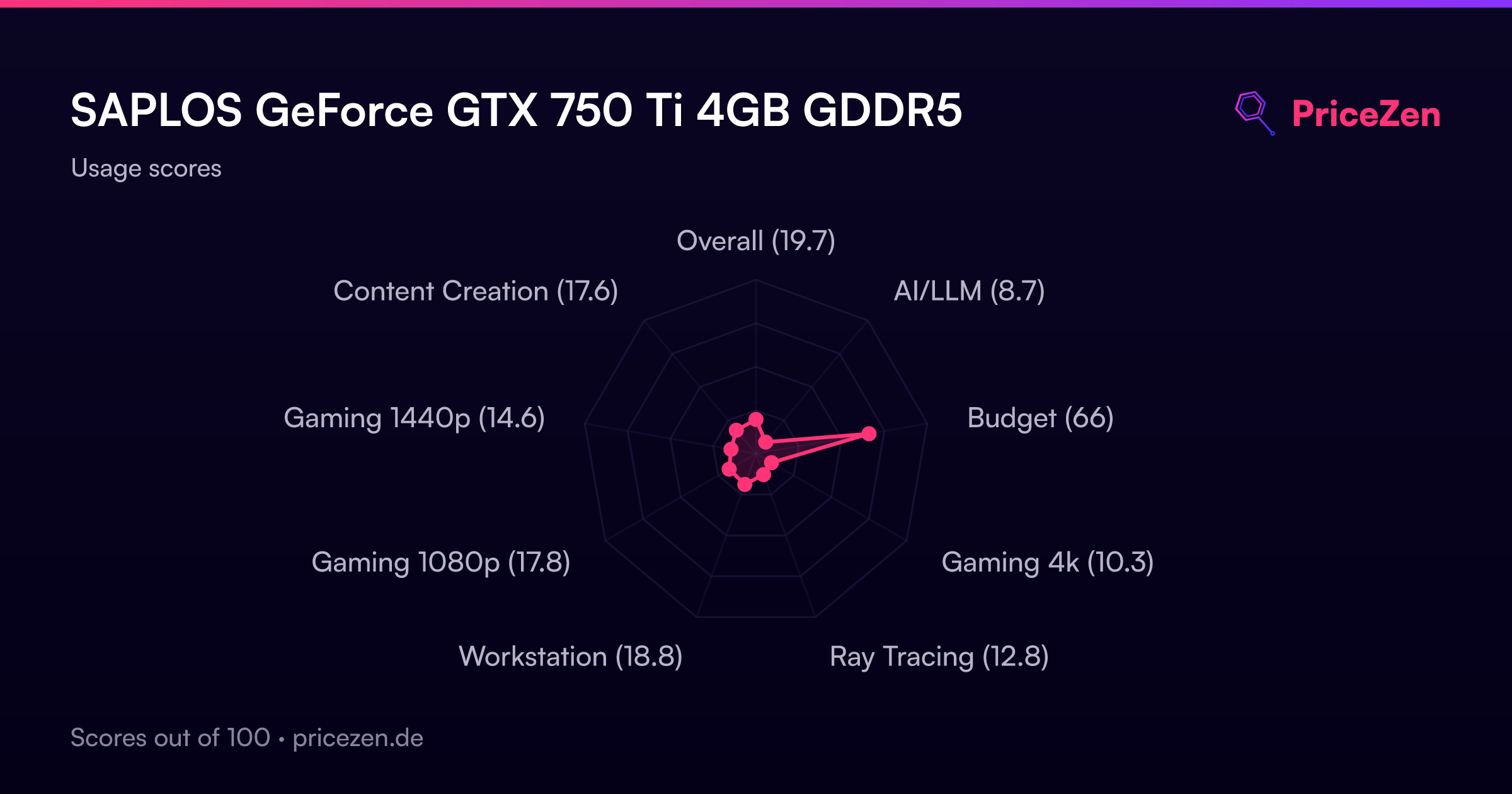
SAPLOS GeForce GTX 750 Ti 4GB GDDR5
The Maxwell-based GPU with 4GB of GDDR5 VRAM stands out for its 60W TDP, requiring no external power connector and fitting easily into mainstream ITX cases. Its dual-fan cooling and low-profile design make it a practical drop-in upgrade for older office PCs lacking robust power supplies. This card is best for users assembling a basic home or children's computer for daily tasks, legacy gaming, and driving dual 1080p monitors.

No current retailer price











Snapshot
The 30-Second Version
The SAPLOS GeForce GTX 750 Ti is a low-profile budget graphics card that runs entirely off PCIe slot power, making it ideal for retro builds and SFF office PCs. It handles older games and esports titles fine at 1080p, but lacks modern driver support and DirectX 12 compatibility. At around $105 USD, it's overpriced for what you get unless you specifically need its unique low-power, low-profile form factor.
Pros & Cons
Pros
- No external power connector needed, runs entirely off the PCIe slot 92nd
- Low-profile design with included half-height brackets for SFF cases
- 4GB VRAM is double what the original 750 Ti shipped with
- Works with Windows XP through 11, great for retro builds
- Much faster than GT 730 and GT 710 alternatives
Cons
- No official driver updates from Nvidia anymore
- Doesn't natively support DirectX 12
- Some units reportedly fail within weeks of installation
- Fan noise is noticeable under load
- Poor value at prices above $80 USD
What owners think
The Word on the Street
How owner sentiment changed over time
ExclusiveBased on when customers actually wrote their reviews - so you can see whether early praise held up.
9 written reviews, Jul 2025 – Mar 2026: 7 happy, 1 mixed, 1 unhappy
Across all 57 store ratings: 4.2★. Most owners rate without writing a review. The chart counts the 9 written reviews.
Each dot is one written review, in the month it was written. Happy = 4-5★, mixed = 3★, unhappy = 1-2★.
The proof
Performance
The PassMark G3D score of 3899 puts this card firmly in budget territory. For context, that's roughly on par with a GT 1030, and it absolutely crushes the GT 730 and GT 710 that SAPLOS mentions in their marketing. In our database, the raster performance lands in the 14th percentile, which means it's near the bottom of modern GPUs, but that's expected for a card this old and this cheap.
In practice, you're looking at 60+ fps in older esports titles at 1080p with medium settings. Older AAA games from the 2012-2015 era will run fine at high settings. Anything newer than that and you'll be dialing things way back. The 4GB of VRAM is actually more than the original 750 Ti shipped with, which helps with texture-heavy older games, but the 128-bit memory bus limits bandwidth. The 1020MHz boost clock is stock for this chip, so don't expect any factory overclocking magic here.
Specifications
Full Specifications
Chipset
| GPU Chipset | GeForce GTX 750 Ti |
| Brand | NVIDIA |
| Architecture | Maxwell |
| Class | consumer |
Memory
| VRAM | 4 GB |
| Memory Type | GDDR5 |
| Memory Bus | 128 |
Compute
| Base Clock | 1020 |
| Boost Clock | 1020 |
Performance
| PassMark G3D | 3899 |
| GPU Compute | 1741 |
Power & Cooling
| TDP | 60 |
| Power Connectors | None |
| Cooler | Dual Fan |
Connectivity
| Interface | PCI Express x16 |
| DisplayPort | 0 |
| HDMI | 1 |
| USB-C | 0 |
| Max Displays | 2 |
Physical
| Form Factor | ITX |
| Weight | 0.2 kg / 0.5 lbs |
Features
| DirectX | 12 |
vs Competition
Stacked against the ASUS Dual RTX 4060 or the XFX Speedster RX 7600, the SAPLOS GTX 750 Ti isn't even in the same conversation. Those cards are 10-15x faster and cost 3-4x more, so they're really for different buyers entirely. The more relevant comparison is against the Gigabyte Low Profile RTX 5050, which is also a low-profile card but offers modern features and driver support. The 750 Ti wins on price alone, but you're giving up a lot.
Against the MSI GTX 1080 Ti, the SAPLOS card is laughably outclassed in raw performance, but the 1080 Ti needs a beefy power supply and a full-size case. The real competition for the 750 Ti is the used market. A used GTX 1050 Ti low-profile card often sells for around the same price and offers better performance with modern driver support. If you're not locked into the 750 Ti specifically for compatibility reasons, the 1050 Ti is the smarter buy.
| Spec | SAPLOS GeForce GTX 750 Ti | ASUS GeForce RTX 5090 TUF Gaming | Gigabyte GeForce RTX 5070 Ti Eagle Ice | MSI GeForce RTX 5070 Ti Ventus 3X OC | ZOTAC GeForce RTX 5080 APOCALYPSE | Sapphire Radeon RX 7900 XTX NITRO+ |
|---|---|---|---|---|---|---|
| Chipset | GeForce GTX 750 Ti | GeForce RTX 5090 | GeForce RTX 5070 Ti | GeForce RTX 5070 Ti | GeForce RTX 5080 | Radeon RX 7900 XTX |
| Vram | 4GB GDDR5 | 32GB GDDR7 | 16GB GDDR7 | 16GB GDDR7 | 16GB GDDR7 | 24GB GDDR6 |
| Boost Clock Mhz | 1020 | 2407 | 2542 | 2482 | 2730 | 2680 |
| Tdp W | 60 | 575 | 300 | 300 | 360 | 339 |
| Memory Bus Bits | 128 | 512 | 256 | 256 | 256 | 384 |
| Ray Tracing | - | true | true | true | true | true |
| GPU Class | consumer | consumer | consumer | consumer | consumer | consumer |
| Compare | Compare | Compare | Compare | Compare |
| Product | AI | Rt | Vram | Raster | Feature | Thermal | User Sentiment | Efficiency | Connectivity | Social Proof | Affordability |
|---|---|---|---|---|---|---|---|---|---|---|---|
| SAPLOS GeForce GTX 750 Ti | 10.9 | 14 | 11.7 | 14.2 | 10.9 | 31 | 13.8 | 21 | 16.7 | 52 | 91.7 |
| ASUS GeForce RTX 5090 TUF Gaming Compare | 97.1 | 90.6 | 97.8 | 98.8 | 95.9 | 72.4 | 85.4 | 23.9 | 99.3 | 98.7 | 2.3 |
| Gigabyte GeForce RTX 5070 Ti Eagle Ice Compare | 79.6 | 88.8 | 86.1 | 89.1 | 95.9 | 91.7 | 85.4 | 72 | 94.1 | 93.3 | 26.9 |
| MSI GeForce RTX 5070 Ti Ventus 3X OC Compare | 79.6 | 92.6 | 86.1 | 89.1 | 95.9 | 91.7 | 85.4 | 72 | 94.1 | 83.8 | 23.4 |
| ZOTAC GeForce RTX 5080 APOCALYPSE Compare | 85.6 | 97.6 | 89.1 | 94.5 | 95.9 | 91.7 | 99.5 | 57 | 94.1 | 98.7 | 20.5 |
| Sapphire Radeon RX 7900 XTX NITRO+ Compare | 95.1 | 96.3 | 92 | 83.6 | 95.9 | 91.7 | 85.4 | 52 | 98.8 | 69 | 19 |
Price
Value & Pricing
At $105 USD, the SAPLOS GTX 750 Ti is in a weird spot. You can find used GTX 1050 Ti or RX 570 cards for similar money that absolutely demolish this thing in performance. The value proposition really only makes sense if you specifically need a low-profile card with no external power requirement, or if you're building a period-correct retro machine. The 92nd percentile affordability score in our database reflects that it's cheap in absolute terms, but cheap doesn't always mean good value. If you can stretch your budget or shop used, there are better options out there.
Read more
Overview
The SAPLOS GeForce GTX 750 Ti is a budget graphics card aimed at people who need a cheap, low-power GPU that doesn't require extra power cables. It's based on Nvidia's old Maxwell architecture and comes with 4GB of GDDR5 on a 128-bit bus. The card sits in that weird space where it's technically a gaming GPU from 2014, but in 2025 it's mostly useful for retro builds, office PCs, and light esports titles. Prices float around $105 USD in the US, with European listings running 131-133 EUR and Canadian listings at 171 CAD.
Is the SAPLOS GTX 750 Ti good for gaming? For older games and esports titles at 1080p, sure. It'll handle CS:GO, League of Legends, Minecraft, and similar games without breaking a sweat. But don't expect it to run modern AAA games at anything above low settings, if at all. The card doesn't natively support DirectX 12, which locks it out of some newer titles entirely.
What makes this card interesting is the low-profile ITX design and the fact that it draws all its power from the PCIe slot. That 60W TDP means you can drop it into an old Dell or HP office tower, a small form factor case, or a retro Windows XP machine without upgrading the power supply. SAPLOS includes half-height brackets, which is a nice touch for SFF builds.
Common Questions
Q: Is the SAPLOS GTX 750 Ti good for gaming?
It's fine for older games and esports titles like CS:GO, League of Legends, and Minecraft at 1080p, but it won't handle modern AAA games well. The lack of native DirectX 12 support also locks it out of some newer titles.
Q: Does the GTX 750 Ti need external power?
No, the SAPLOS GTX 750 Ti draws all its power from the PCIe slot with a 60W TDP, so no extra power cables are needed. This makes it perfect for older PCs with weak power supplies.
Q: Is the GTX 750 Ti better than a GT 1030?
The GTX 750 Ti is slightly faster than the GT 1030 in most benchmarks, with a PassMark score of 3899. However, the GT 1030 has newer driver support, so the choice depends on whether you prioritize raw speed or long-term compatibility.
Q: Can the GTX 750 Ti run Windows 11?
Yes, the SAPLOS GTX 750 Ti works with Windows 11, 10, 8, 7, and even XP, according to the manufacturer. Just keep in mind that Nvidia no longer provides official driver updates for this card.
Who Should Skip This
Skip this card if you're building a modern gaming PC, doing any kind of AI or machine learning work, or want something that'll still get driver updates in a year. The 9.3/100 AI score and 13th percentile ray tracing ranking mean it's useless for those workloads. If you need a low-profile card but want modern features, look at the Gigabyte Low Profile RTX 5050 or hunt for a used GTX 1050 Ti low-profile. And if you're just looking for a cheap gaming GPU, the used market has far better options at this price point.
Verdict
Should you buy the SAPLOS GeForce GTX 750 Ti? Only if you have a very specific use case. If you're building a retro Windows XP gaming rig, upgrading an old SFF office PC, or need a cheap card that won't stress a weak power supply, this card does the job. The low-profile design and slot-only power draw are genuinely useful features that are hard to find in newer cards.
But for everyone else, this is a tough sell in 2025. The lack of driver updates, no native DirectX 12 support, and reliability concerns from user reviews make it hard to recommend at full price. The 65/100 user sentiment score tells the story: people who know what they're getting into are happy, but there are enough reports of early failures to give us pause. If you can find this card under $80 USD, it's a decent niche buy. Above that, look elsewhere.
Usage Scores
- Overall19.7
- AI/LLM8.7
- Budget66
- Gaming 4k10.3
- Ray Tracing12.8
- Workstation18.8
- Gaming 1080p17.8
- Gaming 1440p14.6
- Content Creation17.6