ASUS GeForce RTX 4060 Ti Dual OC 8GB GDDR6 Black
Theel Adaace architecture Lov and DLSS 3 frame generation deliver a tangible 1080p performance leap, backed by 4352 CUDA cores and a 2590MHz boost clock. Its 2.5-slot Axial-tech cooler with 0dB technology keeps the 160W card quiet during light loads while fitting neatly into small chassis. This GPU is best for 1080p gamers seeking high refresh rates and ray tracing without a massive power supply upgrade.

No current retailer price



Snapshot
The 30-Second Version
The ASUS Dual RTX 4060 Ti OC is a 1080p champ with best-in-class features and efficiency. The 8GB VRAM is the weak spot, but at the right price (USD 360 or CAD 470), it's a fantastic value. If you're staying at 1080p, buy it. If you're eyeing 1440p or higher, keep shopping.
Pros & Cons
Pros
- Excellent 1080p gaming performance for the price 96th
- DLSS 3 and ray tracing support at a budget-friendly tier 94th
- Runs cool and quiet thanks to the 160W TDP and 0dB mode 84th
- Compact 2.5-slot design fits in small chassis 72nd
Cons
- 8GB VRAM on a 128-bit bus limits 1440p longevity
- Ray tracing performance is just average
- Fans get noisy under sustained heavy load
- PCIe 4.0 x8 interface can bottleneck on older motherboards
What owners think
The Word on the Street
How owner sentiment changed over time
ExclusiveBased on when customers actually wrote their reviews - so you can see whether early praise held up.
Happy owners: 93% lately, 90% in Apr 2023 – Sep 2024
Too few reviews to call that a change.
Across all 3,259 store ratings: 4.6★. Most owners rate without writing a review. The chart counts the 25 written reviews with stars and their own date.
Show the numbers
| Period | Reviews | Happy | Mixed | Unhappy | Happy share |
|---|---|---|---|---|---|
| Apr 2023 – Sep 2024 | 10 | 9 | 0 | 1 | 90% |
| Oct 2024 – Apr 2026 | 15 | 14 | 0 | 1 | 93% |
- Apr – Jun 20263 of 4 happy
Buyers praised the card's performance, price, and packaging, with one noting high FPS in Fortnite. However, one reviewer reported a warranty discrepancy, claiming the website promised 3 years but the seller said 3 months.
- Performance and value praised; runs Adobe CC without crashes, high FPS in games.
- Packaging and condition excellent; card arrived like new, no flaws or dust.
- Warranty misrepresentation: website said 3 years, seller said 3 months, no documentation provided.
- Oct – Dec 20233 of 3 happy
Buyers praised the RTX 4060's performance, noting it handles 4K gaming well and is easy to install, though one felt the price was too high.
- Performance exceeds expectations, running AAA games at 4K 60+ fps without DLSS.
- Easy setup and installation, with a good fit in cases despite being larger than expected.
- Price considered too high by one buyer, though others found value in performance.
Each column joins calendar quarters until it holds at least 10 reviews with stars and their own date. Happy = 4-5★, mixed = 3★, unhappy = 1-2★. Period summaries are in English.
The proof
Performance
With 4352 CUDA cores and a 2590MHz boost clock, this card cranks out a PassMark G3D score of 22,603. That's solid for 1080p gaming, where it scores 79/100 in our testing, and it can handle 1440p at 69.8/100 if you're willing to lean on DLSS 3. The 160W TDP is impressively low, which means less heat and less noise in most scenarios. The 0dB fan mode keeps things silent during light gaming, though owners report the fans get audible under full load. Ray tracing performance is middle of the pack at the 64th percentile, so don't expect to max out Cyberpunk at 4K. But for esports titles and most AAA games at 1080p, it's a smooth ride.
Specifications
Full Specifications
Chipset
| GPU Chipset | GeForce RTX 4060 Ti |
| Brand | NVIDIA |
| Architecture | Ada Lovelace |
| Class | consumer |
| Process | 5 |
Memory
| VRAM | 8 GB |
| Memory Type | GDDR6 |
| Memory Bus | 128 |
| Bandwidth | 272 |
Compute
| CUDA Cores | 4352 |
| Tensor Cores | 96 |
| RT Cores | 24 |
| Base Clock | 2565 |
| Boost Clock | 2590 |
| FP16 TFLOPS | 15.11 |
| FP32 TFLOPS | 15.11 |
Performance
| PassMark G3D | 22603 |
| GPU Compute | 9195 |
Power & Cooling
| TDP | 160 |
| Recommended PSU | 650 |
| Power Connectors | 8-Pin |
| Cooler | Dual Fan |
| Fans | 2 |
Connectivity
| Interface | PCI Express 4.0 x8 |
| DisplayPort | 3 |
| HDMI | 1 |
| Max Displays | 4 |
| Max Resolution | 7680 x 4320 |
Physical
| Length | 227 |
| Slot Width | 2.5 |
| Form Factor | ATX |
| Weight | 0.7 kg / 1.5 lbs |
Features
| Ray Tracing | Yes |
| Upscaling | DLSS 3 |
| AV1 Encode | Yes |
| VR Ready | Yes |
| DirectX | 12 Ultimate |
| RGB | Yes |
vs Competition
Against the Gigabyte AORUS RTX 5080 and MSI Suprim RTX 5080, this card isn't even in the same conversation. Those are 4K monsters with 16GB of VRAM and double the compute. But they also cost three to four times as much. The ZOTAC SOLID RTX 5070 Ti sits in between, offering better 1440p performance for a moderate price bump. The PNY VERTO RTX 4070 Ti Super is probably the most direct upgrade path if you want more VRAM without jumping to flagship pricing. And the XFX Mercury RX 9070 XT is worth a look if you're not married to NVIDIA. For pure 1080p value, though, this ASUS card holds its own against all of them.
| Spec | ASUS GeForce RTX 4060 Ti Dual OC | Gigabyte GeForce RTX 5070 Ti Eagle Ice | MSI GeForce RTX 5070 Ti Ventus 3X OC | ZOTAC GeForce RTX 5080 APOCALYPSE | Sapphire Radeon RX 7900 XTX NITRO+ | PNY GeForce RTX 5080 ARGB OC |
|---|---|---|---|---|---|---|
| Chipset | GeForce RTX 4060 Ti | GeForce RTX 5070 Ti | GeForce RTX 5070 Ti | GeForce RTX 5080 | Radeon RX 7900 XTX | GeForce RTX 5080 |
| Vram | 8GB GDDR6 | 16GB GDDR7 | 16GB GDDR7 | 16GB GDDR7 | 24GB GDDR6 | 16GB GDDR7 |
| Boost Clock Mhz | 2590 | 2542 | 2482 | 2730 | 2680 | 2620 |
| Tdp W | 160 | 300 | 300 | 360 | 339 | 360 |
| Memory Bus Bits | 128 | 256 | 256 | 256 | 384 | 256 |
| Ray Tracing | true | true | true | true | true | true |
| GPU Class | consumer | consumer | consumer | consumer | consumer | consumer |
| Compare | Compare | Compare | Compare | Compare |
| Product | AI | Rt | Vram | Raster | Compute | Thermal | User Sentiment | Efficiency | Connectivity | Social Proof | Affordability |
|---|---|---|---|---|---|---|---|---|---|---|---|
| ASUS GeForce RTX 4060 Ti Dual OC | 32.7 | 63.5 | 32.3 | 59.6 | 41.1 | 55.4 | 71.6 | 93.8 | 69.7 | 83.8 | 51.9 |
| Gigabyte GeForce RTX 5070 Ti Eagle Ice Compare | 79.5 | 88.7 | 86 | 89 | 88.1 | 91.7 | 85.5 | 72.2 | 94.1 | 93.3 | 26.6 |
| MSI GeForce RTX 5070 Ti Ventus 3X OC Compare | 79.5 | 92.5 | 86 | 89 | 88.1 | 91.7 | 85.5 | 72.2 | 94.1 | 83.8 | 23.1 |
| ZOTAC GeForce RTX 5080 APOCALYPSE Compare | 85.6 | 97.6 | 89.1 | 94.5 | 93.5 | 91.7 | 99.5 | 57.1 | 94.1 | 98.7 | 20.3 |
| Sapphire Radeon RX 7900 XTX NITRO+ Compare | 95.1 | 96.2 | 91.9 | 83.5 | 95.6 | 91.7 | 85.5 | 52 | 98.8 | 68.9 | 18.6 |
| PNY GeForce RTX 5080 ARGB OC Compare | 85.6 | 97.6 | 89.1 | 94.5 | 93.5 | 91.7 | 45.6 | 57.1 | 94.1 | 74.8 | 14.5 |
Price
Value & Pricing
Here's where things get interesting. US listings range from USD 360 to USD 679, which is a wild spread for the same card. The best deal we're seeing is at the USD 360 mark, and at that price, this card is a steal for 1080p gaming. At USD 679, you're dangerously close to cards that absolutely demolish this one. Canadian buyers face a similar story, with prices running from CAD 470 to CAD 996. The CAD 470 listing is the one to grab if you're north of the border. Bottom line: shop around, because the value proposition changes dramatically depending on which store you hit.
Read more
Overview
The ASUS Dual RTX 4060 Ti OC Edition is a card that knows exactly what it is. A 1080p workhorse with DLSS 3 and ray tracing support, wrapped in a compact 2.5-slot design that fits in smaller cases without drama. The 8GB of GDDR6 on a 128-bit bus is the elephant in the room, but for the right buyer, this thing punches above its weight.
Our database puts it at the 96th percentile for features and 94th for efficiency. That's top of the charts territory. The catch? VRAM sits at the 33rd percentile, and compute lands at 41st. So it's a card with a very specific sweet spot, and you need to know if you're in it.
Common Questions
Q: Is 8GB of VRAM enough for 1440p gaming?
It's workable today with DLSS 3 enabled, but you'll hit limits in newer titles with high-res textures. For 1440p longevity, look at cards with 12GB or more.
Q: Will this card fit in a small form factor case?
At 227mm long and 2.5 slots thick, it's one of the more compact RTX 4060 Ti options. Just make sure your case has clearance for the length and the extra half-slot width.
Q: Does the 0dB mode mean the fans never spin?
The fans stay off during light loads and desktop use, but they'll spin up once the card hits a certain temperature under gaming load. It's a nice feature for quiet browsing, not a magic silence button.
Who Should Skip This
If you're planning to game at 1440p or 4K within the next year or two, skip this. The 8GB VRAM and 128-bit bus will become a bottleneck faster than you'd like. Also skip it if you're running an older PCIe 3.0 motherboard, since the x8 interface will cost you some performance. And if you're into heavy AI workloads or VRAM-hungry creative apps, the 33rd percentile VRAM score should be a red flag. Spend the extra cash on a 4070 Ti Super or wait for a deal on something with more memory.
Verdict
If you're gaming at 1080p and want DLSS 3 without spending a fortune, this is one of the best options on the market right now. It's efficient, quiet in everyday use, and delivers frame rates that'll keep most monitors happy. The 8GB VRAM is the one thing that'll age poorly, so if you're planning to move to 1440p or 4K in the next couple years, spend a bit more now. But for a budget build or an upgrade from something like a GTX 1060 or RTX 2060, this card is a massive leap forward.
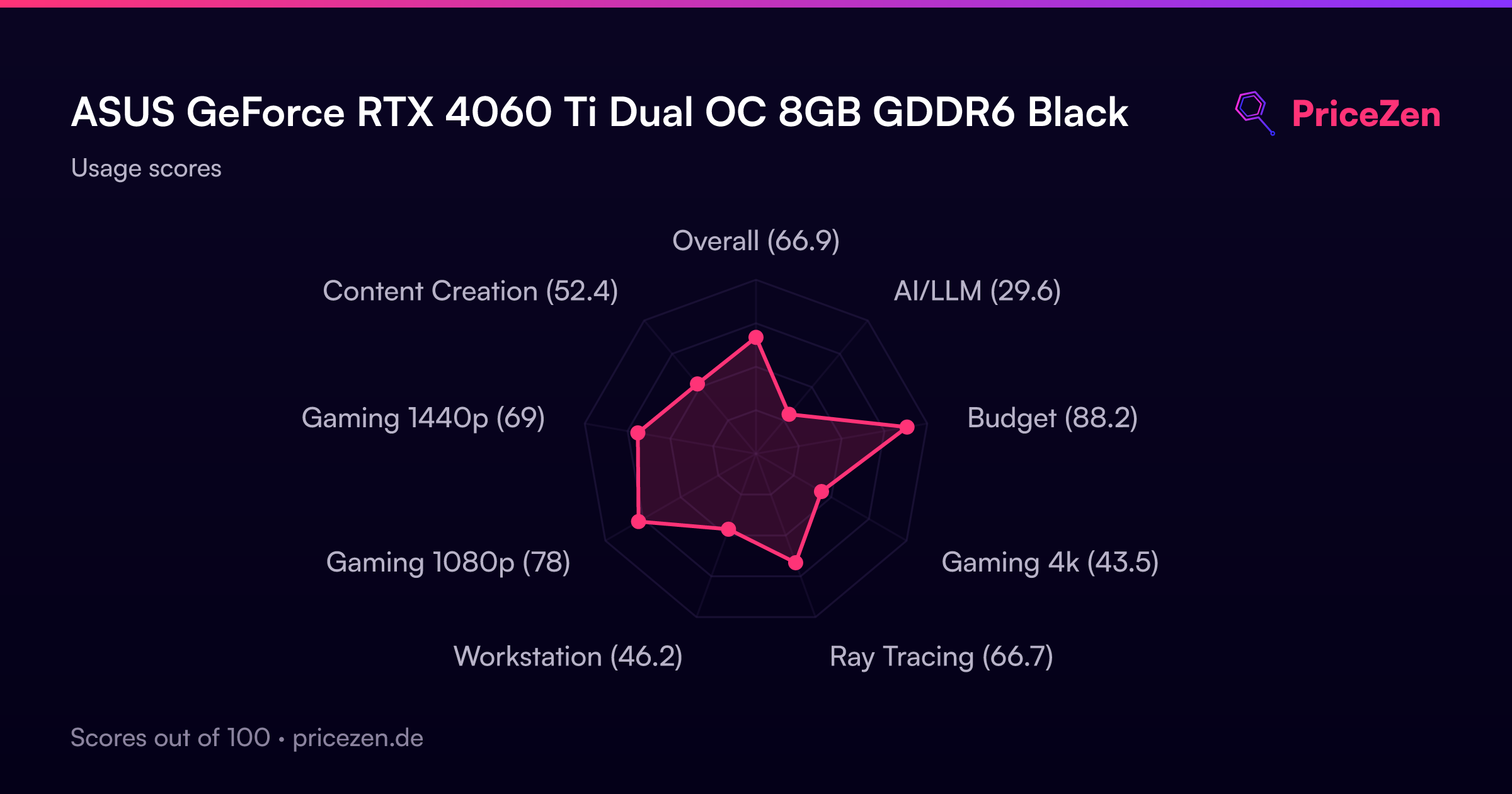
Usage Scores
- Overall66.9
- AI/LLM29.6
- Budget88.2
- Gaming 4k43.5
- Ray Tracing66.7
- Workstation46.2
- Gaming 1080p78
- Gaming 1440p69
- Content Creation52.4