NVIDIA GeForce RTX 2060 SUPER 8GB GDDR6
The Turing-based RTX 2060 Super stands out with 8GB of GDDR6 memory and a 1650 MHz boost clock, delivering solid 1080p gaming with real-time ray tracing and DLSS support. Its dual-fan cooling and 175W TDP make it a practical, VR-ready card for multi-display setups without demanding a high-wattage power supply. This card is best for budget-conscious 1080p gamers who want entry-level ray tracing and smooth VR performance in a single upgrade.

No current retailer price











Snapshot
The 30-Second Version
The GPVHOSO RTX 2060 SUPER is a budget 1080p card with solid raster performance and weak ray tracing. It scores 75.8 for budget value, but the no-name brand and 4.1 star rating are red flags. Worth it if you're on a tight budget and willing to gamble.
Pros & Cons
Pros
- Great budget value at 75.8 out of 100 81st
- 8GB GDDR6 handles 1080p gaming without breaking a sweat 66th
- DLSS support gives you a nice frame rate boost
- Dual fans keep it reasonably cool under load
Cons
- Ray tracing performance is weak, 42.9 out of 100
- Only 4.1 stars from 56 reviews, and one buyer got a dud
- Connectivity is limited, just one DP and one HDMI
- No-name brand means warranty support is a gamble
What owners think
The Word on the Street
How owner sentiment changed over time
ExclusiveBased on when customers actually wrote their reviews - so you can see whether early praise held up.
6 written reviews, Apr – Nov 2025: 5 happy, 1 unhappy
Across all 56 store ratings: 4.1★. Most owners rate without writing a review. The chart counts the 6 written reviews.
Each dot is one written review, in the month it was written. Happy = 4-5★, mixed = 3★, unhappy = 1-2★.
The proof
Performance
The 2060 SUPER hits 16,473 on PassMark G3D, which lands it in the middle of the pack for raster performance. That translates to smooth 1080p gaming at high settings in most titles. The 8GB of VRAM and 448 GB/s memory bandwidth help, but don't expect 4K miracles. Ray tracing is technically supported, but at 42.9 out of 100, it's more of a checkbox than a feature you'll actually want to use. DLSS helps claw back some frames, but this card's real strength is plain old 1080p rasterization.
Specifications
Full Specifications
Chipset
| GPU Chipset | GeForce RTX 2060 SUPER |
| Brand | NVIDIA |
| Architecture | Turing |
| Class | consumer |
| Process | 12 |
Memory
| VRAM | 8 GB |
| Memory Type | GDDR6 |
| Memory Bus | 256 |
| Bandwidth | 448 |
Compute
| CUDA Cores | 2176 |
| Tensor Cores | 272 |
| RT Cores | 34 |
| Base Clock | 1531 |
| Boost Clock | 1650 |
| FP16 TFLOPS | 14.36 |
| FP32 TFLOPS | 7.181 |
Performance
| PassMark G3D | 16473 |
| GPU Compute | 6697 |
Power & Cooling
| TDP | 175 |
| Recommended PSU | 450 |
| Cooler | Dual Fan |
| Fans | 2 |
Connectivity
| Interface | PCI Express x 16 3.0 |
| DisplayPort | 1 |
| HDMI | 1 |
| Max Displays | 3 |
| Max Resolution | 7680 x 4320 |
Physical
| Weight | 0.9 kg / 1.9 lbs |
Features
| Ray Tracing | Yes |
| Upscaling | DLSS |
| VR Ready | Yes |
vs Competition
Stacked against the ASUS TUF RTX 5090 or Gigabyte AERO RTX 5080, this card looks ancient. But those cards cost several times more. The real comparison is against other budget options. The MSI Ventus RTX 5070 Ti is a massive step up in performance but also in price. The ZOTAC AMP Extreme Infinity is another budget-friendly option with better brand recognition. If you can stretch your budget, the ZOTAC is the safer bet. If you can't, the GPVHOSO gets you in the game.
| Spec | NVIDIA GeForce RTX 2060 SUPER | Gigabyte GeForce RTX 5070 Ti Eagle Ice | ASUS GeForce RTX 5080 PRIME EVO OC | MSI GeForce RTX 5070 Ti Ventus 3X OC | ZOTAC GeForce RTX 5080 APOCALYPSE | Sapphire Radeon RX 7900 XTX NITRO+ |
|---|---|---|---|---|---|---|
| Chipset | GeForce RTX 2060 SUPER | GeForce RTX 5070 Ti | GeForce RTX 5080 | GeForce RTX 5070 Ti | GeForce RTX 5080 | Radeon RX 7900 XTX |
| Vram | 8GB GDDR6 | 16GB GDDR7 | 16GB GDDR7 | 16GB GDDR7 | 16GB GDDR7 | 24GB GDDR6 |
| Boost Clock Mhz | 1650 | 2542 | 2685 | 2482 | 2730 | 2680 |
| Tdp W | 175 | 300 | 360 | 300 | 360 | 339 |
| Memory Bus Bits | 256 | 256 | 256 | 256 | 256 | 384 |
| Ray Tracing | true | true | true | true | true | true |
| GPU Class | consumer | consumer | consumer | consumer | consumer | consumer |
| Compare | Compare | Compare | Compare | Compare |
| Product | AI | Rt | Vram | Raster | Compute | Feature | Thermal | Efficiency | Connectivity | Social Proof | Affordability |
|---|---|---|---|---|---|---|---|---|---|---|---|
| NVIDIA GeForce RTX 2060 SUPER | 44 | 41.2 | 37.9 | 35.6 | 24.2 | 65.7 | 42.2 | 52.9 | 25.5 | 51.3 | 81.4 |
| Gigabyte GeForce RTX 5070 Ti Eagle Ice Compare | 79.3 | 88.7 | 86 | 89 | 88 | 95.8 | 91.8 | 71.6 | 94.1 | 93.3 | 23.8 |
| ASUS GeForce RTX 5080 PRIME EVO OC Compare | 85.5 | 97.6 | 89.1 | 94.5 | 93.4 | 88.7 | 91.8 | 56.6 | 94.1 | 93.3 | 18.3 |
| MSI GeForce RTX 5070 Ti Ventus 3X OC Compare | 79.3 | 92.4 | 86 | 89 | 88 | 95.8 | 91.8 | 71.6 | 94.1 | 83.8 | 23.5 |
| ZOTAC GeForce RTX 5080 APOCALYPSE Compare | 85.5 | 97.6 | 89.1 | 94.5 | 93.4 | 95.8 | 91.8 | 56.6 | 94.1 | 98.7 | 20.7 |
| Sapphire Radeon RX 7900 XTX NITRO+ Compare | 95.2 | 96.3 | 92 | 83.4 | 95.7 | 95.8 | 91.8 | 51.5 | 98.8 | 69.1 | 18.8 |
Price
Value & Pricing
At 57,921 JPY or 8,399 MXN, this card is priced to move. For budget builders, it's a steal if you just want 1080p gaming without ray tracing. But the value proposition gets murky when you factor in the brand risk. A 4.1 star rating with 56 reviews isn't terrible, but it's not confidence-inspiring either. If it works, you're getting a lot of card for the money. If it doesn't, you're stuck dealing with a company nobody's heard of.
We started tracking prices for this product on Jun 17, 2026. The chart appears once we have more data.
Read more
Overview
The GPVHOSO RTX 2060 SUPER is a budget-friendly card that still packs a punch for 1080p gaming. It's got 8GB of GDDR6, 2176 CUDA cores, and a 1650MHz boost clock. Nothing flashy, but it gets the job done.
Our database puts it at 75.8 for budget value, which is solid. The catch? It's a no-name brand with a 4.1 star rating from 56 reviews. Some buyers love it, one got burned. We'll dig into what that means for you.
Common Questions
Q: Can this card handle 1440p gaming?
It can manage 1440p in less demanding titles, but 1080p is really its sweet spot. The 8GB of VRAM and mid-range raster performance mean you'll need to dial settings back at higher resolutions.
Q: Is ray tracing worth using on this card?
Not really. With a ray tracing score of 42.9 out of 100, you'll see significant frame rate drops. DLSS helps, but you're better off leaving ray tracing off for smooth gameplay.
Q: Will this fit in a standard ATX case?
Yes, it's a dual-fan card with a standard PCI Express x16 3.0 interface. It should fit in most mid-tower and full-tower cases without issues.
Who Should Skip This
Skip this if you need reliable warranty support or plan to do any serious ray tracing. The no-name brand and mixed reviews mean you're taking a risk. If you're building a system for work or can't afford downtime, spend a bit more on a card from ASUS, MSI, or ZOTAC. Also skip it if you want 1440p or 4K gaming, this card will struggle.
Verdict
This card is for budget builders who need 1080p gaming now and don't care about ray tracing or brand prestige. It's a solid performer for the price, but the no-name brand and mixed reviews mean you're rolling the dice. If you get a good unit, you'll be happy. If you don't, you'll wish you'd spent a bit more on a known brand.
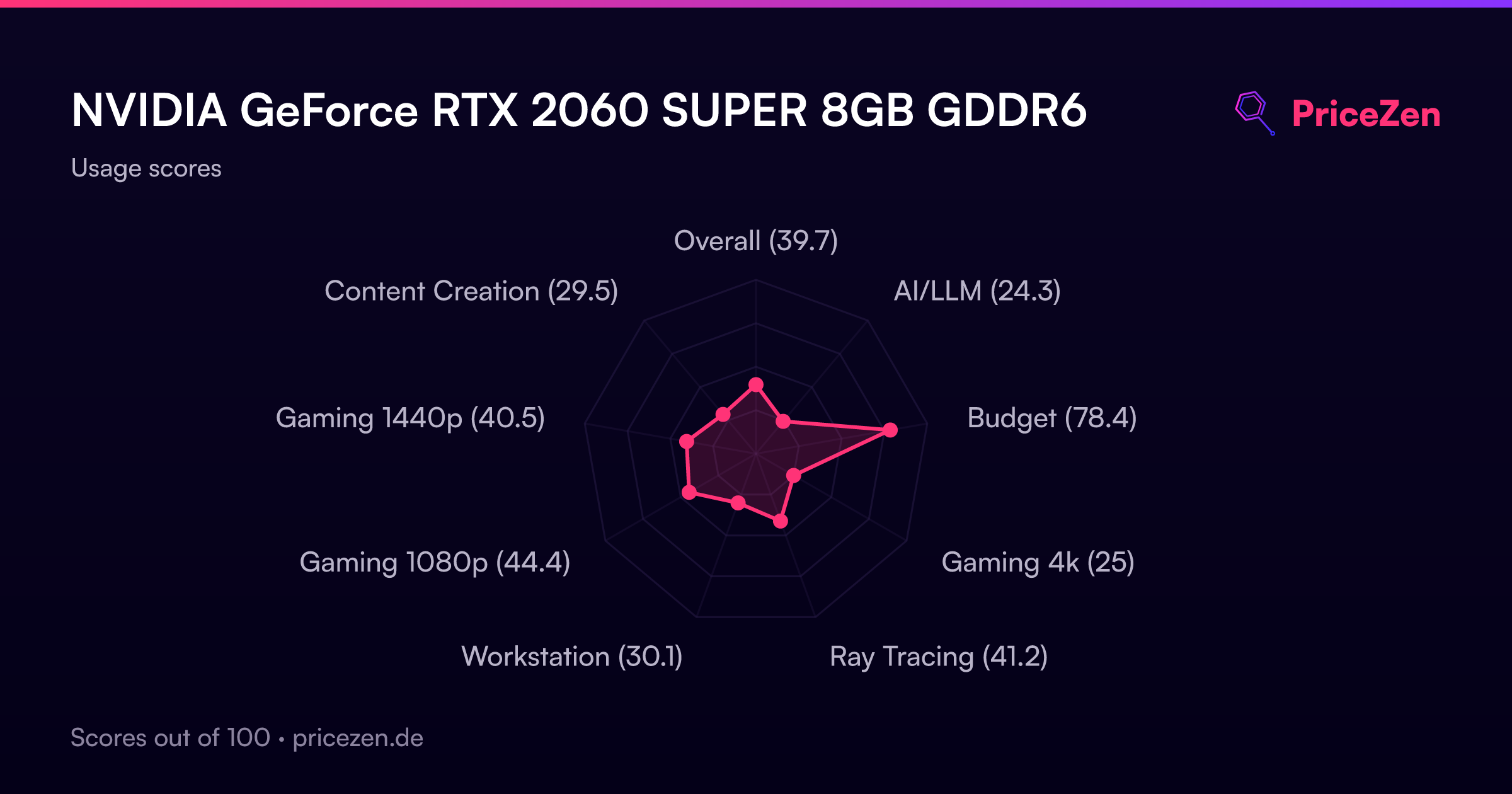
Usage Scores
- Overall39.7
- AI/LLM24.3
- Budget78.4
- Gaming 4k25
- Ray Tracing41.2
- Workstation30.1
- Gaming 1080p44.4
- Gaming 1440p40.5
- Content Creation29.5