ASUS GeForce RTX 3070 ROG Strix V2 OC 8GB GDDR6
The 1935MHz boost clock and robust triple-fan Axial-tech cooler on a 2.9-slot design deliver chart-topping thermal performance for sustained high frame rates. Its premium build quality and Super Alloy Power II components ensure reliability, while the 2nd Gen RT and 3rd Gen Tensor cores provide effective ray tracing and DLSS at 1440p. This card is best for 1080p and 1440p gamers who prioritize a cool, quiet, and overbuilt card over absolute value.

No current retailer price











Snapshot
The 30-Second Version
The ROG Strix RTX 3070 posts a 22,099 PassMark score and keeps temps under 60°C, which owners love. But 8GB of VRAM at 39th percentile and a 29th percentile connectivity score make it a tough sell in 2025. At EUR 1,027 to EUR 1,316, you're paying a premium for cooling and build quality on a last-gen card.
Pros & Cons
Pros
- PassMark G3D score of 22,099 handles 1440p gaming above 60 FPS in most titles 75th
- Triple-fan cooling keeps temps under 60°C even under load 72nd
- Quiet operation with solid build quality per owner reviews
- 1935MHz boost clock in OC mode with 5120 CUDA cores
- 4.5/5 customer rating across 113 reviews
Cons
- 8GB VRAM lands at 39th percentile, limiting future AAA titles
- 318mm length and 2.9-slot width won't fit smaller cases
- Connectivity sits at 29th percentile with limited outputs
- AI/LLM performance scores just 29/100
- EUR pricing varies by EUR 289 across vendors
What owners think
The Word on the Street
How owner sentiment changed over time
ExclusiveBased on when customers actually wrote their reviews - so you can see whether early praise held up.
9 written reviews, Apr 2022 – Jul 2025: 9 happy
Across all 113 store ratings: 4.5★. Most owners rate without writing a review. The chart counts the 9 written reviews.
Each dot is one written review, in the month it was written. Happy = 4-5★, mixed = 3★, unhappy = 1-2★.
The proof
Performance
The 1935MHz boost clock in OC mode pushes this card to 15.97 FP32 TFLOPS, which is solid but not spectacular. Our raster ranking puts it at 57th percentile, meaning it's a bit above the middle of the pack. For 1440p gaming, owners consistently report staying above 60 FPS in most AAA titles, which is the sweet spot this card was built for. The 5120 CUDA cores do the heavy lifting, and the 448 GB/s memory bandwidth keeps things moving.
Ray tracing sits at 61st percentile, so it's functional but not a standout. The 40 RT cores handle the basics, but don't expect to max out Cyberpunk with RT on without DLSS doing some serious work. Speaking of DLSS, the 160 Tensor cores are third-gen Ampere units, and they're the card's saving grace for modern titles. Compute overall lands at 44th percentile, which is about average. The weakest area is AI/LLM work at 29/100, so if you're planning to run local language models, this isn't your card.
Specifications
Full Specifications
Chipset
| GPU Chipset | GeForce RTX 3070 |
| Brand | NVIDIA |
| Architecture | Ampere |
| Class | consumer |
| Process | 8 |
Memory
| VRAM | 8 GB |
| Memory Type | GDDR6 |
| Memory Bus | 256 |
| Bandwidth | 448 |
Compute
| CUDA Cores | 5120 |
| Tensor Cores | 160 |
| RT Cores | 40 |
| Base Clock | 1290 |
| Boost Clock | 1935 |
| FP16 TFLOPS | 15.97 |
| FP32 TFLOPS | 15.97 |
Performance
| PassMark G3D | 22099 |
| GPU Compute | 11082 |
Power & Cooling
| TDP | 220 |
| Cooler | Triple Fan |
Connectivity
| Interface | PCI Express 4.0 x16 |
| DisplayPort | 1 |
| HDMI | 1 |
| Max Resolution | 7680 x 4320 |
Physical
| Length | 318 |
| Slot Width | 2.9 |
| Form Factor | Full Height |
| Weight | 1.8 kg / 4.0 lbs |
Features
| Ray Tracing | Yes |
| Upscaling | DLSS |
vs Competition
Against the current field, this card faces some stiff competition. The MSI Ventus RTX 5070 Ti and Gigabyte AERO RTX 5070 Ti both offer significantly more performance with 16GB of VRAM, which is double what this card carries. The ZOTAC APOCALYPSE and PNY ARGB OC are also in the mix with newer architectures. Where the ROG Strix 3070 still holds its own is in cooling and build quality, owners consistently praise the thermal performance, but raw numbers don't lie. The 8GB VRAM at 39th percentile is a real limitation compared to 16GB cards. If you're buying new in 2025, the newer options make more sense unless you find this at a steep discount.
| Spec | ASUS GeForce RTX 3070 ROG Strix V2 OC | Gigabyte GeForce RTX 5070 Ti Eagle Ice | MSI GeForce RTX 5070 Ti Ventus 3X OC | ZOTAC GeForce RTX 5080 APOCALYPSE | PNY GeForce RTX 5080 ARGB OC | Sapphire Radeon RX 9070 XT PULSE |
|---|---|---|---|---|---|---|
| Chipset | GeForce RTX 3070 | GeForce RTX 5070 Ti | GeForce RTX 5070 Ti | GeForce RTX 5080 | GeForce RTX 5080 | Radeon RX 9070 XT |
| Vram | 8GB GDDR6 | 16GB GDDR7 | 16GB GDDR7 | 16GB GDDR7 | 16GB GDDR7 | 16GB GDDR6 |
| Boost Clock Mhz | 1935 | 2542 | 2482 | 2730 | 2620 | 2970 |
| Tdp W | 220 | 300 | 300 | 360 | 360 | 304 |
| Memory Bus Bits | 256 | 256 | 256 | 256 | 256 | 256 |
| Ray Tracing | true | true | true | true | true | true |
| GPU Class | consumer | consumer | consumer | consumer | consumer | consumer |
| Compare | Compare | Compare | Compare | Compare |
| Product | AI | Rt | Vram | Raster | Compute | Feature | Thermal | User Sentiment | Efficiency | Connectivity | Social Proof | Affordability |
|---|---|---|---|---|---|---|---|---|---|---|---|---|
| ASUS GeForce RTX 3070 ROG Strix V2 OC | 37.3 | 61 | 38.5 | 56.4 | 44.1 | 53.1 | 34.8 | 71.6 | 61.4 | 28 | 74.8 | 38.8 |
| Gigabyte GeForce RTX 5070 Ti Eagle Ice Compare | 79.6 | 88.6 | 86 | 89 | 88.2 | 96 | 91.6 | 85.4 | 72.2 | 94.1 | 93.3 | 26.8 |
| MSI GeForce RTX 5070 Ti Ventus 3X OC Compare | 79.6 | 92.4 | 86 | 89 | 88.2 | 96 | 91.6 | 85.4 | 72.2 | 94.1 | 83.8 | 23 |
| ZOTAC GeForce RTX 5080 APOCALYPSE Compare | 85.7 | 97.5 | 89 | 94.5 | 93.5 | 96 | 91.6 | 99.5 | 57.1 | 94.1 | 98.7 | 20.2 |
| PNY GeForce RTX 5080 ARGB OC Compare | 85.7 | 97.5 | 89 | 94.5 | 93.5 | 96 | 91.6 | 45.4 | 57.1 | 94.1 | 74.8 | 14.4 |
| Sapphire Radeon RX 9070 XT PULSE Compare | 89.3 | 84.7 | 73.8 | 75.3 | 90.2 | 96 | 72.3 | 96 | 45.7 | 88.8 | 93.3 | 43.3 |
Price
Value & Pricing
Value is where this card gets complicated. The affordability ranking sits at 37th percentile, which means you're paying a premium for the ROG Strix branding and cooling solution. In Europe, prices swing from EUR 1,027 to EUR 1,316 across four listings, with the best deal coming in at the lower end of that range. That EUR 289 spread is significant, so shopping around actually matters here. The budget score of 69.2/100 suggests it's not a terrible deal, but you're paying for the cooler and build quality more than raw performance. If you can find it near EUR 1,027, it's a reasonable buy. At EUR 1,316, you're overpaying for what is now a last-gen card.
We started tracking prices for this product on Nov 12, 2026. The chart appears once we have more data.
Read more
Overview
The ASUS ROG Strix RTX 3070 V2 OC Edition posts a PassMark G3D score of 22,099, which lands it in the top half of our database but nowhere near the current heavy hitters. That's the story of this card in 2025: it was a monster when it launched, and it still handles 1440p gaming respectably, but the 8GB of GDDR6 and 256-bit bus are starting to show their age. Owners give it a 4.5/5 across 113 reviews, and the sentiment summary backs that up with an 85/100 score, so people who bought it genuinely like it.
The cooling is the real headline here. Multiple owners report temperatures staying under 60°C even under load, which is impressive for a 220W TDP card. The triple-fan Axial-tech design earns its keep. But you'll pay for that cooling in physical space: this thing is 318mm long and takes up 2.9 slots, so measure your case before you click buy. The LHR limiter caps ETH mining at 25 MH/s, which is irrelevant for gamers but worth knowing if you were hoping to offset the cost.
Common Questions
Q: Can this card handle 1440p gaming at high settings?
Yes, owners consistently report staying above 60 FPS in most AAA titles at 1440p. The 5120 CUDA cores and 448 GB/s memory bandwidth handle the resolution well, though the 8GB VRAM may require lowering texture settings in newer games.
Q: Will this card fit in a mid-tower case?
It depends on your case. The card is 318mm long and takes up 2.9 slots, which is larger than many competing 3070s. Several owners report needing a bigger case, so measure your clearance before buying.
Q: Is the LHR version different from the original RTX 3070?
The LHR (Lite Hashrate) version limits ETH mining to 25 MH/s, but gaming performance is identical. The OC Edition actually runs a higher boost clock at 1935MHz in OC mode versus 1905MHz in game mode, so it's slightly faster than reference cards.
Who Should Skip This
Skip this card if you're building a new system in 2025. The 8GB VRAM at 39th percentile is already limiting in newer titles, and the AI/LLM score of 29/100 means it's not a good choice for productivity or local model work. The connectivity options at 29th percentile are sparse, with just one DisplayPort and one HDMI. If you have a smaller case, the 318mm length and 2.9-slot width will likely be a problem. And at EUR 1,027 to EUR 1,316, you're paying current-gen prices for last-gen performance. Anyone looking at RTX 5070 Ti options with 16GB of VRAM should not look back.
Verdict
The ROG Strix RTX 3070 V2 OC Edition is a well-built card that does exactly what it was designed to do: deliver smooth 1440p gaming with excellent thermals. The 22,099 PassMark score and sub-60°C temperatures under load are genuinely impressive for a card of this generation. But the 8GB VRAM and 29th percentile connectivity are hard to ignore in 2025. If you already own one, keep it, it's still a solid performer. If you're buying now, the EUR 1,027 starting price is tough to justify when newer cards with double the VRAM are available. The 85/100 sentiment score tells you owners are happy, but that happiness was mostly earned at launch pricing.
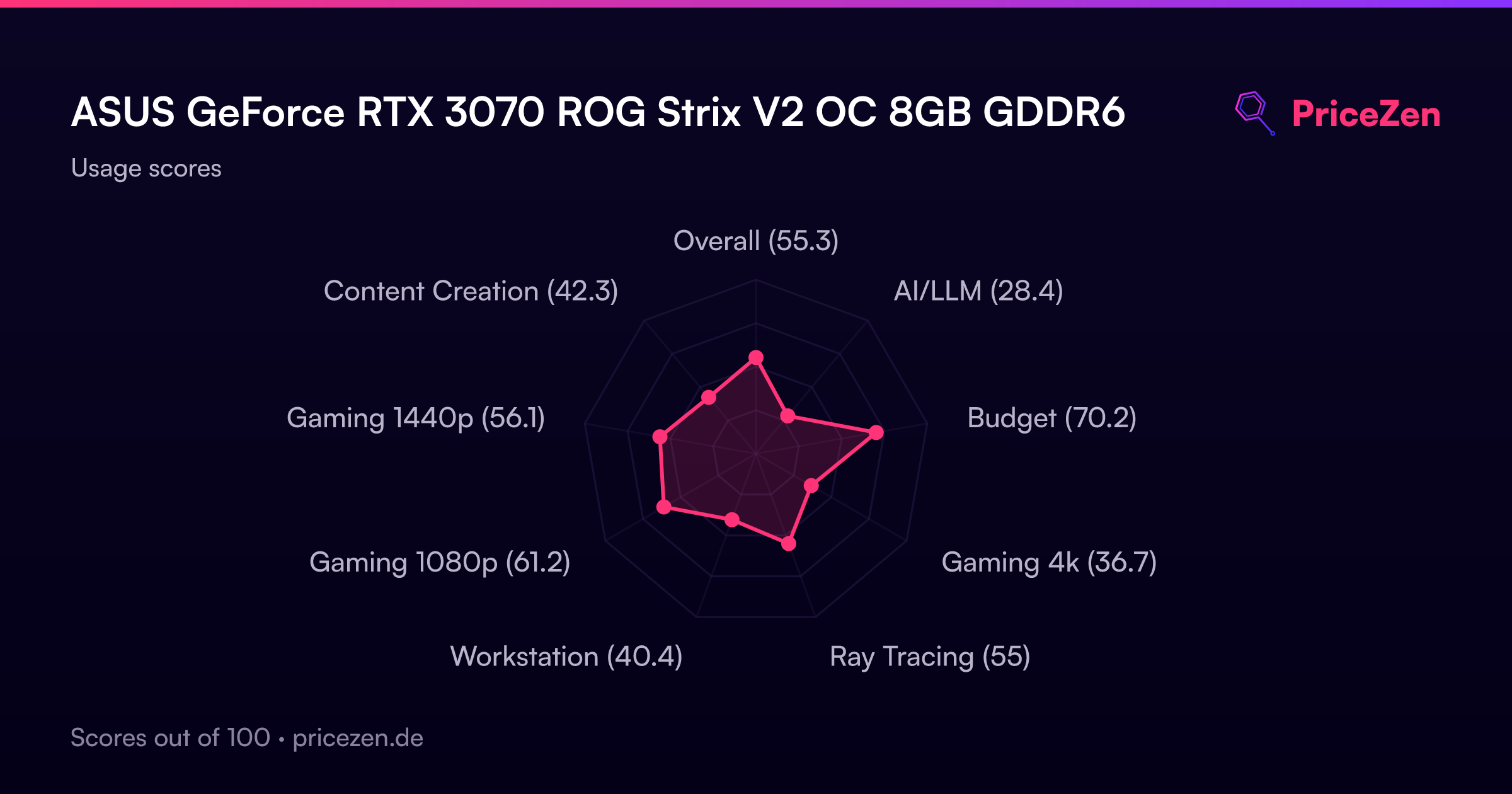
Usage Scores
- Overall55.3
- AI/LLM28.4
- Budget70.2
- Gaming 4k36.7
- Ray Tracing55
- Workstation40.4
- Gaming 1080p61.2
- Gaming 1440p56.1
- Content Creation42.3