ASUS GeForce GTX 1060 Dual OC 6GB GDDR5 White
The Pascal-based GTX 1060 with 6GB GDDR5 and a 1809MHz boost clock delivers reliable 1080p gaming, backed by a dual-fan cooler that provides 3x quieter operation. Its dual HDMI 2.0 ports enable simultaneous VR headset and monitor connections, while the certified refurbished unit offers a like-new experience with a 90-day warranty. This card is best for budget-conscious gamers building or upgrading a system strictly for 1080p titles and entry-level VR.

No current retailer price











Snapshot
The 30-Second Version
The ASUS Dual GTX 1060 6GB is a quiet, cool-running card that still handles 1080p esports and older AAA games fine, but its 6GB VRAM and aging Pascal architecture are showing their age. At $160-165, it's overpriced for what you get, but under $100 it's a reasonable stopgap for budget builds. Owners love it, with a 4.1 out of 5 rating from 116 reviews, but the thermal and efficiency numbers are mediocre by modern standards. Buy it only if you're upgrading from something much older and can find it cheap.
Pros & Cons
Pros
- Excellent 1080p gaming performance for the price 82nd
- Quiet dual-fan cooler with decent temperatures
- Only 120W TDP, runs on a single 6-pin connector
- 6GB VRAM still handles most esports and older AAA titles
- Massive upgrade over GTX 960 or R9 380 class cards
Cons
- Raster performance sits in the 24th percentile overall
- VRAM capacity is in the 19th percentile, struggles with modern AAA textures
- No ray tracing or DLSS support despite the marketing copy
- Thermal and efficiency rankings are below average
- Renewed units can arrive with scuffs or packaging damage
What owners think
The Word on the Street
How owner sentiment changed over time
ExclusiveBased on when customers actually wrote their reviews - so you can see whether early praise held up.
40 written reviews, Aug 2016 – Mar 2026: 36 happy, 1 mixed, 2 unhappy, 1 without stars
Across all 112 store ratings: 4.0★. Most owners rate without writing a review. The chart counts the 40 written reviews.
Each dot is one written review, in the month it was written. Happy = 4-5★, mixed = 3★, unhappy = 1-2★.
The proof
Performance
Let's talk numbers. The PassMark G3D score of 10037 puts this card in the 24th percentile for raster performance against everything in our database. That sounds rough until you remember we're comparing it to RTX 4090s and RX 7900 XTXs. For its actual job, 1080p gaming, it's still capable. The 1280 CUDA cores and 4.375 FP32 TFLOPS of compute mean you'll hit 60fps in most esports titles on high settings, and older AAA games will run fine if you're willing to drop a few settings from ultra to high.
The 6GB of VRAM is the real story here. It sits at the 19th percentile for memory capacity, which means modern titles like Cyberpunk 2077 or Hogwarts Legacy will choke on texture streaming if you push settings too far. But for Fortnite, Valorant, Apex Legends, CS2, and similar games, 6GB is still workable. The 192 GB/s bandwidth is also a limiting factor, but again, at 1080p with reasonable settings, it's not a dealbreaker. The card draws 120W TDP and needs a single 6-pin connector, so it'll slot into almost any prebuilt with a 300W PSU or better.
Specifications
Full Specifications
Chipset
| GPU Chipset | GeForce GTX 1060 |
| Brand | NVIDIA |
| Architecture | Pascal |
| Class | consumer |
| Process | 16 |
Memory
| VRAM | 6 GB |
| Memory Type | GDDR5 |
| Memory Bus | 192 |
| Bandwidth | 192.2 |
Compute
| CUDA Cores | 1280 |
| Base Clock | 1569 |
| Boost Clock | 1809 |
| FP32 TFLOPS | 4.375 |
Performance
| PassMark G3D | 10037 |
| GPU Compute | 4264 |
Power & Cooling
| TDP | 120 |
| Recommended PSU | 300 |
| Power Connectors | 6-Pin |
| Cooler | Dual Fan |
| Fans | 2 |
Connectivity
| Interface | PCI Express 3.0 |
| DisplayPort | 2 |
| HDMI | 2 |
| USB-C | 0 |
| Max Displays | 4 |
| Max Resolution | 7680 x 4320 |
Physical
| Length | 242 |
| Slot Width | 2 |
| Form Factor | Full Height |
| Weight | 1.1 kg / 2.4 lbs |
Features
| Ray Tracing | No |
| Upscaling | DLSS |
| AV1 Encode | No |
| VR Ready | Yes |
| DirectX | 12 |
| RGB | No |
vs Competition
The competitors in our database tell an interesting story. The MSI Ventus G5060-8V3C and PNY Dual Fan OC VCG50608DFXPB1-O are both RTX 5060 cards, which are several generations newer and in a completely different performance class. They'll run circles around the GTX 1060 in every benchmark, but they also cost significantly more. If you have the budget, there's no contest. The Sapphire PULSE 11330-02-20G is an RX 6600, which is probably the closest modern equivalent in terms of price-to-performance for 1080p gaming, and it beats the 1060 handily while offering 8GB of VRAM.
The Gigabyte Vision GV-N3080VISION OC-10GD is an RTX 3080, which is just a different universe entirely. The XFX Swift RX-96TSW16BQ is an RX 9600 series card, also much newer. The point is, every competitor in our list is newer and faster. The GTX 1060's only real advantage is price, and even that advantage is shrinking as used market prices for newer cards come down. If you're building a system today, this card only makes sense if you're on an extremely tight budget and can find it cheap.
| Spec | ASUS GeForce GTX 1060 Dual OC | Gigabyte GeForce RTX 5070 Ti Eagle Ice | MSI GeForce RTX 5070 Ti Ventus 3X OC | ZOTAC GeForce RTX 5080 APOCALYPSE | Sapphire Radeon RX 7900 XTX NITRO+ | PNY GeForce RTX 5080 ARGB OC |
|---|---|---|---|---|---|---|
| Chipset | GeForce GTX 1060 | GeForce RTX 5070 Ti | GeForce RTX 5070 Ti | GeForce RTX 5080 | Radeon RX 7900 XTX | GeForce RTX 5080 |
| Vram | 6GB GDDR5 | 16GB GDDR7 | 16GB GDDR7 | 16GB GDDR7 | 24GB GDDR6 | 16GB GDDR7 |
| Boost Clock Mhz | 1809 | 2542 | 2482 | 2730 | 2680 | 2620 |
| Tdp W | 120 | 300 | 300 | 360 | 339 | 360 |
| Memory Bus Bits | 192 | 256 | 256 | 256 | 384 | 256 |
| Ray Tracing | false | true | true | true | true | true |
| GPU Class | consumer | consumer | consumer | consumer | consumer | consumer |
| Compare | Compare | Compare | Compare | Compare |
| Product | AI | Rt | Vram | Raster | Compute | Feature | Thermal | User Sentiment | Efficiency | Connectivity | Social Proof | Affordability |
|---|---|---|---|---|---|---|---|---|---|---|---|---|
| ASUS GeForce GTX 1060 Dual OC | 19.1 | 23.4 | 18.4 | 23.5 | 15.8 | 40.7 | 42.6 | 58.2 | 36.8 | 40.3 | 59.1 | 81.5 |
| Gigabyte GeForce RTX 5070 Ti Eagle Ice Compare | 79.6 | 88.7 | 86.1 | 89 | 88.1 | 95.9 | 91.7 | 85.5 | 72 | 94.1 | 93.3 | 26.6 |
| MSI GeForce RTX 5070 Ti Ventus 3X OC Compare | 79.6 | 92.5 | 86.1 | 89 | 88.1 | 95.9 | 91.7 | 85.5 | 72 | 94.1 | 83.8 | 23.2 |
| ZOTAC GeForce RTX 5080 APOCALYPSE Compare | 85.6 | 97.6 | 89.1 | 94.5 | 93.4 | 95.9 | 91.7 | 99.5 | 56.9 | 94.1 | 98.7 | 20.3 |
| Sapphire Radeon RX 7900 XTX NITRO+ Compare | 95.1 | 96.3 | 92 | 83.5 | 95.6 | 95.9 | 91.7 | 85.5 | 51.9 | 98.8 | 69 | 18.7 |
| PNY GeForce RTX 5080 ARGB OC Compare | 85.6 | 97.6 | 89.1 | 94.5 | 93.4 | 95.9 | 91.7 | 45.6 | 56.9 | 94.1 | 74.8 | 14.6 |
Price
Value & Pricing
Pricing is all over the place depending on where you shop. US listings hover around $160-165, which is honestly too much for a card this old unless you're desperate. The GBP listing at £156 is similarly steep. But then you've got the CAD listing at $698, which is just absurd, and the JPY listing at ¥34,337, which is also rough. The affordability percentile sits at 81st, meaning it's cheaper than most cards in our database, but that's because most cards in our database are much newer and much faster.
Here's the thing: if you can find this card used or renewed for under $100, it's a decent deal. At $160, you're better off saving a bit more for something like a used RTX 2060 or RX 6600, which will absolutely demolish this card in every metric. The value proposition only works if the price is right, and right now, the price is only right in very specific situations.
Read more
Overview
The ASUS Dual GTX 1060 6GB is one of those cards that just refuses to die. It came out in 2016, and here we are still talking about it because it nails the basics: solid 1080p gaming, quiet cooling, and a price that makes sense for budget builds. This particular model, the DUAL-GTX1060-O6G, is the OC Edition with a 1809MHz boost clock out of the box in OC Mode, though it ships in Gaming Mode at 1785MHz unless you flip the switch in GPU Tweak II.
Who's this for? Someone piecing together a cheap gaming rig, upgrading from something like a GTX 960 or R9 380, or just trying to get playable frame rates without selling a kidney. The 6GB of GDDR5 on a 192-bit bus gives it 192 GB/s of memory bandwidth, which was plenty for 1080p textures back then and still holds up for most esports titles and older AAA games today.
What makes it interesting is the mismatch between its age and its reputation. Our database puts its user sentiment at the 58th percentile overall, but the actual review score from 116 buyers sits at 4.1 out of 5. People who own this card genuinely like it. The thermal and efficiency numbers are mediocre by modern standards, but for what it is, the dual-fan cooler keeps things surprisingly civil.
Common Questions
Q: How loud does this card get under load?
The dual-fan cooler is pretty quiet in normal use. Under heavy gaming loads you'll hear the fans spin up, but most owners report it's not intrusive, especially if you're wearing headphones. The thermal percentile is only 43rd, so it's not the coolest card out there, but the noise level is generally considered a non-issue.
Q: What does the 'Dual' in the name mean?
It refers to the dual-fan cooling design. ASUS uses the 'Dual' branding for cards with two fans, as opposed to their single-fan or triple-fan models. This one has two wing-blade fans in a white shroud, which ASUS says matches their white motherboards.
Q: Will this card work with my power supply?
The card has a 120W TDP and requires a single 6-pin PCIe power connector. ASUS recommends a 300W power supply minimum. If your PSU has a 6-pin connector and at least 300W capacity, you should be fine. It's one of the more power-friendly cards from its generation.
Q: Can this card handle VR?
The card is marketed as VR Ready, and technically it meets the minimum requirements for older VR headsets like the original HTC Vive or Oculus Rift. But with only 6GB of VRAM and Pascal-era performance, don't expect smooth experiences in newer VR titles. It'll work for basic VR, but it's not a great VR card by modern standards.
Who Should Skip This
If you're building a new PC in 2025 or 2026, skip this card entirely. The 6GB VRAM will bottleneck modern AAA games, and the lack of ray tracing or DLSS support means you're locked out of features that even budget cards have now. The compute and AI percentiles are both in the teens, so if you're doing any kind of content creation, machine learning, or video editing, this card will frustrate you.
Also skip it if you're paying more than $100. At $160-165, you're within striking distance of used RTX 2060s or RX 6600s, which offer dramatically better performance and more VRAM. And if you're in Canada looking at that $698 CAD listing, just close the tab. That's highway robbery for an eight-year-old card. Look for a used RX 6600, RTX 2060, or even a GTX 1660 Super instead.
Verdict
If you're upgrading from a GTX 960, R9 380, or integrated graphics, and you can find this card for under $100, it's a solid stopgap. The jump in performance will feel massive, and the quiet cooler is a genuine quality-of-life win. You'll be able to play esports titles at high frame rates and older AAA games at 1080p without much fuss. The 6GB of VRAM is enough for that use case, and the 120W TDP means you won't need a new power supply.
But if you're building a new system from scratch, or if you want to play anything released in the last three years at decent settings, look elsewhere. The 6GB VRAM and aging Pascal architecture will hold you back. Save up for a used RTX 2060, RX 6600, or even a GTX 1660 Super if you can find one. The GTX 1060 was a legend in its day, but its day was eight years ago.
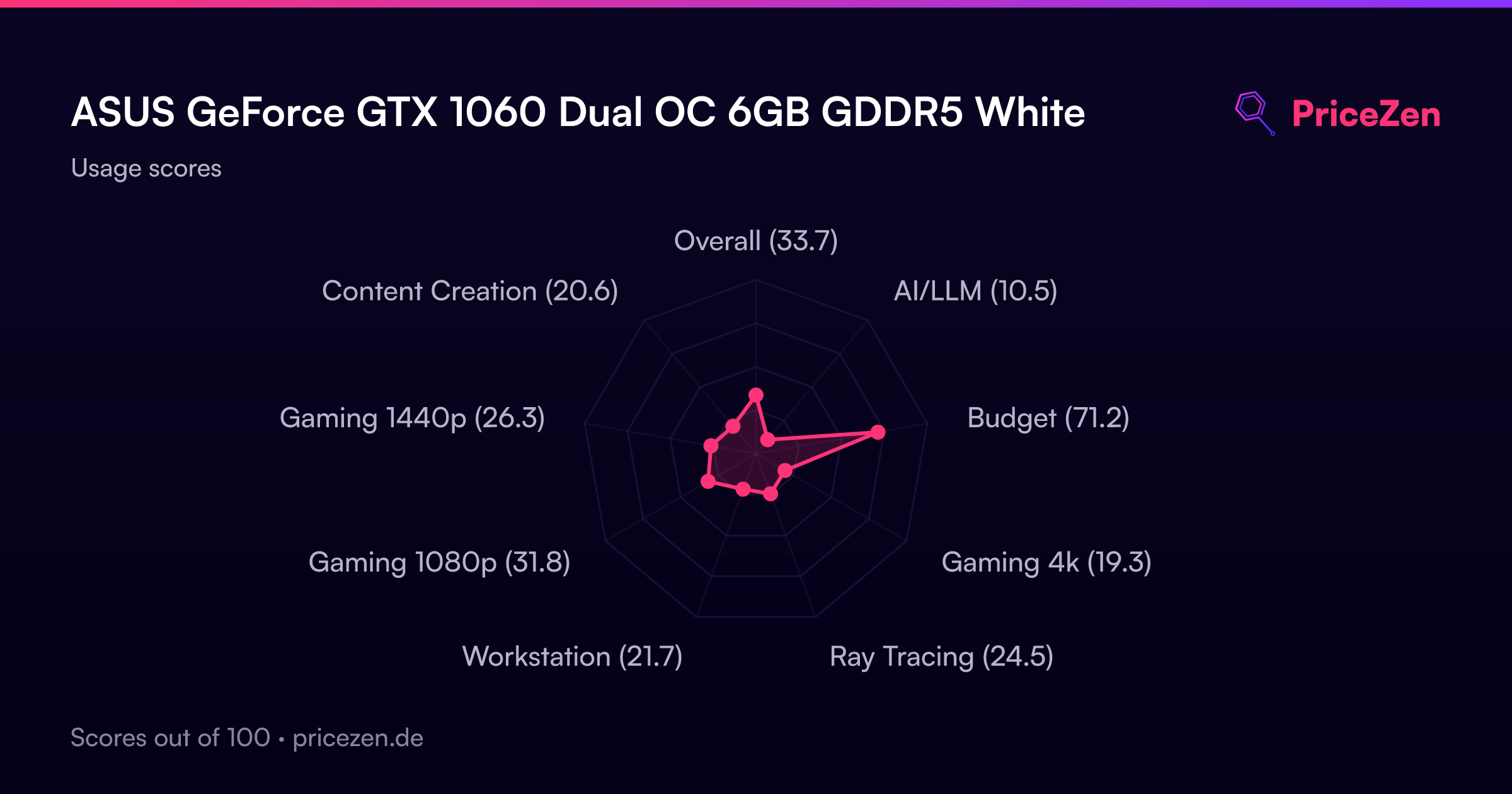
Usage Scores
- Overall33.7
- AI/LLM10.5
- Budget71.2
- Gaming 4k19.3
- Ray Tracing24.5
- Workstation21.7
- Gaming 1080p31.8
- Gaming 1440p26.3
- Content Creation20.6