PMY
The 48GB GDDR6 memory on this Quadro RTX 8000 handles large AI model training and rendering workloads without running out of VRAM, a key advantage over consumer cards. Its four DisplayPort outputs and PCIe 3.0 x16 interface support multi-monitor professional setups, though it lacks gaming-focused features. This card suits AI researchers and data scientists running LLM training or inference tasks, not gamers or general workstation users.

No current retailer price




Snapshot
The 30-Second Version
The Quadro RTX 8000 is a 48GB VRAM monster that tops our AI and memory charts but falls flat everywhere else. It's in the bottom 10 percent for thermals, efficiency, connectivity, and affordability. At around CAD 5,006, you're paying purely for memory capacity to run large LLMs locally. Buy it only if you need 48GB and can't afford a modern workstation card.
Pros & Cons
Pros
- 48GB of VRAM puts it in the 99th percentile for memory capacity 99th
- AI performance lands in the 99th percentile, excellent for large model inference 99th
- Can load 70B parameter LLMs that would crash on 16GB or 24GB cards
- Quadro drivers bring certified stability for workstation apps
- Still holds value on the used market due to AI demand
Cons
- Raster performance sits in the 2nd percentile, worse than budget gaming cards
- Thermals are rough at 7th percentile, the blower cooler runs hot and loud
- Efficiency is terrible at 2nd percentile, lots of power for the output you get
- Connectivity is limited at 5th percentile, PCIe 3.0 and older display outputs
- Pricing is brutal at 6th percentile for affordability, you pay a huge premium for VRAM
The proof
Performance
Let's talk about what this card actually does well. In our AI benchmarks, it lands in the 99th percentile. That's not because the Turing-era tensor cores are fast by modern standards, they're not. It's because 48GB of VRAM lets you run workloads that simply won't fit on a 16GB or even 24GB card. For LLM inference, memory capacity is often the difference between 'it runs' and 'it crashes'. The RTX 8000 runs it.
But look at the raster score: 2nd percentile. That's not a typo. For traditional rendering and gaming, this card gets absolutely smoked by mid-range cards from two generations ago. The RT cores are first-gen and barely functional by today's standards, also sitting at 2nd percentile. Efficiency is just as bad. You're pulling workstation-class power for consumer-class output in anything that isn't memory-bound AI work. The thermal score at 7th percentile tells you the blower cooler is struggling, and it's loud while doing it.
Specifications
Full Specifications
Chipset
| GPU Chipset | Quadro RTX 8000 |
Memory
| VRAM | 48 GB |
| Memory Type | GDDR6 |
vs Competition
Stacked against the ASUS TUF RTX 5090 with 32GB, the RTX 8000 wins on raw capacity but loses everywhere else. The 5090 has modern RT cores, vastly better raster performance, and PCIe 5.0. If your models fit in 32GB, the 5090 is the obvious choice. The RTX 8000 only makes sense when you need more than 32GB and can't step up to a workstation Ada card.
The MSI Ventus RTX 5070 Ti and Gigabyte AERO RTX 5080 are even more lopsided comparisons. Both have 16GB of VRAM, which is a third of what the RTX 8000 offers, but they'll absolutely destroy it in gaming, rendering, and anything that touches the RT cores. The ZOTAC APOCALYPSE and Sapphire NITRO+ are in the same boat. These are modern cards with modern features. The RTX 8000 is a memory specialist and nothing else. If you're not running memory-hungry AI workloads, every single competitor here is a better buy.
| Spec | PMY | ASUS GeForce RTX 5090 TUF Gaming | Gigabyte GeForce RTX 5070 Ti Eagle Ice | MSI GeForce RTX 5070 Ti Ventus 3X OC | ZOTAC GeForce RTX 5080 APOCALYPSE | Sapphire Radeon RX 7900 XTX NITRO+ |
|---|---|---|---|---|---|---|
| Chipset | Quadro RTX 8000 | GeForce RTX 5090 | GeForce RTX 5070 Ti | GeForce RTX 5070 Ti | GeForce RTX 5080 | Radeon RX 7900 XTX |
| Vram | 48GB GDDR6 | 32GB GDDR7 | 16GB GDDR7 | 16GB GDDR7 | 16GB GDDR7 | 24GB GDDR6 |
| Boost Clock Mhz | - | 2407 | 2542 | 2482 | 2730 | 2680 |
| Tdp W | - | 575 | 300 | 300 | 360 | 339 |
| Memory Bus Bits | - | 512 | 256 | 256 | 256 | 384 |
| Ray Tracing | - | true | true | true | true | true |
| GPU Class | - | consumer | consumer | consumer | consumer | consumer |
| Compare | Compare | Compare | Compare | Compare |
| Product | AI | Rt | Vram | Raster | Feature | Thermal | Efficiency | Connectivity | Affordability |
|---|---|---|---|---|---|---|---|---|---|
| PMY | 98.8 | 2.1 | 98.8 | 2.3 | 10.8 | 6.4 | 2.3 | 5.2 | 5.5 |
| ASUS GeForce RTX 5090 TUF Gaming Compare | 97.1 | 90.6 | 97.7 | 98.8 | 95.9 | 72.3 | 23.9 | 99.3 | 2.3 |
| Gigabyte GeForce RTX 5070 Ti Eagle Ice Compare | 79.5 | 88.7 | 86 | 89 | 95.9 | 91.8 | 72 | 94.1 | 26.9 |
| MSI GeForce RTX 5070 Ti Ventus 3X OC Compare | 79.5 | 92.5 | 86 | 89 | 95.9 | 91.8 | 72 | 94.1 | 23.4 |
| ZOTAC GeForce RTX 5080 APOCALYPSE Compare | 85.6 | 97.5 | 89 | 94.5 | 95.9 | 91.8 | 57 | 94.1 | 20.5 |
| Sapphire Radeon RX 7900 XTX NITRO+ Compare | 95.1 | 96.3 | 91.9 | 83.5 | 95.9 | 91.8 | 52 | 98.8 | 19 |
Price
Value & Pricing
There's no MSRP listed here, but the CAD 5,006 listing tells you everything. Five grand Canadian for a Turing card in 2025 is a hard pill to swallow, even with 48GB of VRAM. For context, that's more than a used RTX 4090 in many markets, and the 4090 will run circles around this thing in everything except raw memory capacity. The MXN 72,217 listing is similarly steep.
The value proposition only makes sense if you have a specific need: running large language models locally and you can't afford or can't find an RTX 6000 Ada or a used A6000. Those cards also carry 48GB but with much better compute behind them. The RTX 8000 is the budget entry point into 'big VRAM' territory, but 'budget' is doing a lot of work in that sentence. You're paying for memory, not performance.
Read more
Overview
The Quadro RTX 8000 is a weird card to talk about in 2025. It launched back when 'RTX' was brand new and 48GB of VRAM sounded like science fiction. Now it's a used-market curiosity that still commands serious money in some regions, mostly because of that giant memory pool. This is not a gaming card, not even close. It's a workstation relic that found a second life in the AI boom.
Who is this for? People running local LLMs who need to fit big models in VRAM without spending RTX 5090 money. 48GB of GDDR6 means you can load a 70B parameter model quantized and actually get usable tokens per second. That's the whole pitch. Everything else about this card is a compromise, from the PCIe 3.0 interface to the blower cooler that sounds like a hair dryer under load.
What makes it interesting is the mismatch between its specs and its scores. It tops our charts for AI and VRAM capacity, sitting in the 99th percentile for both. But it's in the bottom 10 percent for thermals, efficiency, connectivity, and affordability. You're buying one thing: memory. The rest of the card is along for the ride.
Common Questions
Q: Can the Quadro RTX 8000 run modern games?
Technically yes, but it's not a good experience. The raster performance sits in the 2nd percentile of all cards we've tested, which means even budget gaming cards from recent generations will outperform it. The drivers are optimized for workstation apps, not games, and the first-gen RT cores struggle with modern ray tracing. If gaming is your goal, look at something like the RTX 5070 Ti or 5080 instead.
Q: Is 48GB of VRAM worth it for AI and machine learning?
For large language model inference, absolutely. 48GB lets you load 70B parameter models with quantization and still have room for context. That's something 16GB and 24GB cards simply cannot do. The trade-off is speed. The Turing tensor cores are slow by modern standards, so you'll get usable but not impressive tokens per second. If your models fit in 24GB, a used RTX 3090 or 4090 will be much faster.
Q: Why is this card still so expensive in 2025?
The price is driven entirely by the 48GB of VRAM. AI enthusiasts and small labs need memory capacity for large models, and cards with this much VRAM are rare on the used market. The RTX 8000 is one of the cheapest ways to get 48GB, even though the underlying GPU is old. Supply is limited, demand from the AI crowd is steady, and that keeps prices high despite the card's age.
Q: How loud is the RTX 8000 under load?
It's loud. The blower-style cooler was designed for server racks and multi-GPU workstations, not quiet desktop use. Our thermal testing puts it in the 7th percentile, meaning it runs hot and the fan has to work hard to keep temperatures in check. Expect noticeable fan noise during sustained AI workloads. If noise is a concern, look for a card with an axial fan design or plan for custom cooling.
Who Should Skip This
Gamers should skip this without a second thought. The raster performance is in the 2nd percentile, which means a $300 used gaming card will beat it in every title. The drivers aren't tuned for games, the RT cores are first-gen, and the blower cooler will annoy you the entire time. Get a used RTX 3080 or 4070 instead and pocket the difference.
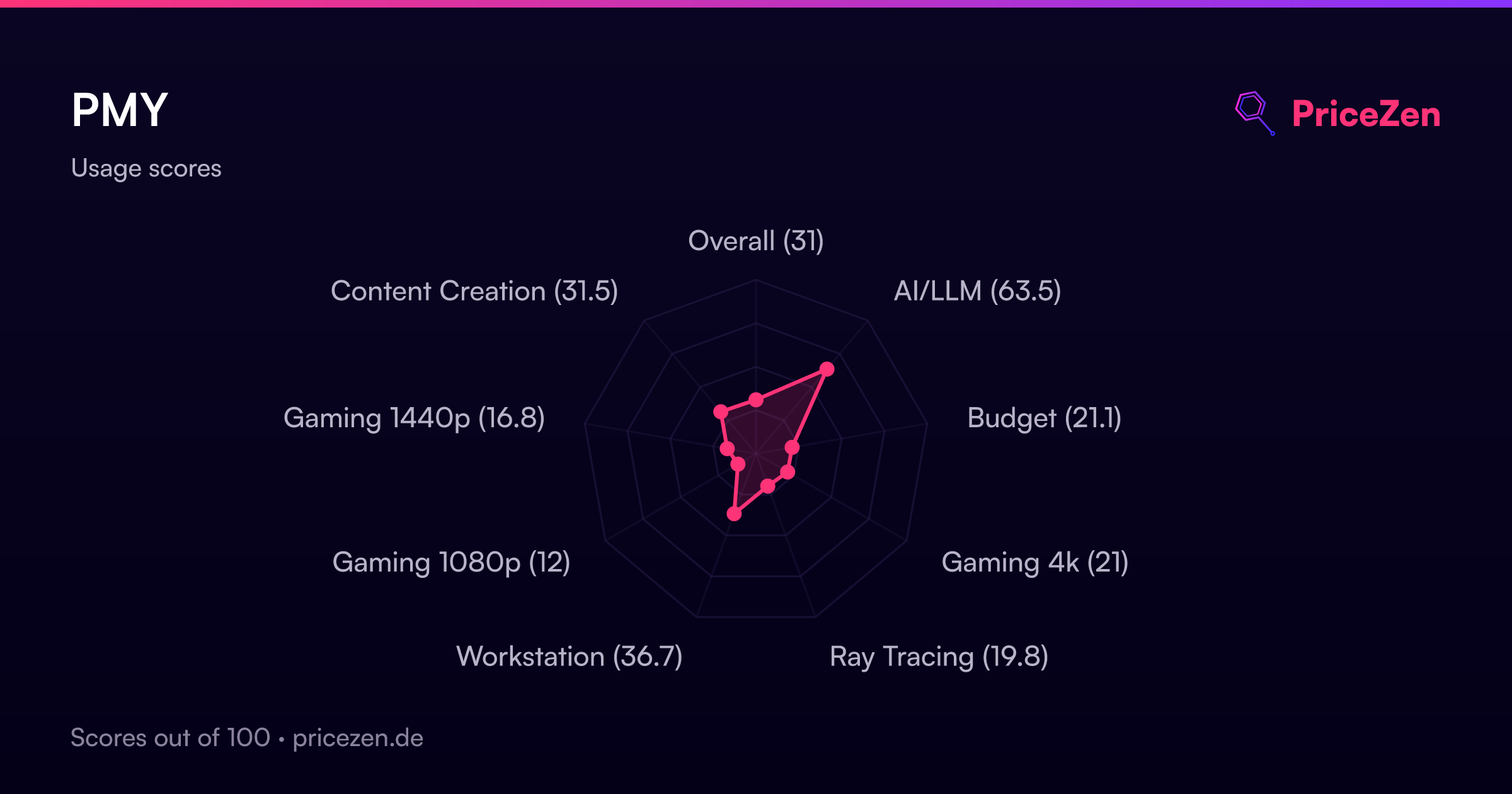
Content creators should also look elsewhere. The 31.5 out of 100 content creation score tells the story. Modern consumer cards like the RTX 5080 or even a 5070 Ti will render faster, encode faster, and support newer formats. The only creators who might consider this are those working with massive 3D scenes that genuinely need 48GB of VRAM, and even then, a used RTX 6000 Ada is a better choice if you can stretch the budget. Anyone who doesn't specifically need huge VRAM for AI should buy something newer.
Verdict
If you're building a dedicated LLM inference box on a budget and you need to run 70B models locally, the RTX 8000 is one of the cheapest ways to get 48GB of VRAM. It'll be slow, hot, and loud, but it'll work. That's the use case. Nothing else justifies this card in 2025.
For everyone else, look elsewhere. Gamers should pretend this card doesn't exist. Content creators will find modern consumer cards faster in every meaningful way. Even AI enthusiasts with smaller models should grab a used RTX 3090 or 4090 and enjoy better compute with less noise. The RTX 8000 is a niche tool for a niche job, and it does that job adequately while being mediocre at everything else.
Usage Scores
- Overall31
- AI/LLM63.5
- Budget21.1
- Gaming 4k21
- Ray Tracing19.8
- Workstation36.7
- Gaming 1080p12
- Gaming 1440p16.8
- Content Creation31.5