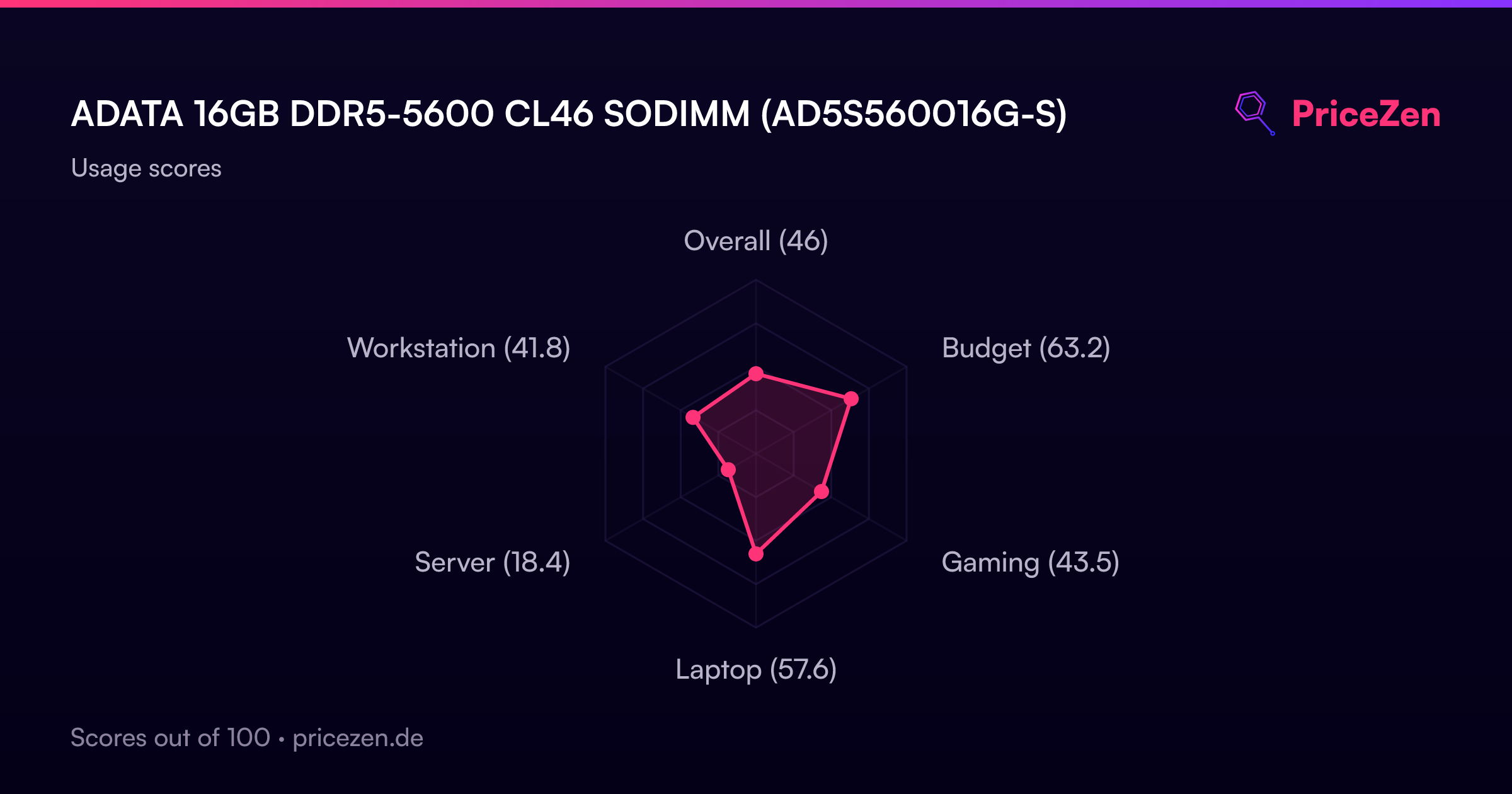
ADATA 16GB DDR5-5600 CL46 SODIMM (AD5S560016G-S)
Delivers 5600 MT/s bandwidth with on-die ECC for real-time error correction, a feature rarely found in standard laptop memory. The onboard power management IC ensures stable 1.1V operation for lower power consumption and straightforward, tool-free installation. This module is best for laptop and mini PC users upgrading from DDR4 who need reliable, single-rank capacity for general multitasking and productivity.

No current retailer price









Snapshot
The 30-Second Version
The ADATA AD5S560016G-S is a 16GB DDR5 SODIMM running at 5600 MT/s with a low 1.1V power draw, making it a solid drop-in upgrade for laptops and mini PCs. The CL46 latency is mediocre, but you won't notice it in everyday use. Most buyers report it works reliably and passes memory tests, though one stick failed after four months and prices have crept up recently. If you need more laptop RAM and find it at a fair price, it's a safe bet.
Pros & Cons
Pros
- Strong 5600 MT/s speed for a laptop SODIMM 78th
- Low 1.1V power draw helps battery life
- Works well in mini PCs and laptops per user reports
- Passes MEMTEST86+ reliably for most buyers
- Simple drop-in upgrade with no compatibility fuss
Cons
- CL46 latency is mediocre, 22nd percentile
- One verified failure after 4 months with kernel issues
- Price has crept up since November per buyers
- No heat spreader or any premium features
- Single 16GB stick means you need two for dual-channel
What owners think
The Word on the Street
How owner sentiment changed over time
ExclusiveBased on when customers actually wrote their reviews - so you can see whether early praise held up.
11 written reviews, Dec 2024 – Mar 2026: 9 happy, 1 mixed, 1 unhappy
Across all 66 store ratings: 4.3★. Most owners rate without writing a review. The chart counts the 11 written reviews.
- Jul – Sep 20253 of 3 happy
All three reviews report the SSD works well in mini PCs, with one noting 24x7 use for months. Delivery was quick.
- Works well in mini PCs, including Chinese N100 boxes.
- Reliable for 24x7 operation over months.
- Quick delivery and product satisfaction.
- Apr – Jun 20252 of 3 happy
Buyers report the product works as advertised and passes memory tests, but delivery can be slow and lacks tracking.
- Product functions as advertised and passes MEMTEST86+.
- Delivery took about 10 days with no tracking available.
- Shipping was faster than estimated for some buyers.
Each dot is one written review, in the month it was written. Happy = 4-5★, mixed = 3★, unhappy = 1-2★. Period summaries are in English.
The proof
Performance
At 5600 MT/s, this stick lands in the 78th percentile for speed across all memory products in our database. That's genuinely strong for a SODIMM, especially one without any overclocking pretensions. For real-world use, that means snappier multitasking, faster file operations, and better performance in memory-hungry apps compared to the 4800 MT/s DDR5 or older DDR4 sticks many laptops still ship with. If you're coming from a single-channel 8GB setup, adding this as a second stick to enable dual-channel will feel like a new machine.
The CL46 latency is the trade-off. That's a 22nd percentile result, which is mediocre by modern standards. In practice, you won't notice it in day-to-day tasks, but memory-sensitive workloads like large database operations or heavy compilation will leave a little performance on the table compared to tighter CL32 or CL34 kits. For a laptop part at this price point, it's an acceptable compromise. The 1.1V operating voltage also means less heat and better battery life, which is a real plus for thin-and-light machines.
Specifications
Full Specifications
Memory
| Type | DDR5 |
| Form Factor | SODIMM |
| Total Capacity | 16384 |
| Modules | 1 |
| Per Module | 16384 |
| Pins | 262 |
Performance
| Speed | 5600 |
| CAS Latency | 46 |
| Voltage | 1.1 |
Class
| ECC | Yes |
| Registered | No |
vs Competition
Against the G.Skill Trident Z5 Royal Neo and Kingston Fury Renegade kits, this ADATA stick looks pretty plain. Those are desktop-oriented kits with heat spreaders, RGB, and much tighter timings, but they're also not SODIMMs, so they're not really competing for the same slot. The Corsair Vengeance RGB and Crucial Pro Overclocking kits are similarly desktop parts. If you're building a desktop, skip this ADATA entirely and look at those instead.
The real competition for this stick is other laptop SODIMMs, and there the field is thinner. Crucial's standard DDR5 SODIMMs are the most direct rival, often priced similarly but with slightly better brand recognition and warranty support. KLEVV's CRAS V is another option if you want something with a bit more flair, though it's harder to find. For most laptop upgraders, the choice comes down to price and availability, and ADATA is competitive on both fronts, even if the brand doesn't carry the same weight as Crucial or Kingston.
| Spec | ADATA 16GB DDR5 SODIMM | Kingston FURY Beast | G.Skill Trident Z5 Royal | Corsair VENGEANCE RGB | Team Group T-CREATE EXPERT | XPG Lancer Blade RGB |
|---|---|---|---|---|---|---|
| Capacity | 16GB | 64GB | 64GB | 64GB | 32GB | 32GB |
| Kit | 1 x 16GB | 2 x 32GB | 2 x 32GB | 2 x 32GB | 2 x 16GB | 2 x 16GB |
| Memory Type | DDR5 | DDR5 | DDR5 | DDR5 | DDR5 | DDR5 |
| Speed Mts | 5600 | 6400 | 6000 | 6400 | 6400 | 6000 |
| Cas Latency | CL46 | CL32 | CL26 | CL32 | CL32 | CL30 |
| Form Factor | SODIMM | UDIMM | UDIMM | UDIMM | UDIMM | UDIMM |
| Ecc | Yes | No | No | No | No | No |
| Compare | Compare | Compare | Compare | Compare |
| Product | Speed | Feature | Latency | Capacity | User Sentiment | Social Proof | Affordability |
|---|---|---|---|---|---|---|---|
| ADATA 16GB DDR5 SODIMM | 77.5 | 18 | 22.3 | 44.8 | 38.5 | 54 | 41 |
| Kingston FURY Beast Compare | 94.8 | 89.6 | 87.6 | 89.5 | 90.1 | 96.4 | 8.2 |
| G.Skill Trident Z5 Royal Compare | 87.6 | 89.6 | 99 | 89.5 | 90.1 | 58.4 | 3.8 |
| Corsair VENGEANCE RGB Compare | 94.8 | 89.6 | 87.6 | 89.5 | 97.5 | 96.4 | 6.5 |
| Team Group T-CREATE EXPERT Compare | 94.8 | 74.8 | 87.6 | 70.5 | 90.1 | 87.3 | 22.8 |
| XPG Lancer Blade RGB Compare | 87.6 | 89.6 | 87.6 | 70.5 | 0 | 96.4 | 15.8 |
Price
Value & Pricing
Pricing is a bit scattered across regions. We see it listed at $288 USD, 60,980 JPY, and 5,989 MXN, which makes direct comparisons tricky since those currencies don't line up neatly. What we can say is that the affordability score sits at the 40th percentile, so it's not a screaming deal, but it's not highway robbery either. For a 16GB DDR5 SODIMM at 5600 MT/s, you're paying a small premium for the speed bump over 4800 MT/s alternatives.
The value story gets murkier when you factor in the user sentiment score of 37th percentile. Most buyers are happy with what they got, but a few complaints about price increases tied to shortage news suggest you might be paying more than you should right now. If you can find this stick at a price close to what it sold for before the recent bumps, it's a solid buy. If not, you might want to wait or shop around.
Read more
Overview
The ADATA AD5S560016G-S is a single 16GB stick of DDR5 SODIMM memory aimed squarely at laptop and mini PC owners who need a straightforward capacity bump. It runs at 5600 MT/s, which puts it in the upper-middle tier for laptop RAM speed right now, and it's the kind of part you buy when your machine shipped with 8GB and you're tired of watching it choke on browser tabs. No heat spreaders, no RGB, no overclocking theatrics. Just a green PCB doing its job.
What makes this stick interesting is the timing. DDR5 SODIMMs at 5600 MT/s are becoming the default for newer Intel and AMD mobile platforms, so this is a safe, boring upgrade that should just work in most recent laptops. The CL46 latency is nothing to write home about, but for a laptop part, stability and compatibility matter more than shaving a few nanoseconds off your memory access. And at 1.1V, it sips power, which matters when you're running off a battery.
Who's this for? Someone with a laptop or mini PC that has a free SODIMM slot and needs more headroom for multitasking, light content work, or running virtual machines. It's not for desktop builders, and it's not for anyone chasing benchmark leaderboards. It's a utility upgrade, and there's nothing wrong with that.
Common Questions
Q: Will this work in my laptop?
If your laptop has a DDR5 SODIMM slot and supports 5600 MT/s or can downclock to a lower speed, this should work. It's compatible with both AMD and Intel platforms per the manufacturer, and most recent laptops with DDR5 support will accept it without issue. Check your laptop's spec sheet to confirm it uses DDR5 SODIMMs and not soldered memory or DDR4.
Q: Should I buy one 16GB stick or two for dual-channel?
If your laptop has two SODIMM slots and you can afford it, two sticks in dual-channel will give you noticeably better performance, especially for integrated graphics. A single 16GB stick will work fine, but you'll leave some bandwidth on the table. If you're upgrading from a single 8GB stick, adding one 16GB stick for 24GB total is a decent middle ground, though mixing capacities can sometimes disable dual-channel for the mismatched portion.
Q: Is the CL46 latency going to hurt performance?
For everyday tasks like web browsing, office work, and media playback, you won't notice the CL46 latency at all. It only becomes relevant in memory-sensitive workloads like heavy compilation, large database operations, or some scientific computing. Even then, the impact is modest. The 5600 MT/s speed matters more for most users than the latency rating.
Q: Does this RAM have error correction (ECC)?
No, this is a standard unbuffered non-ECC SODIMM. The 'automatic error correction' mentioned in the retailer notes refers to on-die ECC, which is a standard feature of all DDR5 memory and helps with internal data integrity, but it's not the same as full ECC memory used in servers and workstations. If you need true ECC, you'll need to look at server-grade SODIMMs, which are rare and expensive.
Who Should Skip This
If you're building or upgrading a desktop, skip this entirely. It's a SODIMM, so it physically won't fit in a standard desktop motherboard. Look at full-size DDR5 DIMMs from G.Skill, Kingston, or Corsair instead, where you'll get better timings, heat spreaders, and often better pricing per gigabyte. The desktop kits in our comparison data all offer tighter latencies and more features for similar or better value.
Also skip this if you're running a laptop with soldered memory, which is increasingly common in ultrabooks and MacBooks. No SODIMM will help you there. And if you're doing serious memory-intensive work on a laptop and want every last bit of performance, hunt for a kit with CL32 or CL34 timings instead. The CL46 on this stick is fine for general use, but it's not the right tool for heavy compilation or large dataset work.
Verdict
If you've got a laptop or mini PC with a free SODIMM slot and you're running low on RAM, this ADATA stick is a perfectly fine choice. The 5600 MT/s speed is a genuine step up from older DDR4 or entry-level DDR5, and the low voltage means your battery won't take a hit. Most users report it just works, which is exactly what you want from a memory upgrade. The CL46 latency is a non-issue for everyday use, and the lack of a heat spreader is fine for a laptop part that won't be pushed hard.
For anyone doing serious memory-intensive work on a laptop, like video editing or large code compiles, you might want to hunt down a kit with tighter timings, though your options in SODIMM form are limited. And if you're on a desktop, this isn't your product at all. But for the average person who just wants their laptop to stop swapping to disk every time they open a few tabs, this stick does the job without drama.
Usage Scores
- Overall46
- Budget63.2
- Gaming43.5
- Laptop57.6
- Server18.4
- Workstation41.8