HP 16GB DDR5-4800 (340K1AA)
The 16GB DDR5-4800 registered ECC module with XMP 3.0 support targets workstation stability, not raw speed, making it a dependable choice for memory-intensive tasks. Its single-stick 16GB capacity and 288-pin DIMM form factor simplify upgrades in compatible workstation boards, while the registered design adds error correction for data integrity. This module suits workstation builders running ECC-capable platforms who prioritize reliability over overclocking headroom.

No current retailer price
Where we saw it before. Check the store for today's price.











Snapshot
The 30-Second Version
HP's 340K1AA is a 16GB DDR5 ECC registered DIMM built for workstations and servers. It's got a top-tier feature set with ECC, registered support, and XMP 3.0, but the latency is weak and the pricing is wildly inconsistent, with one US listing at $2,130. If you need HP-validated memory for an HP workstation, it works. Otherwise, Crucial or Kingston ECC kits offer better value.
Pros & Cons
Pros
- ECC and registered design catches memory errors before they corrupt your work 100th
- 100th percentile feature set with XMP 3.0 support 68th
- 4800 MT/s is solid for an ECC module
- HP branding means it's validated for HP workstation boards
- One-year HP warranty included
Cons
- Latency is a weak spot at the 13th percentile
- Single 16GB stick leaves dual-channel performance on the table
- Pricing is all over the map, with one US listing at $2,130
- Social proof is thin, only 4 reviews in our database
- No heat spreader, which is fine for servers but looks bare in a workstation
The proof
Performance
The 4800 MT/s speed puts this module at the 68th percentile in our database. That's solid, middle of the pack territory for DDR5. It's not going to blow the doors off a 6000 MT/s enthusiast kit, but for ECC registered memory, 4800 is a perfectly reasonable speed. The latency sits at the 13th percentile, which is a weak spot. ECC and registered memory always carries a latency penalty compared to unbuffered consumer sticks, and this module shows that. For workstation workloads that lean on bandwidth more than latency, it's not a dealbreaker. For latency-sensitive tasks, you'll feel it.
The feature set is where this thing shines. It's at the 100th percentile for features, which makes sense. ECC, registered, XMP 3.0, 288-pin DIMM, this is a fully loaded enterprise-class module. The capacity is average at 16GB, landing at the 45th percentile. For a single stick, that's fine, but modern workstations often want 32GB or 64GB total. You'll need multiple sticks to get there, and that's where the price starts to sting.
Specifications
Full Specifications
Memory
| Type | DDR5 |
| Form Factor | DIMM |
| Total Capacity | 16384 |
| Modules | 1 |
| Per Module | 16384 |
| Pins | 288 |
Performance
| Speed | 4800 |
Class
| ECC | Yes |
| Registered | Yes |
| OC Profile | Intel XMP 3.0 |
vs Competition
The G.Skill Trident Z5 Royal Neo RGB and the Kingston Fury Renegade are both faster kits, running at 6000 MT/s and up, but they're unbuffered consumer memory. No ECC, no registered support. If you're building a gaming rig or a content creation box that doesn't need error correction, those are better picks. They're faster and cheaper per gigabyte. The Corsair Vengeance RGB kit is in the same boat, flashy and fast but not built for server duty.
The Crucial Pro Overclocking kit is the closest competitor in spirit. Crucial makes solid ECC memory and their pricing tends to be more reasonable than HP's. The ADATA Lancer Blade RGB is another consumer-oriented option that doesn't compete directly. If you need ECC registered DDR5 specifically, your real choices are HP, Crucial, Kingston's server lines, and a few others. Among those, HP's module is fine but you're paying for the badge.
| Spec | HP 16GB DDR5 | Kingston FURY Beast | G.Skill Trident Z5 Royal | Corsair VENGEANCE RGB | Team Group T-CREATE EXPERT | XPG Lancer Blade RGB |
|---|---|---|---|---|---|---|
| Capacity | 16GB | 64GB | 64GB | 64GB | 32GB | 32GB |
| Kit | 1 x 16GB | 2 x 32GB | 2 x 32GB | 2 x 32GB | 2 x 16GB | 2 x 16GB |
| Memory Type | DDR5 | DDR5 | DDR5 | DDR5 | DDR5 | DDR5 |
| Speed Mts | 4800 | 6400 | 6000 | 6400 | 6400 | 6000 |
| Cas Latency | - | CL32 | CL26 | CL32 | CL32 | CL30 |
| Form Factor | DIMM | UDIMM | UDIMM | UDIMM | UDIMM | UDIMM |
| Ecc | Yes | No | No | No | No | No |
| Compare | Compare | Compare | Compare | Compare |
| Product | Speed | Feature | Latency | Capacity | Affordability |
|---|---|---|---|---|---|
| HP 16GB DDR5 | 67.7 | 99.6 | 12.9 | 44.8 | 12.7 |
| Kingston FURY Beast Compare | 94.8 | 89.5 | 87.6 | 89.5 | 7.7 |
| G.Skill Trident Z5 Royal Compare | 87.6 | 89.5 | 99 | 89.5 | 3.9 |
| Corsair VENGEANCE RGB Compare | 94.8 | 89.5 | 87.6 | 89.5 | 6.7 |
| Team Group T-CREATE EXPERT Compare | 94.8 | 74.8 | 87.6 | 70.5 | 23.5 |
| XPG Lancer Blade RGB Compare | 87.6 | 89.5 | 87.6 | 70.5 | 16.2 |
Price
Value & Pricing
Here's where things get weird. The pricing data we have is scattered across currencies and wildly inconsistent. One US listing shows $2,130, which is absurd for a single 16GB stick of DDR5, even ECC registered. A French listing shows EUR 349, which is still expensive but at least in the realm of sanity for enterprise memory. The Canadian listing at CAD 4,258 and the Japanese listing at JPY 466,538 are similarly hard to make sense of. Different markets, different distributors, different markups.
What we can say is that the affordability percentile is 11th, which means this module is priced near the bottom of the value scale compared to other memory in our database. You're paying a premium for the HP name and the enterprise validation. If you're buying this for an HP workstation under a corporate budget, that's fine. If you're a home user just looking for ECC DDR5, there are cheaper options from Crucial or Kingston that will do the same job.
We started tracking prices for this product on Jun 15, 2026. The chart appears once we have more data.
Read more
Overview
HP's 340K1AA is a 16GB stick of DDR5 ECC Registered memory aimed squarely at workstations and servers. This isn't the flashy RGB kit you'd toss into a gaming rig. It's the kind of module that lives inside a machine doing real work, rendering, simulation, virtualization, that sort of thing. The ECC and Registered bits matter here because they mean the memory can catch and correct single-bit errors on the fly, which is a big deal when a flipped bit means a corrupted dataset or a crashed render that's been running for six hours.
The spec sheet is straightforward. You get 16GB on a single 288-pin DIMM running at 4800 MT/s with Intel XMP 3.0 support. That's a single stick, so you're leaving dual-channel performance on the table unless you buy a second one. For a workstation build, that's worth keeping in mind. One stick is fine for getting started, but you'll want a matched pair to get the most out of your memory bandwidth.
Who is this for? Someone building or upgrading an HP workstation, or any system that needs registered ECC DDR5. If you're running a Z-series HP box or a comparable server board, this is the kind of part that keeps things stable. It's not exciting, but stability is the whole point. And honestly, for a memory module, boring is a compliment.
Common Questions
Q: Is this memory compatible with standard desktop motherboards?
No. This is registered ECC memory, which requires a motherboard and CPU that support registered DIMMs. Most consumer desktop boards and CPUs, including mainstream Intel Core and AMD Ryzen, do not support registered memory. You'll need a workstation or server platform, like an HP Z-series workstation with a Xeon or Threadripper Pro CPU, to use this module.
Q: Can I mix this with non-ECC or unbuffered memory?
You should not. Mixing ECC registered memory with unbuffered or non-ECC modules will either prevent the system from booting or force the memory controller to run in a degraded mode. If you're adding memory to a workstation, match the exact type, speed, and ideally the same brand and model. For this module, that means another 16GB DDR5-4800 ECC registered DIMM.
Q: Why is this memory so expensive compared to regular DDR5?
ECC registered memory costs more to manufacture because it includes extra chips for error correction and a register buffer that reduces electrical load on the memory controller. Enterprise validation and HP branding add another layer of cost. The pricing in our database is also inconsistent across regions, with some listings showing extreme markups. If you don't need ECC or registered support, standard DDR5 is much cheaper.
Q: Will one stick of this memory run in dual-channel mode?
No. Dual-channel operation requires at least two identical memory modules installed in the correct slots. With a single 16GB stick, you'll run in single-channel mode, which cuts memory bandwidth roughly in half compared to a matched pair. For workstation workloads that depend on memory bandwidth, like simulation or large dataset processing, buy two sticks.
Who Should Skip This
Gamers and mainstream PC builders should look elsewhere. This module is slower than consumer DDR5 kits, has higher latency, and costs dramatically more. A $100 kit of DDR5-6000 from G.Skill or Corsair will run circles around this in games and everyday tasks. You're paying for ECC and registered support that your system can't even use.
Also skip this if you're building a home server or NAS on a budget. There are cheaper ECC options from Crucial and Kingston that offer the same reliability without the HP price premium. Unless your specific HP workstation requires HP-branded memory, or your employer is footing the bill, this module doesn't make financial sense.
Verdict
If you're running an HP workstation and you need ECC registered DDR5, this module will do the job. It's validated for HP boards, it's got the full feature set, and 4800 MT/s is a reasonable speed for this class of memory. Buy two sticks if you can, because single-channel operation will hold back memory bandwidth on any modern platform.
For everyone else, this is a hard sell. The pricing is inconsistent and often outrageous. The latency is mediocre. And there are cheaper ECC options from Crucial and Kingston that offer the same stability without the HP tax. Unless your system specifically requires HP-branded memory, or your IT department insists on it, you can do better elsewhere.
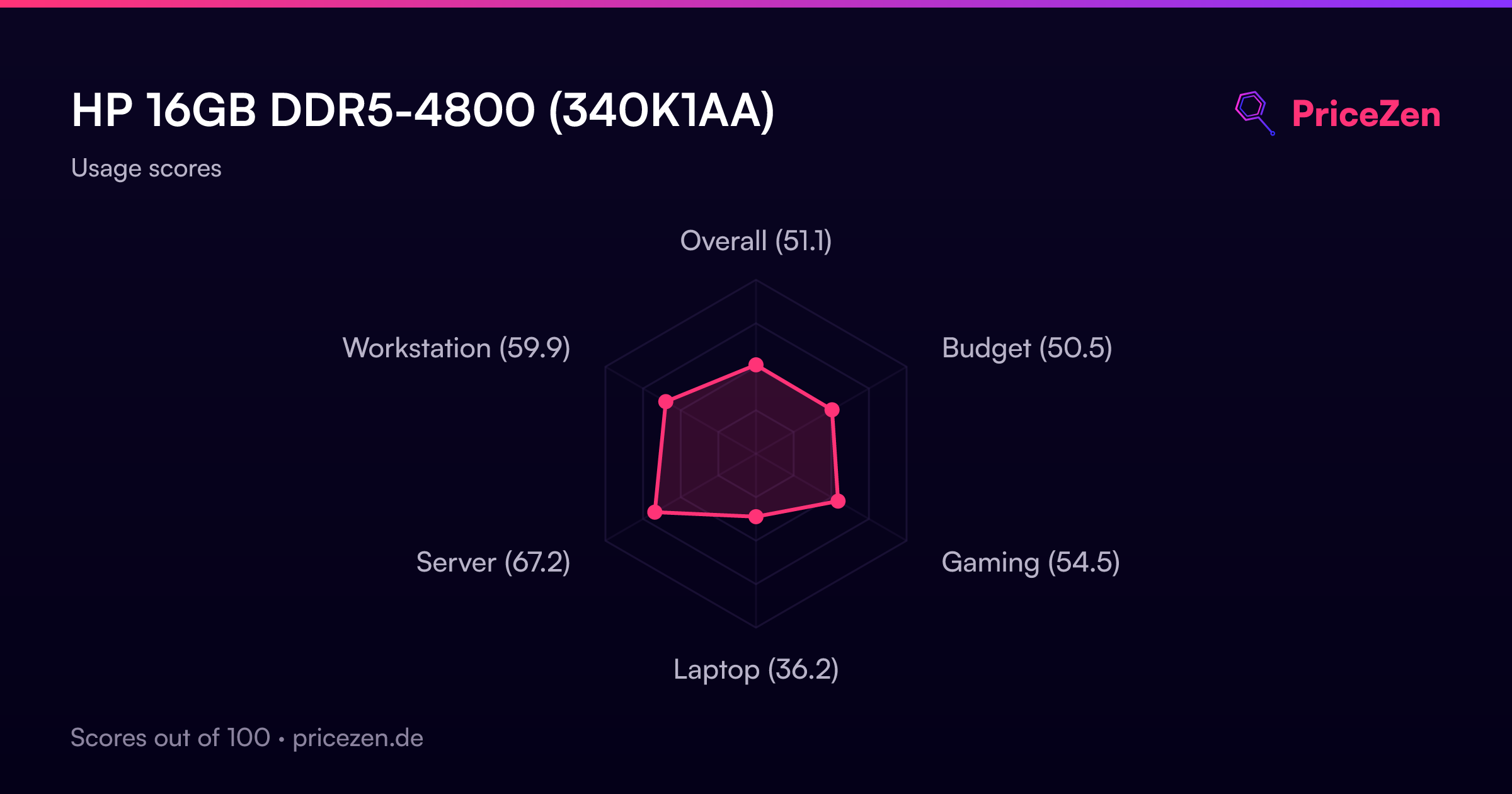
Usage Scores
- Overall51.1
- Budget50.5
- Gaming54.5
- Laptop36.2
- Server67.2
- Workstation59.9