Western Digital SN740 256GB PCIe 4.0 x4 NVMe M.2 2280
The PCIe 4.0 x4 interface delivers up to 5150 MB/s reads and 4000 MB/s writes, with 740K random read IOPS, in a compact M.2 2280 form factor. Its low power draw and 1,750,000-hour MTBF make it a reliable choice for portable devices, though the 256GB capacity limits heavy workloads. Best for budget-conscious buyers needing a fast boot or game drive in a secondary slot, not for large-scale workstation storage.

No current retailer price
Snapshot
The 30-Second Version
The SN740 256GB hits 5150 MB/s reads and lands in the 91st percentile for random performance, which is wild for a $60 drive. But the 256GB capacity is in the 18th percentile and endurance is below average. It's a fast little boot drive for budget builds, not a daily driver.
Pros & Cons
Pros
- Random performance in the 91st percentile, 740K read and 800K write IOPS 91st
- 5150 MB/s sequential reads beat plenty of pricier drives 88th
- 88th percentile affordability at $60 USD 73rd
- Low power draw makes it a good fit for laptops and portables
- WD reliability reputation, even if the endurance numbers are mid
Cons
- 256GB capacity is in the 18th percentile, cramped for modern use
- Endurance in the 32nd percentile, below average for its class
- OEM bulk packaging means no retail warranty support
- Portable score of 8.9 out of 100 is a real weak spot
- Social proof in the 20th percentile, only 4 reviews to go on
The proof
Performance
Let's talk numbers, because this drive has a split personality. Sequential reads hit 5150 MB/s and writes reach 4000 MB/s. That's solidly above average for PCIe 4.0 drives, landing in the 73rd percentile for speed. But the real surprise is random performance: 740K read IOPS and 800K write IOPS put this thing in the 91st percentile. That's one of the best random access results we've seen at this price point, which means snappy boot times and quick app launches, even if big file transfers aren't class-leading.
Where it stumbles is endurance. The 1,750,000 hour MTBF sounds like a big number, but it's in the 32nd percentile, which is mediocre for modern NVMe drives. And the 256GB capacity is a real constraint. You can't outrun physics: fewer NAND chips means less parallel write bandwidth under sustained load. For bursty workloads, this drive punches above its weight. For sustained writes or heavy workstation use, it falls behind.
Specifications
Full Specifications
Drive
| Capacity | 256 |
| Form Factor | M.2 2280 |
| Interface | PCIe 4.0 x4 |
| Protocol | NVMe |
| PCIe Generation | 4 |
| External | No |
Performance
| Sequential Read (MB/s) | 5150 |
| Sequential Write (MB/s) | 4000 |
| Random Read (IOPS) | 740000 |
| Random Write (IOPS) | 800000 |
Reliability
| MTBF (hours) | 1750000 |
Features
| Heatsink | No |
vs Competition
Stacked against the Crucial T500, Samsung 990 EVO, and SK Hynix Platinum P41, the SN740 is the budget option that trades capacity and endurance for random speed. The T500 and P41 both offer significantly higher sequential throughput and better endurance ratings, but they cost more per gig and target a different buyer. The Samsung 990 EVO is the closest competitor in spirit, a mainstream PCIe 4.0 drive with better brand recognition and retail support, but it doesn't match the SN740's random IOPS at this price. The Team Group MP44 and Kingston NV3 are both cheaper per gig at higher capacities, but their random performance doesn't touch the SN740's 91st percentile showing. You're essentially choosing between raw random speed on a tiny drive or more balanced performance with actual storage space.
| Spec | Western Digital SN740 | Samsung 9100 PRO | Kingston FURY Renegade | Crucial T700 | SanDisk WD_BLACK | Seagate FireCuda 530R |
|---|---|---|---|---|---|---|
| Capacity | 256GB | 8TB | 4TB | 2TB | 8TB | 4TB |
| Form Factor | M.2 2280 | M.2 2280 | M.2 2280 | M.2 2280 | M.2 2280 | M.2 2280 |
| Interface | PCIe 4.0 x4 | PCIe 5.0 x4 | PCIe 4.0 x4 | PCIe 5.0 x4 | PCIe 5.0 x4 | PCIe 4.0 x4 |
| Seq Read | 5,150 MB/s | 14,800 MB/s | 7,300 MB/s | 12,400 MB/s | 14,900 MB/s | 7,400 MB/s |
| Nand Type | - | TLC | TLC | TLC | TLC | TLC |
| Dram Cache | - | true | true | true | true | false |
| Endurance | - | 4800 TBW | 4000 TBW | 1200 TBW | 4800 TBW | 5050 TBW |
| Compare | Compare | Compare | Compare | Compare |
| Product | Speed | Random | Feature | Capacity | Endurance | Affordability |
|---|---|---|---|---|---|---|
| Western Digital SN740 | 73.4 | 91.4 | 14.7 | 18.6 | 31.7 | 88.3 |
| Samsung 9100 PRO Compare | 99.2 | 99.8 | 99.8 | 98.1 | 85.6 | 1.9 |
| Kingston FURY Renegade Compare | 93.4 | 94.4 | 94.1 | 92.6 | 93.9 | 11.2 |
| Crucial T700 Compare | 96.7 | 97.6 | 97.6 | 78.8 | 82.5 | 21.7 |
| SanDisk WD_BLACK Compare | 99.1 | 99.3 | 97.6 | 98.1 | 80.3 | 3.1 |
| Seagate FireCuda 530R Compare | 92.9 | 96.8 | 53.2 | 92.6 | 95.6 | 7.5 |
Price
Value & Pricing
At $60 USD, the SN740 256GB sits in the 88th percentile for affordability. That's genuinely cheap for a PCIe 4.0 drive with these random performance numbers. But value isn't just price, it's price per gigabyte. And at roughly 23 cents per gig, you're paying a premium for speed while getting very little storage. For comparison, many 1TB drives in our database land closer to 6 to 8 cents per gig. If you need a fast boot drive for a budget build and already have bulk storage elsewhere, this is a reasonable buy. If this is your only drive, you'll feel the capacity pinch within weeks.
Read more
Overview
The WD SN740 256GB is a weird little drive. On paper, it's got some serious chops: 5150 MB/s sequential reads and 4000 MB/s writes put it in the 73rd percentile for speed, while its random performance lands at the 91st percentile, which is genuinely impressive for a budget-tier OEM part. But then you look at the capacity, 256GB in 2025, and it's in the 18th percentile. That's a tough pill to swallow when games are routinely 100GB plus.
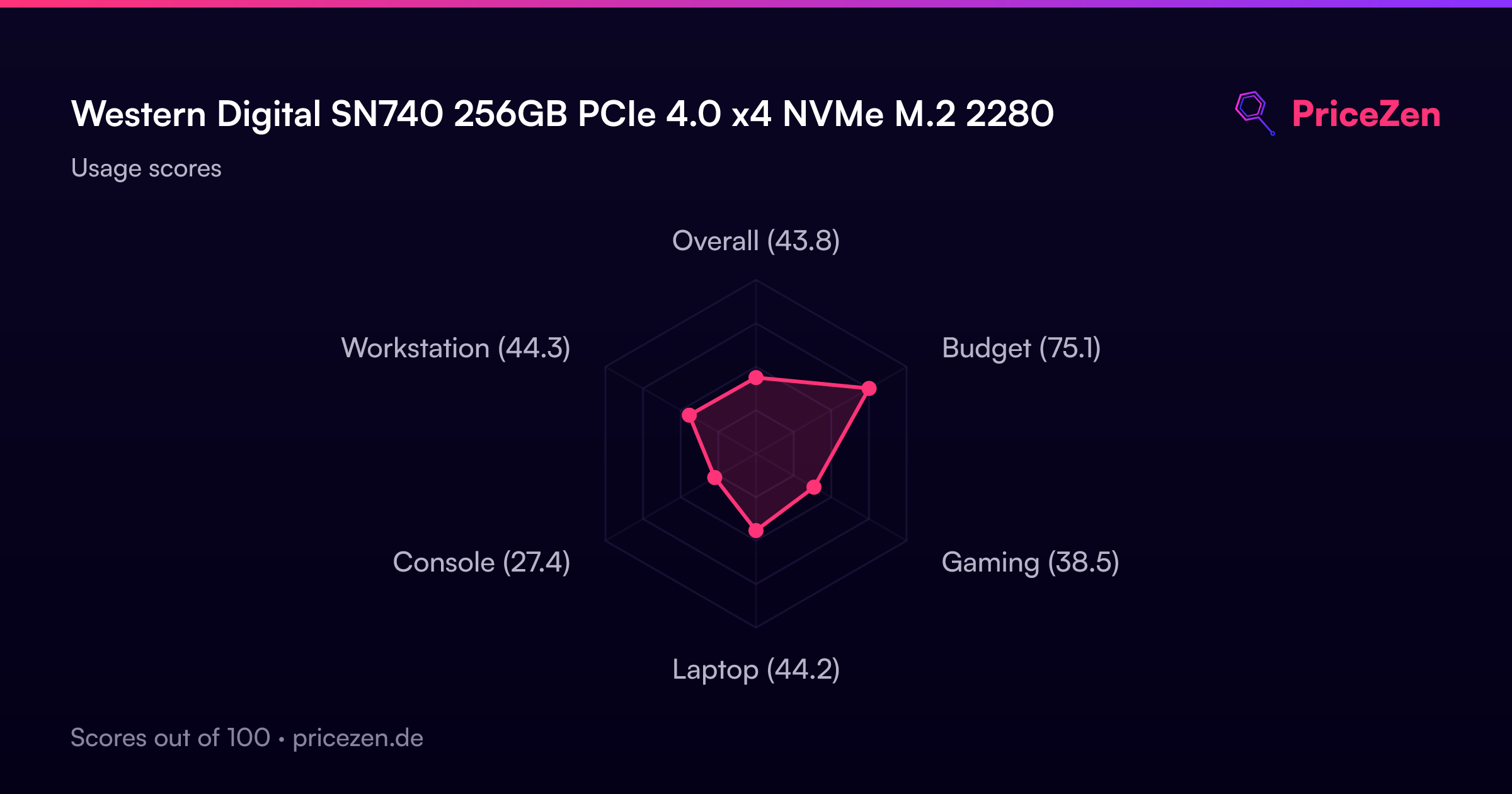
Our database scores it 68.2 for budget builds, which makes sense. The affordability ranking sits at the 88th percentile, and at $60 USD it's cheap enough to toss into an older laptop or a secondary machine. But the workstation score of 40.5 tells the real story: this drive is not built for heavy lifting. The endurance rating of 1,750,000 hours MTBF sounds impressive until you realize it's in the 32nd percentile for its class. You're getting speed on a budget, but you're not getting longevity or space.
Common Questions
Q: Is 256GB enough for a boot drive?
It depends on what you install. The SN740's 256GB capacity is in the 18th percentile for its class, which means it's smaller than the vast majority of modern SSDs. You can fit Windows or Linux plus a handful of apps, but a single large game or a video editing project will eat most of the space. If this is your only drive, you'll run out of room fast.
Q: How does the SN740 compare to other PCIe 4.0 drives?
Its sequential reads of 5150 MB/s and writes of 4000 MB/s put it in the 73rd percentile for speed, which is above average but not class-leading. Where it shines is random performance: 740K read IOPS and 800K write IOPS land in the 91st percentile. That's better than many pricier drives, including some from Samsung and Crucial, at least in bursty workloads.
Q: Is this drive good for a laptop?
The low power draw is a plus for battery life, and the M.2 2280 form factor fits most modern laptops. But our database scores it just 8.9 out of 100 for portable use, which is one of the weakest results we've seen. The small capacity and below-average endurance are the main culprits. If you're upgrading a laptop, a 512GB or 1TB drive with better endurance will serve you longer.
Who Should Skip This
Skip this drive if you need actual storage space or plan to write a lot of data. The 256GB capacity is in the 18th percentile, which means it's smaller than 82% of drives in our database. The endurance rating lands in the 32nd percentile, so heavy write workloads like video editing, large game installs, or running a database will wear it out faster than average. And the portable score of 8.9 out of 100 is a red flag if you're planning to use this in a laptop that travels. If you need a single drive that does everything, this isn't it. Look for a 1TB drive with better endurance, even if it costs a bit more upfront.
Verdict
The WD SN740 256GB is a niche drive that does one thing really well: fast random access on a budget. The 91st percentile random performance and 88th percentile affordability make it a tempting boot drive for a cheap build or an upgrade for an older laptop. But the 18th percentile capacity and 32nd percentile endurance mean it's not a drive we'd recommend for anyone who needs to store more than an OS and a handful of apps. If you've got a specific use case, a tiny fast boot drive paired with bulk storage, this makes sense. For everyone else, spend a bit more and get a 1TB drive with better endurance.
Usage Scores
- Overall42.9
- Budget75.1
- Gaming37.8
- Laptop43.3
- Console27
- Portable10.2
- Workstation43.3