Kingston KC600 256GB SATA III mSATA
The SM2259 controller with TLC NAND and DRAM cache delivers 550 MB/s reads and 500 MB/s writes, plus 90K random read IOPS, making it a solid performer for its form factor. Its mSATA SATA III design fits compact systems, and hardware encryption with TCG Opal, AES 256-bit, and eDrive adds enterprise-grade security. Best for users upgrading older ultrabooks or mini PCs with an mSATA slot who need reliable, encrypted storage with a 5-year warranty.

No current retailer price
Where we saw it before. Check the store for today's price.











Snapshot
The 30-Second Version
The KC600 hits 550 MB/s reads, which is the SATA III ceiling, and backs it up with 150 TBW endurance and a 5-year warranty. It's in the 94th percentile for features and the 82nd for endurance, but only the 18th for capacity at 256GB. A 4.6/5 rating from 840 owners says it delivers where it counts for older mSATA machines.
Pros & Cons
Pros
- Hardware encryption puts it in the 94th percentile for features 94th
- 150 TBW endurance and 5-year warranty beat most budget drives 82nd
- 550 MB/s reads max out the SATA III interface 78th
- DRAM cache keeps random performance consistent at 90K IOPS 75th
- 4.6/5 rating from 840 reviews suggests solid real-world reliability
Cons
- 256GB capacity is in the 18th percentile, cramped for modern use
- Speed percentile of 29th reflects SATA III's ceiling, not the drive's fault
- Random IOPS at 42nd percentile are nothing special
- mSATA form factor limits compatibility to older machines
- One buyer reported the drive not being recognized in their laptop
What owners think
The Word on the Street
How owner sentiment changed over time
ExclusiveBased on when customers actually wrote their reviews - so you can see whether early praise held up.
17 written reviews, Mar 2022 – Mar 2026: 16 happy, 1 mixed
Across all 840 store ratings: 4.6★. Most owners rate without writing a review. The chart counts the 17 written reviews.
Each dot is one written review, in the month it was written. Happy = 4-5★, mixed = 3★, unhappy = 1-2★.
The proof
Performance
Sequential reads at 550 MB/s and writes at 500 MB/s are basically the ceiling for SATA III. You're not going to squeeze more out of this interface. Random performance is more telling: 90K read IOPS and 80K write IOPS put it in the 42nd percentile, which is solidly middle of the pack. The SM2259 controller and TLC NAND with a DRAM cache keep things consistent, which matters more for an OS drive than peak numbers.
One buyer mentioned using this as a ZIL/SLOG drive in a large RAID array, which is a pretty demanding role for a consumer SSD. It handled it without complaints. Another noted that a USB 2.0 enclosure choked performance, but switching to USB 3.0 unlocked the full speed. That's not a knock on the drive, it's just physics. The drive itself delivers what the SATA III spec allows.
Specifications
Full Specifications
Drive
| Capacity | 256 |
| Form Factor | mSATA |
| Interface | SATA III |
| Protocol | SATA |
| External | No |
Performance
| Sequential Read (MB/s) | 550 |
| Sequential Write (MB/s) | 500 |
| Random Read (IOPS) | 90000 |
| Random Write (IOPS) | 80000 |
Hardware
| NAND | TLC |
| DRAM Cache | Yes |
| Controller | SM2259 |
Reliability
| Endurance (TBW) | 150 |
| Warranty (years) | 5 |
Features
| Hardware Encryption | Yes |
vs Competition
Stacking this against the Crucial T500, Samsung 990 PRO, or WD Black SN850X is almost unfair. Those are NVMe drives that run circles around SATA III, with sequential speeds multiple times higher. But they also won't fit in an mSATA slot, so the comparison is mostly academic. The Corsair MP700 Elite and MSI SPATIUM are in the same boat. If your machine has an M.2 slot, buy any of those and don't look back. If it doesn't, the KC600 is one of the few new mSATA drives still on shelves, and it's a competent one. The real trade-off is capacity: 256GB versus the 1TB and 2TB options those NVMe competitors offer.
| Spec | Kingston KC600 | Samsung 990 PRO | Western Digital WD_BLACK SN8100 | Crucial T500 | MSI SPATIUM M480 PRO | XPG GAMMIX S70 Blade |
|---|---|---|---|---|---|---|
| Capacity | 256GB | 2TB | 1TB | 1TB | 1TB | 2TB |
| Form Factor | mSATA | M.2 2280 | M.2 2280 | M.2 2280 | M.2 2280 | M.2 2280 |
| Interface | SATA III | PCIe 4.0 x4 | PCIe 5.0 x4 | PCIe 4.0 x4 | PCIe 4.0 x4 | PCIe 4.0 x4 |
| Seq Read | 550 MB/s | 7,450 MB/s | 14,900 MB/s | 7,300 MB/s | 7,400 MB/s | 7,400 MB/s |
| Nand Type | TLC | TLC | TLC | TLC | TLC | TLC |
| Dram Cache | Yes | Yes | Yes | Yes | Yes | Yes |
| Endurance | 150 TBW | 1200 TBW | 600 TBW | 600 TBW | 3000 TBW | 1480 TBW |
| Compare | Compare | Compare | Compare | Compare |
| Product | Speed | Random | Feature | Capacity | User Sentiment | Endurance | Social Proof | Affordability |
|---|---|---|---|---|---|---|---|---|
| Kingston KC600 | 30.3 | 42.5 | 94.3 | 20.2 | 66.7 | 82 | 74.9 | 78.4 |
| Samsung 990 PRO Compare | 93.9 | 97.5 | 99 | 78.2 | 57.8 | 86 | 94.9 | 22.4 |
| Western Digital WD_BLACK SN8100 Compare | 97.9 | 98.7 | 99.8 | 56.5 | 95.3 | 80.7 | 94.9 | 38.9 |
| Crucial T500 Compare | 91.7 | 96.9 | 99 | 56.5 | 95.3 | 82.9 | 94.9 | 45.5 |
| MSI SPATIUM M480 PRO Compare | 94.2 | 81.7 | 94.3 | 56.5 | 80.1 | 98.5 | 94.9 | 40.3 |
| XPG GAMMIX S70 Blade Compare | 93.1 | 91 | 94.3 | 78.2 | 80.1 | 77.6 | 74.9 | 31.6 |
Price
Value & Pricing
Pricing is all over the map depending on where you shop. In the US you're looking at $97 to $98, while Canadian buyers face a CAD 17 spread between CAD 130 and CAD 147 across two listings. Best Buy has the lower end of that Canadian range, so if you're north of the border, that's the store_name to check first. For a drive with this endurance rating and warranty, the price per gigabyte isn't amazing, but you're paying for the mSATA form factor more than raw capacity. There aren't many new mSATA drives left, so the KC600's affordability percentile of 79th is actually decent for what it is.
We started tracking prices for this product on Nov 18, 2026. The chart appears once we have more data.
Read more
Overview
The Kingston KC600 in mSATA form factor is a niche product, and the numbers tell that story. It hits 550 MB/s sequential reads and 500 MB/s writes, which lands it in the 29th percentile for speed in our database. That sounds rough until you remember this is SATA III, not NVMe. For the old laptops and small form factor machines that still use mSATA, this is about as fast as the interface allows. The feature set is where it shines, sitting in the 94th percentile thanks to hardware encryption and a DRAM cache.
Capacity is the real limitation here. 256GB puts it in the 18th percentile, which is tiny by modern standards. But the endurance story is better than you'd expect: 150 TBW and a 5-year warranty put it in the 82nd percentile. That's a drive built to outlast the ancient laptop it's going into. The customer rating of 4.6 out of 5 across 840 reviews backs that up.
Common Questions
Q: How fast is the KC600 mSATA really?
Sequential reads top out at 550 MB/s and writes at 500 MB/s, which is the practical limit of the SATA III interface. Random performance is 90K read IOPS and 80K write IOPS, putting it in the 42nd percentile in our database. It's not going to impress anyone coming from NVMe, but it's a solid SATA performer.
Q: Is 256GB enough for an OS drive?
It's tight. 256GB puts this drive in the 18th percentile for capacity in our database. You'll fit Windows or Linux plus a handful of apps, but you'll be managing storage constantly. For an older machine that just needs to boot and run a browser, it's workable. For anything more, you'll want external storage.
Q: How long will this drive last?
Kingston rates it for 150 TBW with a 5-year warranty, which lands in the 82nd percentile for endurance. For a 256GB drive, that's a lot of write cycles. In a typical older laptop doing light work, you'd be hard pressed to hit that limit within the warranty period.
Who Should Skip This
If your machine has an M.2 slot, skip this entirely. The 29th percentile speed ranking means any modern NVMe drive will embarrass it, and you'll get way more capacity for similar money. Also skip it if you need more than 256GB, since the 18th percentile capacity ranking means you'll be juggling files constantly. And if you're planning to use it in a USB 2.0 enclosure, don't bother. The interface will choke it to a fraction of its potential. This drive is for one specific use case: breathing life into an old mSATA machine that can't take anything else.
Verdict
The KC600 256GB mSATA is a rescue drive for aging hardware, and it does that job well. The 94th percentile feature score and 82nd percentile endurance rating mean it's built to last longer than the laptop it's going into. The 4.6/5 customer rating across 840 reviews confirms owners are happy with the speed and reliability. Just know what you're getting: a SATA III drive with a 29th percentile speed ranking. If your machine only takes mSATA, this is one of your best remaining options. If it takes anything else, buy something else.
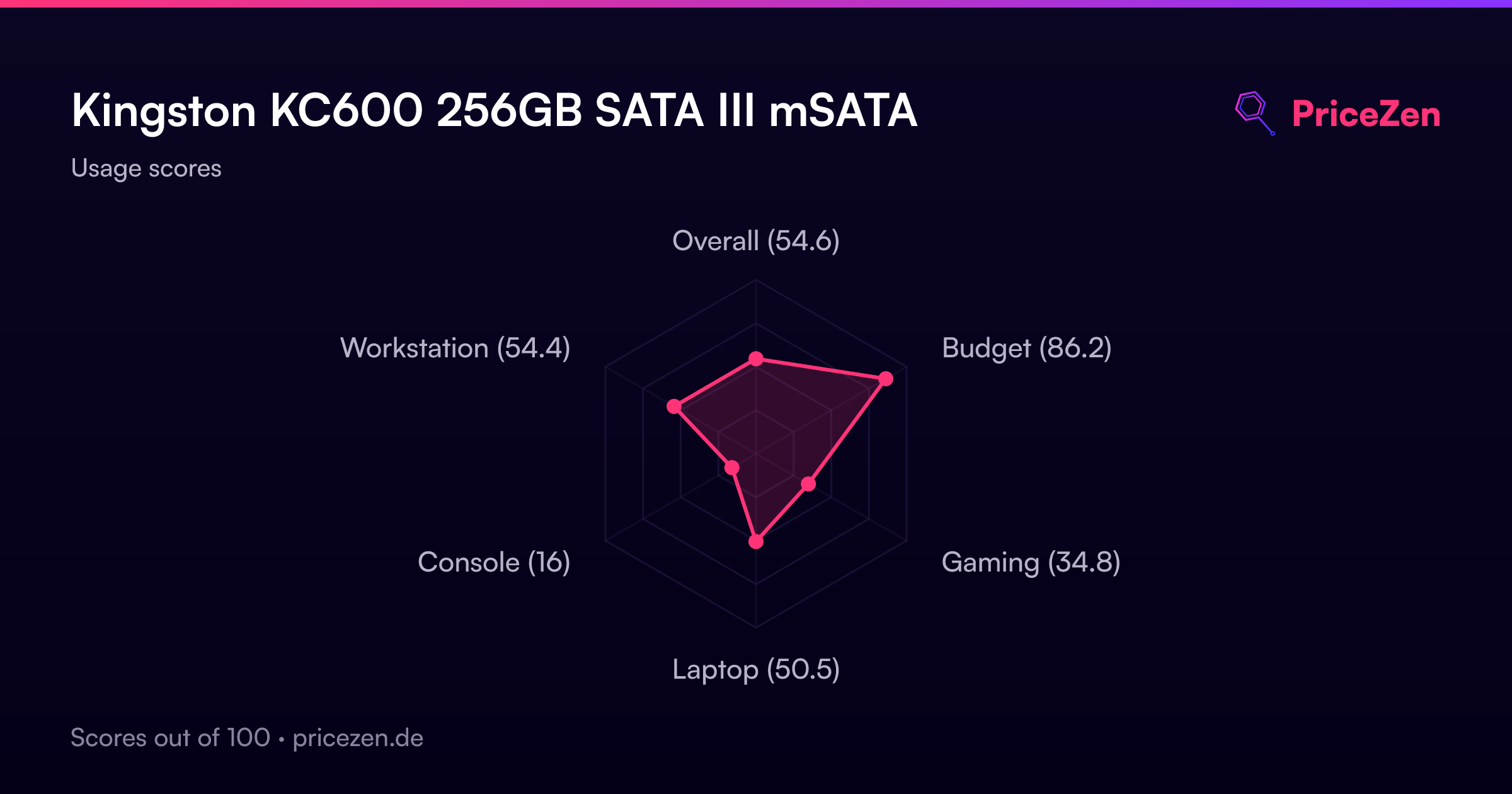
Usage Scores
- Overall54.6
- Budget86.2
- Gaming34.8
- Laptop50.5
- Console16
- Workstation54.4