Patriot P210 512GB SATA III 2.5"
The 512GB Patriot P210 hits 520 MB/s read and 430 MB/s write over SATA III, with TLC NAND and a DRAM-less design that keeps costs down. It supports TRIM, S.M.A.R.T., and backward compatibility with SATA II, making it a straightforward drop-in upgrade for older systems. Best for budget-conscious users replacing a slow hard drive in a desktop or laptop, where the 3-year warranty adds peace of mind.

No current retailer price











Snapshot
The 30-Second Version
The Patriot P210 is a cheap 512GB SATA SSD that's brilliant at rescuing old machines from hard drives and nothing else. Its 520 MB/s read maxes out SATA III, but speed ranks in the 17th percentile among internal SSDs and it's DRAM-less. Amazon has it at USD 67 versus USD 80 at Best Buy, so the store you pick matters. Buy it for a spare or secondary machine, skip it as the sole home for important data given repeated owner reports of early failures.
Pros & Cons
Pros
- Cheap: USD 67 at Amazon, affordability in the 86th percentile 88th
- 520 MB/s read nearly saturates SATA III, a huge jump from any HDD 75th
- SATA II backwards compatibility keeps genuinely old machines alive
- 46g and a standard 2.5" shape, owners call installation trivial
- 4.6/5 across 6283 reviews, strong social proof in our data
Cons
- Repeated owner reports of drives failing within months
- DRAM-less design, random IOPS of 50K falls behind most rivals
- Speed ranks in the 17th percentile across internal SSDs
- Only a 3-year warranty on a drive with reliability complaints
- 512GB capacity sits below average for the category
What owners think
The Word on the Street
How owner sentiment changed over time
ExclusiveBased on when customers actually wrote their reviews - so you can see whether early praise held up.
28 written reviews, May 2022 – Mar 2026: 17 happy, 2 mixed, 7 unhappy, 2 without stars
Across all 6,283 store ratings: 4.6★. Most owners rate without writing a review. The chart counts the 28 written reviews.
Each dot is one written review, in the month it was written. Happy = 4-5★, mixed = 3★, unhappy = 1-2★.
The proof
Performance
On paper the numbers are 520 MB/s sequential read and 430 MB/s write, with 50K random read IOPS and 50K random write IOPS. Those sequential figures are close to the practical ceiling of SATA III 6Gb/s, so there's no headroom left to squeeze. Against everything else in our internal SSD category, though, speed ranks in the 17th percentile, which is a weak spot. That's not because the P210 is badly built for SATA, it's because the category now includes NVMe drives that leave the entire SATA bus behind. If your motherboard has an M.2 slot, you're paying for a bottleneck.
The random numbers tell you more about daily feel. 50K IOPS in both directions is mediocre by current standards, roughly the 38th percentile in our rankings, and the DRAM-less design means there's no dedicated cache chip mapping where your data lives. In practice that shows up most during heavy sustained writes and when the drive gets full, not while you're opening a browser. Coming off a hard drive, owners describe the change as dramatic, with Windows installs finishing quickly and boot times collapsing. Coming off any modern NVMe drive, you'd notice the downgrade immediately. Endurance sits around the middle of the pack at the 42nd percentile, and the 3-year warranty is the backstop. TRIM and S.M.A.R.T. health reporting are both supported, so you can at least keep an eye on it.
Specifications
Full Specifications
Drive
| Capacity | 512 |
| Form Factor | 2.5" |
| Interface | SATA III |
| Protocol | SATA |
| External | No |
Performance
| Sequential Read (MB/s) | 520 |
| Sequential Write (MB/s) | 430 |
| Random Read (IOPS) | 50000 |
| Random Write (IOPS) | 50000 |
Hardware
| NAND | TLC |
| DRAM Cache | No |
Reliability
| Warranty (years) | 3 |
vs Competition
Our data lines the P210 up against the Crucial T500, Samsung 990 EVO, SanDisk WD Blue SN5100, SK Hynix Platinum P41 and Lexar NM790, and honestly it's a bit of a unfair fight on raw speed. Every one of those names competes in a category where the P210's 17th-percentile speed ranking and 520 MB/s SATA ceiling put it near the back. If your machine has an M.2 slot and your budget stretches, cross-shop the Samsung 990 EVO and the Lexar NM790 first, because the P210's interface caps it before the controller even gets a say. The SK Hynix Platinum P41 and Crucial T500 are the ones to look at if you want the top of the performance chart rather than the bottom of the price chart.
Where the P210 wins is narrower but real. It's a 2.5" SATA drive with SATA II fallback, so it fits machines those competitors simply can't serve, and at USD 67 it's competing on affordability where it ranks in the 86th percentile. The SanDisk WD Blue SN5100 is the name we'd check if you want a saner mainstream pick and have the slot for it. Our feature score for the P210 is a plain 53/100, dead average, and its portable score of 10.3/100 is its worst area by far. So: buy the P210 for compatibility and price, not because it outruns anything.
| Spec | Patriot P210 | Western Digital WD_BLACK SN8100 | Samsung 9100 PRO | Crucial T500 | Kingston 1TB SSD | MSI 1TB SSD |
|---|---|---|---|---|---|---|
| Capacity | 512GB | 1TB | 1TB | 1TB | 1TB | 1TB |
| Form Factor | 2.5" | M.2 2280 | M.2 2280 | M.2 2280 | M.2 2280 | M.2 2280 |
| Interface | SATA III | PCIe 5.0 x4 | PCIe 5.0 x4 | PCIe 4.0 x4 | PCIe 5.0 x4 | PCIe 4.0 |
| Seq Read | 520 MB/s | 14,900 MB/s | 14,700 MB/s | 7,300 MB/s | 14,200 MB/s | 7,400 MB/s |
| Nand Type | TLC | TLC | TLC | TLC | TLC | TLC |
| Dram Cache | false | true | true | true | true | true |
| Endurance | - | 600 TBW | 600 TBW | 600 TBW | 1000 TBW | 3000 TBW |
| Compare | Compare | Compare | Compare | Compare |
| Product | Speed | Random | Feature | Capacity | User Sentiment | Endurance | Social Proof | Affordability |
|---|---|---|---|---|---|---|---|---|
| Patriot P210 | 16.9 | 38 | 52.9 | 34.9 | 14.9 | 42 | 75.1 | 87.6 |
| Western Digital WD_BLACK SN8100 Compare | 97.8 | 98.7 | 99.7 | 55.4 | 95 | 80.4 | 94.9 | 38.9 |
| Samsung 9100 PRO Compare | 98.9 | 99.8 | 99.7 | 55.4 | 64.3 | 85.6 | 99.6 | 42.1 |
| Crucial T500 Compare | 91.4 | 96.7 | 98.9 | 55.4 | 95 | 82.5 | 94.9 | 51.8 |
| Kingston 1TB SSD Compare | 97.4 | 99 | 90.8 | 55.4 | 27.7 | 92.4 | 85.8 | 34.9 |
| MSI 1TB SSD Compare | 84.9 | 81 | 93.9 | 55.4 | 79.2 | 98.5 | 94.9 | 41.3 |
Price
Value & Pricing
This is where the P210 makes its case. We track its price across stores, and right now USD listings run from USD 67 to USD 80, a USD 13 spread. Amazon is cheapest at USD 67, Newegg sits at USD 77, and Best Buy is the outlier at USD 80. That's real money on a purchase this small, so buying from the wrong storefront costs you roughly a fifth more for the identical drive. In Europe the spread is wider: EUR 70 to EUR 92 across four listings, a EUR 22 gap. Elsewhere we're seeing BRL 495 and CAD 96. Shop around, because the price discipline here matters more than the spec sheet.
At USD 67 the value argument is genuinely strong, and our budget score of 89/100 reflects that. But value isn't just price divided by gigabytes. A drive that costs little and then dies in four months isn't cheap, it's a rental. Given the failure reports owners keep raising, we'd treat this as a low-stakes purchase: fine for a spare machine or a games partition, less fine as the only copy of anything you care about.
We started tracking prices for this product on Nov 19, 2026. The chart appears once we have more data.
Read more
Overview
The Patriot P210 is about as old-school as SSDs get: a 2.5" SATA drive, TLC NAND, no DRAM cache, and a 6Gb/s SATA III interface that's backwards compatible with SATA II. That last bit matters more than it sounds. There are still millions of laptops and desktops out there with no M.2 slot at all, and for those machines this is one of the few ways to stop waiting on a spinning hard drive. At 46 grams it's basically a metal wafer, and owners consistently describe swapping it in as a screwdriver-and-five-minutes job.
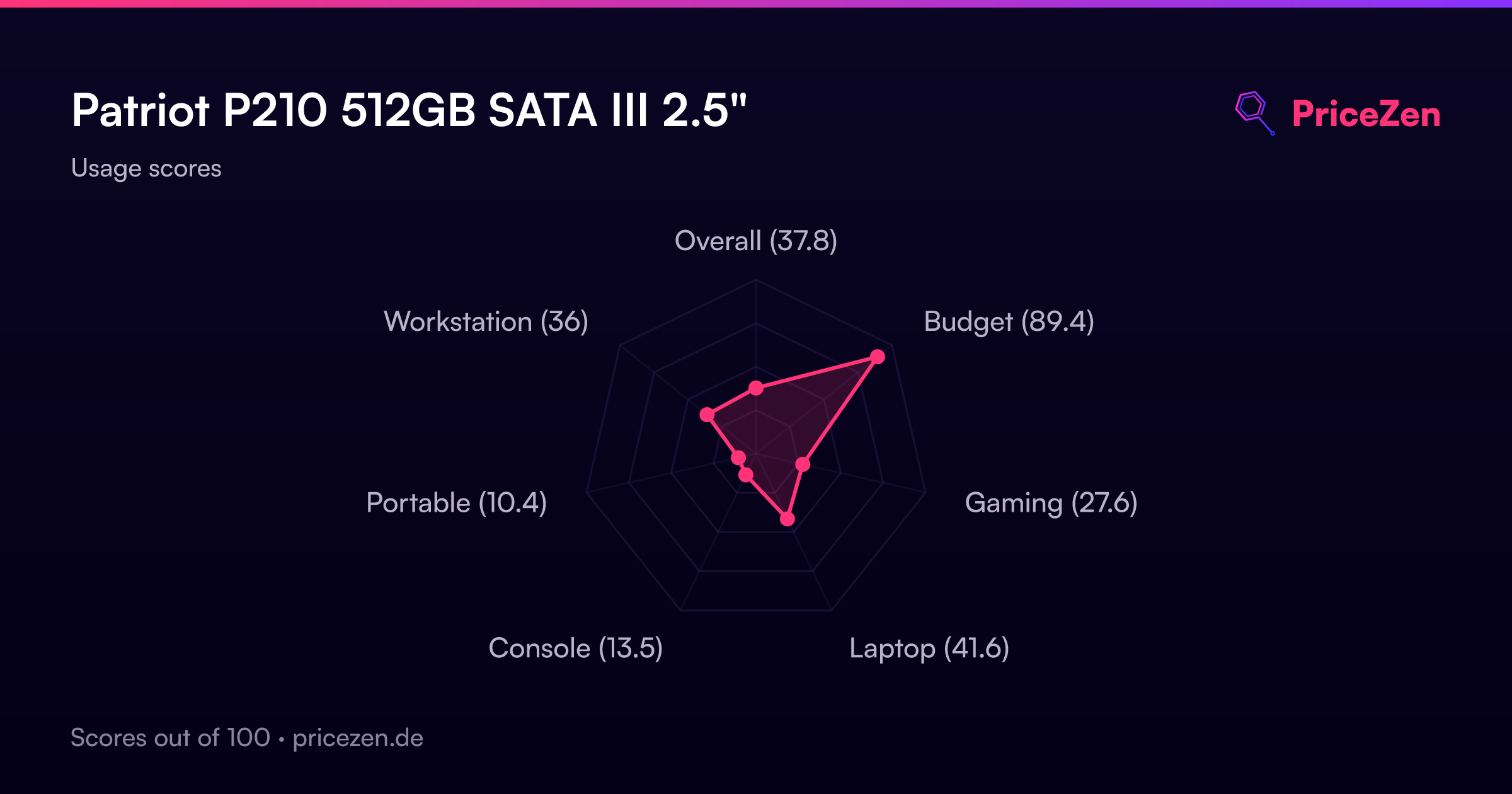
Who's it for? Someone resurrecting an older laptop, building a cheap secondary machine from spare parts, or adding bulk storage to a box where the fast NVMe slot is already taken. Our scoring model puts it at 89/100 for budget builds, which is the highest mark it earns anywhere. Its overall score is 38.3/100, and its laptop score is a middling 41.2/100, so this isn't a drive we'd push at anyone chasing performance. It's a drive we'd point at someone whose alternative is a mechanical disk.
Here's the interesting tension, and we're not going to bury it. The aggregate rating looks fantastic: 4.6/5 across 6283 reviews, which lands it well above average for social proof in our data. But when we weigh what owners actually write, the sentiment picture is much weaker, sitting down at the 15th percentile. A lot of people love it, and a meaningful chunk report the drive dying within months. Both things are true at once, and that split is the whole story of this product.
Common Questions
Q: Will this fit my old laptop that doesn't have an M.2 slot?
Yes, that's exactly its niche. It's a 2.5" SATA III drive at 46g, and it's backwards compatible with SATA II, so even fairly ancient machines can use it. Owners consistently report straightforward swaps, and it's the main reason to pick this over the NVMe drives in our comparison list.
Q: How fast is it really, and does the missing DRAM matter?
Rated at 520 MB/s read and 430 MB/s write with 50K random IOPS in each direction, it's near the SATA III limit but only in the 17th percentile for speed across internal SSDs. The DRAM-less design mostly bites during long sustained writes and when the drive fills up, not during everyday browsing. Against a hard drive it feels enormous; against any NVMe drive it feels slow.
Q: Are the failure reports something to actually worry about?
We'd take them seriously. Despite a 4.6/5 average from 6283 reviews, our weighted owner sentiment lands at the 15th percentile because multiple buyers describe the drive dying within months, including one after light occasional use. The 3-year warranty covers the hardware, but it won't recover your files, so keep backups.
Q: Where should I buy it, and is 512GB enough?
Amazon is cheapest at USD 67 right now, with Newegg at USD 77 and Best Buy at USD 80, so the same drive costs USD 13 more depending on where you click. European listings span EUR 70 to EUR 92. As for capacity, 512GB sits below average for this category, so it's comfortable for an OS plus apps but tight as a sole drive for a big game library.
Who Should Skip This
Skip this if the drive will be the single home for anything irreplaceable. The pattern of owners reporting failures after a few months, combined with a 3-year warranty and endurance around the middle of the pack, makes it a poor bet for a work machine or a family photo archive. Also skip it if your motherboard has a free M.2 slot: paying for a 520 MB/s SATA ceiling when the Crucial T500, Samsung 990 EVO or Lexar NM790 exist is leaving performance on the table for no good reason.
And if you're doing sustained heavy writes, video scratch work, or constantly moving large files, the DRAM-less design and 50K random IOPS will frustrate you. Our portable score for it is 10.3/100, its weakest area, so don't build a mobile workflow around it either. Look at the SanDisk WD Blue SN5100 or SK Hynix Platinum P41 instead if your budget and slots allow.
Verdict
If you're dragging an old laptop or a spare-parts desktop off a mechanical hard drive, the P210 at USD 67 is a sensible, low-drama upgrade. Owners repeatedly describe easy installation, fast boots and a night-and-day difference from the disk it replaced, and the 4.6/5 aggregate rating comes from thousands of people in exactly that situation. For a kid's homework machine, a media box, or a secondary games drive, we'd say go for it, keep backups, and enjoy the speed.
If this drive is going to hold your operating system and your only copy of your files, we'd hesitate. The recurring failure reports are too consistent to wave away, and our weighted owner sentiment sits at the 15th percentile despite the shiny star average. A 3-year warranty helps, but warranties replace hardware, not data. For a primary drive in a machine you depend on daily, spend more on one of the NVMe names in our comparison list if the slot exists, or at minimum buy the P210 knowing you'll be backing it up religiously.
Usage Scores
- Overall37.7
- Budget89.1
- Gaming27.6
- Laptop41.4
- Console13.5
- Portable10.3
- Workstation36