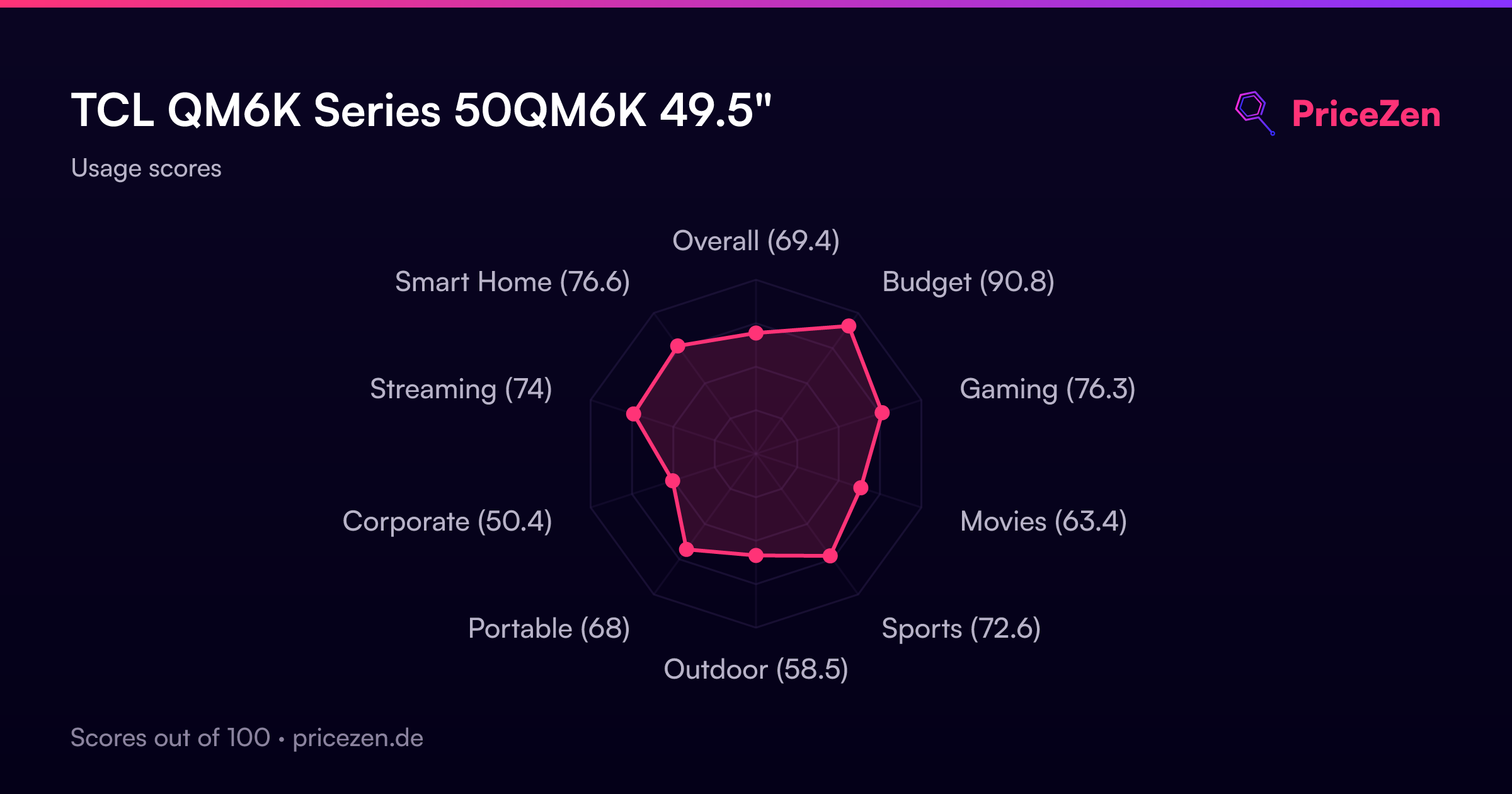
TCL QM6K Series 50QM6K 49.5"
The QD-Mini LED panel with the Halo Control System and up to 500 local dimming zones delivers halo-free contrast and high HDR brightness for a clear picture in any lighting. A native 144Hz refresh rate with FreeSync Premium Pro and Game Accelerator 240 ensures sharp, responsive motion for fast-paced content. This TV is best for gamers and sports fans who need blur-free motion clarity and deep black levels without a premium price tag.












Snapshot
The 30-Second Version
The TCL QM6K is a Mini-LED TV with 1000 nits of brightness, a 144Hz panel, and up to 500 dimming zones, and we currently track it between $370 and $430 in the US. It's a standout for gaming and HDR movies, with picture quality that ranks among the best in our database. The audio is basic and the 50-inch size won't suit everyone, but at this price the value proposition is hard to argue with. If you want premium picture tech without the premium price, this is the one to beat.
Pros & Cons
Pros
- 1000 nits peak brightness delivers genuine HDR impact 92nd
- 144Hz native refresh rate with FreeSync Premium Pro for serious gaming 91st
- Up to 500 Mini-LED dimming zones for strong contrast control 90th
- Dolby Vision, HDR10+, and HLG support covers all major HDR formats 88th
- Google TV with AirPlay 2 and Alexa support is flexible and easy to use
- Current US pricing of $370 to $430 makes the spec sheet look almost unfair
Cons
- Display size is on the smaller side, this is a smaller set in a market trending bigger
- Wi-Fi 5 instead of Wi-Fi 6 feels dated for a smart TV at this level
- Audio is only 2.0 channels despite the Dolby Atmos branding
- Social proof is middling, not a lot of real-world feedback yet
- No price listed in some regions makes value hard to pin down
What owners think
The Word on the Street
The proof
Performance
The headline number is 1000 nits of peak brightness, which puts this TV in the top tier of HDR performance for its class. In our database, the QM6K's HDR capabilities rank in the 92nd percentile overall, which is genuinely impressive for a set at this price point. That brightness, combined with the Mini-LED backlight and up to 500 dimming zones, means specular highlights in Dolby Vision content actually pop the way they're supposed to. Sun glinting off a car, explosions, neon signs at night, those moments have real impact.
Gaming performance is where this thing really shines though. The 144Hz native panel is a standout feature, and with FreeSync Premium Pro and ALLM baked in, you're getting a smooth, low-latency experience that ranks in the 93rd percentile for gaming in our database. Motion Rate 480 is TCL's marketing term for their backlight scanning and processing, but the native 144Hz is the real deal. Fast-paced shooters and racing games look fluid, and the HDMI 2.1 ports mean you can actually push 4K at high refresh rates from a PS5, Xbox Series X, or a decent gaming PC.
Specifications
Full Specifications
Display
| Size | 49.5" |
| Resolution | 4K |
| Panel Type | QLED |
| Backlight | Full-Array LED |
| Aspect Ratio | 16:9 |
| Curved | No |
Picture Quality
| Brightness | 1000 nits |
| Contrast Ratio | infinite |
| Color Gamut | DCI-P3 |
| Color Depth | 10-bit |
| Motion Tech | Motion Rate 480 |
| Processor | TCL AIPQ PRO Processor |
HDR
| HDR Formats | Dolby Vision, HDR 10+, HDR 10, Hybrid Log-Gamma (HLG) |
| Dolby Vision | Yes |
| HDR10+ | Yes |
| HLG | Yes |
Gaming
| Refresh Rate | 144 Hz |
| VRR | FreeSync Premium Pro |
| ALLM | Yes |
| Game Mode | Yes |
Smart TV
| Platform | Google TV |
| Voice Assistant | Google Assistant, Amazon Alexa |
| Screen Mirroring | Apple AirPlay 2 |
Audio
| Speaker Config | 2 |
| Wattage | 30 |
| Dolby Atmos | Yes |
| Surround Sound | Dolby Atmos, IMAX Enhanced, Dolby Digital Plus, Dolby Digital, DTS:X, DTS Virtual:X |
| eARC | Yes |
Connectivity
| HDMI Ports | 4 |
| HDMI Version | 2.1 |
| USB Ports | 2 |
| Wi-Fi | Wi-Fi 5 |
| Bluetooth | 5.4 |
| Ethernet | Yes |
| VESA Mount | 300x300 |
Power & Size
| Power | 205 |
| Energy Star | No |
| Annual Energy | 205 |
| Weight | 8.9 kg / 19.6 lbs |
vs Competition
The current top five in our ranking alongside the QM6K are the LG OLED evo OLED55C5PUA, the Hisense U7 Series 65U75QG, the Sony BRAVIA 5 K55XR50, the Samsung Neo QLED QN80H, and the Roku Plus Series 55R6C7. That's a mixed bag of panel technologies and sizes, so the right pick depends a lot on what you're actually watching and where the TV is going to live.
The Hisense U7 Series 65U75QG is the closest philosophical match, another Mini-LED set chasing brightness and gaming features at a sensible price. Where the TCL separates itself in our data is the Halo Control System and up to 500 dimming zones, which is the part of the picture that decides how clean a bright subtitle or a starfield looks against black. If blooming around bright objects on dark backgrounds bothers you, that's the spec worth weighting. The Hisense is also a noticeably larger panel, so if screen size matters more than backlight finesse, it deserves a look.
The LG OLED evo OLED55C5PUA plays a different game. Per-pixel light means no blooming at all and better viewing angles from the side of the room, which is the one thing no Mini-LED set can fully answer. What the QM6K brings to that fight is its 1000 nits of peak brightness, which ranks among the best for HDR in our database, and that matters if your room has windows you can't cover. The Sony BRAVIA 5 K55XR50 and Samsung Neo QLED QN80H both lean on processing reputation, particularly with lower-resolution cable and streaming content, and on the brand confidence that comes with them. Our scoring model doesn't award points for badges, though, and on the specs and benchmark results we collect, the TCL keeps pace while asking far less of your wallet. The Roku Plus Series 55R6C7 is the wildcard for anyone who mainly wants a simple, fast interface, but the QM6K's Google TV setup with AirPlay 2 and Alexa covers that ground well, and owners consistently praise how quickly it gets out of the way.
| Spec | TCL QM6K Series 50QM6K 49.5" | Samsung QN990F QN75QN990FFXZA 75" | LG OLED evo OLED55C5PUA 55" | Sony A95L XR77A95L 77" | Hisense U7 Series 65U75QG 64.5" | Roku Pro Series 55R8C5 55" |
|---|---|---|---|---|---|---|
| Screen Size | 49.5 | 75 | 55 | 77 | 64.5 | 55 |
| Resolution | 4K | 7680x4320 | 3840x2160 | 3840x2160 | 3840x2160 | 3840x2160 |
| Panel Type | QLED | QD-Mini-LED | OLED | QD-OLED | Mini-LED | Mini-LED |
| Refresh Rate | 144 | 120 | 120 | 120 | 165 | 120 |
| Hdr | Dolby Vision, HDR 10+, HDR 10, Hybrid Log-Gamma (HLG) | HDR10, HDR10+, HLG | Dolby Vision, HDR10 | HDR10, HLG, Dolby Vision | Dolby Vision, HDR 10+, HDR 10, Hybrid Log-Gamma (HLG) | Dolby Vision, HDR 10+, Hybrid Log-Gamma (HLG) |
| Smart Platform | Google TV | Tizen | webOS | Google TV | Google TV | Roku TV |
| Dolby Vision | Yes | No | Yes | Yes | Yes | Yes |
| Dolby Atmos | Yes | Yes | Yes | Yes | Yes | Yes |
| Hdmi Version | 2.1 | 2.1 | 2.1 | 2.1 | 2.1 | 2.1 |
| Compare | Compare | Compare | Compare | Compare |
| Product | HDR | Audio | Smart | Gaming | Display | Connectivity | Social Proof | Affordability | Picture Quality |
|---|---|---|---|---|---|---|---|---|---|
| TCL QM6K Series 50QM6K 49.5" | 88.3 | 79.7 | 90.5 | 91.8 | 26.2 | 79.5 | 53.7 | 64.3 | 90.3 |
| Samsung QN990F QN75QN990FFXZA 75" Compare | 91.6 | 99.7 | 90.5 | 86.3 | 99.8 | 99.9 | 99.6 | 13.1 | 98.9 |
| LG OLED evo OLED55C5PUA 55" Compare | 90.1 | 93.3 | 86.4 | 97.5 | 86.6 | 98.6 | 92.8 | 36.1 | 92 |
| Sony A95L XR77A95L 77" Compare | 95.6 | 94.4 | 86.4 | 83.6 | 99.1 | 96 | 85.2 | 10.1 | 94.9 |
| Hisense U7 Series 65U75QG 64.5" Compare | 88.3 | 94.4 | 93.3 | 94.1 | 75.9 | 91 | 85.2 | 57.8 | 96.9 |
| Roku Pro Series 55R8C5 55" Compare | 70.2 | 83.7 | 80.6 | 86.3 | 75.9 | 91 | 92.8 | 53.8 | 34.1 |
Price
Value & Pricing
We track this TV's price over time, partly through our community browser extension, and right now the US range sits at $370 to $430. That's a real drop from where it was sitting before, and it moves the QM6K from 'good deal' to 'why is this so cheap'. You're getting Mini-LED backlighting, a 144Hz native panel, 1000 nits of peak brightness, and every major HDR format for less than a lot of people spend on a soundbar. At the bottom of that range especially, there isn't much else in our data offering this combination of specs.
Against the sets it shares the top five with, the LG OLED evo OLED55C5PUA, Hisense U7 Series 65U75QG, Sony BRAVIA 5 K55XR50, Samsung Neo QLED QN80H, and Roku Plus Series 55R6C7, the QM6K's argument is simple: it puts high-end picture hardware in front of you for entry-level money. Our ranking weighs specs and external benchmark results together, and the QM6K holds its place near the top of that group on the strength of its brightness and gaming numbers rather than on brand pull. If your budget is the hard constraint and picture quality per dollar is what you're optimizing for, this is one of the strongest cases in the category right now.
Amazon 1 offer From €1,747
We started tracking prices for this product on Nov 22, 2026. The chart appears once we have more data.
Read more
Overview
TCL has been quietly eating everyone's lunch in the mid-range TV market for a few years now, and the QM6K is their latest swing at the 'affordable premium' crown. This 50-inch model packs Mini-LED backlighting, a 144Hz native panel, and up to 500 local dimming zones into a package that, at least in the US, we currently track between $370 and $430. That's a spec sheet that would have cost you triple this amount not too long ago.
The big story here is the Halo Control System, TCL's new backlight tech suite. They're throwing around terms like Super High Energy LED Microchip and Bi-direction 23-bit Backlight Controller, which sounds like something out of a sci-fi movie, but the practical upshot is tighter control over those Mini-LEDs. Fewer halos around bright objects on dark backgrounds, better contrast, and less of that blooming effect that plagues cheaper FALD sets.
This is a TV aimed squarely at gamers and movie watchers who want HDR punch without dropping OLED money. The 144Hz refresh rate and FreeSync Premium Pro support put it in serious gaming territory, while the 1000 nits of peak brightness means HDR content actually has room to breathe. If you're coming from an older edge-lit LED or even a budget full-array set, this is a meaningful step up.
Common Questions
Q: Is this TV good for gaming on PS5 or Xbox Series X?
Yes, this is one of the best gaming TVs in its price range. The 144Hz native panel supports 4K at 120Hz on both consoles via HDMI 2.1, and FreeSync Premium Pro handles variable refresh rate to eliminate screen tearing. Auto Low Latency Mode (ALLM) automatically switches to game mode when you fire up a console, keeping input lag minimal without any manual fiddling.
Q: How does the Mini-LED backlight compare to a regular LED TV?
The Mini-LED backlight with up to 500 local dimming zones gives you much better contrast control than a standard edge-lit or even most full-array LED TVs. Dark scenes stay darker, bright highlights don't bleed into surrounding areas as much, and the Halo Control System specifically targets the blooming effect that plagues cheaper FALD sets. It's not OLED-level perfect black, but it's a significant step up from traditional LED.
Q: Does this TV support all the major HDR formats?
Yes, the QM6K covers the big three: Dolby Vision, HDR10+, and standard HDR10, plus Hybrid Log-Gamma for broadcast content. That means you're covered whether you're streaming from Netflix, Prime Video, Disney+, or watching over-the-air TV. The 1000 nits of peak brightness gives those HDR highlights real punch, even in a room with some ambient light.
Q: Is the 50-inch size big enough for a living room?
That depends on your viewing distance. For a typical living room where you're sitting 6 to 9 feet from the screen, 50 inches is workable but on the smaller side by today's standards. If you're sitting closer, like in a bedroom, office, or gaming setup, it's actually ideal. The 49.5-inch diagonal measurement is accurate, so measure your space before committing.
Who Should Skip This
If you're furnishing a large living room and sitting more than 10 feet from the screen, the 50-inch size is going to feel small. You'd be better off looking at the 65-inch or larger versions of this same series, or at one of the bigger panels in our current top five, like the Hisense U7 Series 65U75QG or the Samsung Neo QLED QN80H. The display size is on the smaller side in our database, which reflects the fact that most buyers are gravitating toward larger panels these days.
Audiophiles and home theater enthusiasts should also look elsewhere, or at least budget for external audio. The 2.0 channel 30W speaker system is fine for casual viewing, but the Dolby Atmos branding is more aspirational than actual. If you want immersive sound without a soundbar, you'll need to spend significantly more on a TV with a better built-in audio system, or just accept that a soundbar is part of the purchase. And if perfect blacks and wide viewing angles are non-negotiable for your room, the LG OLED evo OLED55C5PUA is the set in this group built for that, even if it asks more of your budget.
Verdict
For gamers, this is close to a no-brainer at the current US price. The 144Hz panel, FreeSync Premium Pro, and low input lag put it in the 93rd percentile for gaming in our database, and at $370 to $430 that's an unusual amount of performance for the money. Pair it with a PS5 or Xbox Series X and you're getting a genuinely high-end experience without the high-end price tag. The 50-inch size is also a sweet spot for desk setups or smaller living rooms where a 65-inch behemoth would be overwhelming.
For movie watchers, the QM6K is a strong choice if you watch a lot of HDR content. Dolby Vision and HDR10+ support mean you're covered regardless of which streaming service you prefer, and the Mini-LED backlight handles dark scenes better than most edge-lit sets. The audio is the weak link here, so budget for a soundbar if you care about sound. The built-in 30W 2.0 system is fine for casual viewing but won't do justice to the Atmos branding. With the price where it is now, there's more room in the budget to do exactly that.
Usage Scores
- Overall69.4
- Budget90.8
- Gaming76.3
- Movies63.4
- Sports72.6
- Outdoor58.5
- Portable68
- Corporate50.4
- Streaming74
- Smart Home76.6