Samsung The Frame QN75LS03FWFXZA 75"
The 2025 Neo QLED panel and Wireless One Connect box eliminate visible cables, while Art Mode transforms the 75-inch screen into a lifelike gallery piece when idle. The bundled Kanto R600 mount enables a true no-gap, flush installation that hides all components inside the wall for a museum-grade aesthetic. This bundle is best for interior-focused homeowners who want a large, wall-mounted display that doubles as a permanent art installation rather than a traditional television.

No current retailer price











Snapshot
The 30-Second Version
The Samsung Frame QN75LS03FWFXZA is a 75-inch QD-Mini-LED TV that doubles as wall art, with a wireless One Connect box and 96th percentile built-in audio. It's a strong gaming display with 144Hz and HDMI 2.1, but HDR performance is weak at the 36th percentile. US prices now range from $2,198 to $3,360, a $1,162 spread, so shop carefully and aim for the low end. Buy it for the design and clean install, not for peak HDR brightness.
Pros & Cons
Pros
- Wireless One Connect box keeps wall installs clean with only a power cable running to the panel 95th
- 75W 2.0.2 channel audio with Dolby Atmos ranks in the 96th percentile, best-in-class for built-in TV sound 94th
- 144Hz panel with FreeSync, G-Sync, and ALLM makes this a legit gaming display 93rd
- QD-Mini-LED panel with quantum color delivers vivid, saturated SDR picture quality in the 94th percentile 80th
- Art mode and magnetic customizable bezels make this the only TV that genuinely blends into a designed room
Cons
- HDR performance sits at the 36th percentile, weak for a TV in this price range
- Customizable bezels are sold separately, adding cost to an already premium price
- Smart platform ranks at the 49th percentile, middle of the pack despite Tizen's long history
- Social proof is thin at 4 reviews, so long-term reliability is still an open question
- Price spread of $1,162 across US retailers means you can easily overpay if you don't shop around
The proof
Performance
The QD-Mini-LED panel here is the real deal for SDR and general viewing. The display percentile of 94 puts it among the best panels we track, and the quantum color layer gives you that saturated, vivid look Samsung is known for. Motion handling is a standout too. The 144Hz panel with Motion Xcelerator means fast action stays clean, and the gaming percentile of 86 backs that up. You're getting FreeSync, G-Sync compatibility, ALLM, and a proper game mode. For a TV that's marketed as a piece of furniture, it's surprisingly capable as a gaming display. The 4K AI upscaling pro does solid work on lower resolution content, which matters when you're watching cable or older streaming shows on a 75-inch screen.
The weak spot is HDR. A 36th percentile HDR score on a TV this expensive is hard to ignore. The contrast is listed as infinite, which is typical marketing speak for local dimming, but the peak brightness and tone mapping just don't keep up with the best Mini-LED and OLED sets out there. In a bright room, which is where a lot of Frame owners will use this, that's less of an issue. The matte-ish screen finish helps with reflections. But in a dark room watching HDR content, you'll notice the difference compared to something like the Sony BRAVIA 9 K85XR90 or the LG OLED evo OLED55C5PUA. The audio is a genuine bright spot. A 75W 2.0.2 channel system with Dolby Atmos and eARC ranks in the 96th percentile, which means you might not need a soundbar for casual viewing. That's rare for a thin TV.
Specifications
Full Specifications
Display
| Size | 75" |
| Resolution | 4K |
| Panel Type | QD-Mini-LED |
| Backlight | Mini-LED |
| Aspect Ratio | 16:9 |
| Curved | No |
| Screen Finish | matte |
Picture Quality
| Contrast Ratio | Supreme UHD Dimming |
| Color Gamut | Color Booster Pro |
| Color Depth | 10-bit |
| Motion Tech | Motion Xcelerator 144Hz |
| Processor | 4K AI Upscaling Pro |
HDR
| HDR Formats | HDR |
| Dolby Vision | Yes |
| HDR10+ | Yes |
Gaming
| Refresh Rate | 120 Hz |
| VRR | Motion Xcelerator 144Hz |
| ALLM | Yes |
| Game Mode | Yes |
Smart TV
| Platform | Tizen |
| Voice Assistant | Multiple Voice Assistants Compatible |
| Screen Mirroring | Airplay, Chromecast |
Audio
| Speaker Config | 2.0.2 |
| Wattage | 75 |
| Dolby Atmos | Yes |
| Surround Sound | Simulated Surround |
| eARC | Yes |
Connectivity
| HDMI Ports | 5 |
| HDMI Version | 2.1 |
| USB Ports | 3 |
| Wi-Fi | Wi-Fi 5 |
| Ethernet | Yes |
| Optical Audio | Yes |
| VESA Mount | 400x400 |
Power & Size
| Energy Star | Yes |
| Weight | 67.7 kg / 149.3 lbs |
vs Competition
We compare every TV against the others in its category, and the current top five around The Frame is a mixed bag of sizes and priorities, which actually makes the decision easier to think through.
The Sony BRAVIA 9 K85XR90 is the pick if picture quality is your whole reason for buying a TV. It's an 85-inch set, so it goes bigger than The Frame as well as harder on HDR, where our ranking puts The Frame at just the 36th percentile. What you give up is everything that makes The Frame The Frame: no art mode, no wireless One Connect, no bezel that matches your trim. The Sony is a TV that looks like a TV. The Frame is a TV that looks like a piece of art. Different tools for different jobs.
The Hisense U7 Series 85U7SG is the value play in this group, and it's another 85-inch option, so if raw screen size per dollar is your metric, The Frame is not winning that argument. The trade-off is the same one you make with every non-Frame set here. It won't disappear into your wall when it's off, and it doesn't have the 96th percentile built-in audio that lets a lot of Frame buyers skip a soundbar.
The LG OLED evo OLED55C5PUA is the OLED contrast option, but pay attention to the size. At 55 inches it's a much smaller screen than this 75-inch Samsung, so it's really a different purchase for a bedroom or a smaller space rather than a straight swap for a big living room wall. If you want deep blacks in a compact room, it belongs on your list. If you want to fill a large open space, it doesn't.
The Roku Pro Series 75R8C5 is the closest match on size at 75 inches and the budget-minded choice of the group. It's the set to look at if you've decided the aesthetic angle isn't worth a premium to you. Again, no art mode and no wireless One Connect, and you'll likely want external audio, which is where The Frame's speaker system quietly claws back some of its price gap.
| Spec | Samsung The Frame QN75LS03FWFXZA 75" | LG OLED evo OLED55C5PUA 55" | Sony A95L XR77A95L 77" | Hisense U7 75U7SG 75" | TCL QM7K Series 98QM7K 98" | Roku Plus Series 65R6C7 65" |
|---|---|---|---|---|---|---|
| Screen Size | 75 | 55 | 77 | 75 | 98 | 65 |
| Resolution | 3840x2160 | 3840x2160 | 3840x2160 | 3840x2160 | 3840x2160 | 3840x2160 |
| Panel Type | QD-Mini-LED | OLED | QD-OLED | Mini-LED | QLED | QLED |
| Refresh Rate | 120 | 120 | 120 | 165 | 144 | 60 |
| Hdr | HDR | Dolby Vision, HDR10 | HDR10, HLG, Dolby Vision | Dolby Vision, HDR 10+, HDR 10, Hybrid Log-Gamma (HLG) | Dolby Vision IQ, HDR10+, HDR10, HLG | Dolby Vision, HDR 10+, Hybrid Log-Gamma (HLG) |
| Smart Platform | Tizen | webOS | Google TV | Google TV | Google TV | Roku TV |
| Dolby Vision | Yes | Yes | Yes | Yes | Yes | Yes |
| Dolby Atmos | Yes | Yes | Yes | Yes | Yes | Yes |
| Hdmi Version | 2.1 | 2.1 | 2.1 | 2.1 | 2.1 | 2.1 |
| Compare | Compare | Compare | Compare | Compare |
| Product | HDR | Audio | Smart | Gaming | Display | Connectivity | Social Proof | Affordability | Picture Quality |
|---|---|---|---|---|---|---|---|---|---|
| Samsung The Frame QN75LS03FWFXZA 75" | 28.1 | 94.9 | 39.5 | 75.5 | 93.4 | 93.6 | 12.5 | 14.4 | 80 |
| LG OLED evo OLED55C5PUA 55" Compare | 90 | 93.2 | 86.4 | 97.5 | 86.5 | 98.6 | 92.8 | 36.3 | 92 |
| Sony A95L XR77A95L 77" Compare | 95.6 | 94.4 | 86.4 | 83.6 | 99.1 | 95.9 | 85.1 | 10.2 | 94.9 |
| Hisense U7 75U7SG 75" Compare | 88.2 | 94.4 | 93.2 | 94.1 | 88.3 | 95.9 | 92.8 | 32.6 | 96.9 |
| TCL QM7K Series 98QM7K 98" Compare | 99.3 | 93.2 | 96.1 | 91.8 | 91.3 | 85.7 | 85.1 | 17 | 96.9 |
| Roku Plus Series 65R6C7 65" Compare | 70.2 | 79.7 | 99.5 | 57.1 | 79.7 | 85.7 | 92.8 | 57.4 | 74.5 |
Price
Value & Pricing
Let's talk about what you're actually paying for. In our data the US price runs from $2,198 to $3,360, and that $1,162 spread is not pocket change. Some of the higher priced listings are bundles that include a bezel or soundbar, which explains part of the gap, but not all of it. The good news is the bottom of the range hasn't budged, so the cheapest way into this TV costs exactly what it did before. The bad news is that the top end has climbed, and if you buy without checking a couple of stores you can hand over four figures more for the same panel. We track its price over time, partly through our community browser extension, and this is a set where patience and comparison shopping pay off. Even at $2,198 you're paying a significant premium over comparable Mini-LED TVs, and the Hisense U7 Series 85U7SG in our comparison set goes bigger on screen size while asking less. What you're buying with The Frame is the design, the wireless One Connect, and the art mode. If those features matter to you, the value proposition makes sense. If they don't, you're leaving performance on the table.
The audio situation actually helps the value case. A 75W 2.0.2 channel system with Dolby Atmos means you might skip a soundbar entirely, which saves you real money. That narrows the gap against competitors that need external audio to sound decent. Still, the HDR weakness is the elephant in the room. For a TV that costs over two grand, a 36th percentile HDR score is a tough pill. You're paying for the form factor, not the peak brightness.
Read more
Overview
Samsung's The Frame has always been the TV for people who don't want a giant black rectangle dominating their living room. The 2025 QN75LS03FWFXZA takes that idea and pushes it further with a 75-inch QD-Mini-LED panel, a wireless One Connect box, and the same art mode that made this line famous. It's a lifestyle TV first and a spec monster second, though the spec sheet here is nothing to sneeze at. You're getting 144Hz motion, HDMI 2.1 across the board, and a 75W 2.0.2 channel speaker setup that ranks among the best for audio among TVs we track. That's genuinely unusual for a TV designed to hang flat against a wall like a picture frame.
The target buyer is pretty specific. This is for someone who wants a big screen in a shared space, a living room, a den, an open concept area, without it feeling like a home theater cave. The customizable magnetic bezels, sold separately of course, let you match the frame to your decor. Art mode displays paintings and photography when the TV is off, or at least when it's pretending to be off. You'll need a Samsung account and internet connection for that feature, which is worth knowing before you buy. The wireless One Connect box is the other headline here. It handles all your inputs and sends signal to the panel wirelessly, so the only cable running to the TV is power. That's a big deal for clean wall installs.
But let's be honest about what this isn't. It's not the best pure picture quality TV you can buy at this size. The display ranks in the 94th percentile overall, which is excellent, but the HDR performance sits at just the 36th percentile. For a TV in this price range, that's a real trade-off. You're paying a premium for the design, the art mode, and the wireless connectivity. If you're a cinephile who wants the absolute best HDR pop, there are better options for less money. If you want a gorgeous 75-inch screen that disappears into your room when you're not watching it, this is basically the only game in town.
We should also mention the price spread, because it's wider than it used to be. In our data, US listings run from $2,198 up to $3,360 depending on the retailer and whether you're getting a bundle with a bezel or soundbar. That's a $1,162 gap for the same core TV, so shopping around matters more than usual here. We track prices over time, partly through our community browser extension, and the floor hasn't moved. What changed is the ceiling.
Common Questions
Q: Does the wireless One Connect box introduce lag for gaming?
The wireless One Connect box is designed to handle high-bandwidth signals without noticeable latency, and the TV supports 144Hz with FreeSync, G-Sync, and ALLM. The gaming percentile of 86 suggests solid real-world performance. That said, competitive gamers who are hyper-sensitive to input lag might prefer a direct HDMI connection on a traditional TV. For most people, the wireless setup won't be a problem.
Q: Do I need a Samsung account to use Art Mode?
Yes. Samsung requires a Samsung account login and an internet connection to access the full Art Mode features, including the art store and personal photo uploads. Without an account, you can still use the TV as a normal display, but the art gallery functionality will be limited. If you're not interested in creating a Samsung account, this is worth knowing before you buy.
Q: Are the customizable bezels included in the box?
No, the bezels are sold separately. The TV comes with a standard black frame, and you can purchase magnetic bezels in different colors like Modern Brown or Modern White to match your decor. They snap on easily thanks to the magnetic design, but they add to the overall cost. Some retailer bundles include a bezel, which is why you'll see price differences across listings.
Q: How does the HDR performance compare to other TVs at this price?
The HDR performance is the weakest part of this TV, ranking at the 36th percentile among TVs we track. For a set that costs over $2,000, that's below average. The QD-Mini-LED panel delivers excellent SDR picture quality, but peak brightness and HDR tone mapping lag behind the sets we rank above it, like the Sony BRAVIA 9 K85XR90 and the Hisense U7 Series 85U7SG. If HDR movies are a priority, those are the direction to look.
Who Should Skip This
If you're building a dedicated home theater or you're a serious cinephile, this is not your TV. The HDR performance at the 36th percentile will frustrate you during dark movie scenes, and the Sony BRAVIA 9 K85XR90 or Hisense U7 Series 85U7SG will give you a stronger picture, both on bigger 85-inch panels. The Frame's strengths, art mode, wireless One Connect, design flexibility, are wasted in a dark room where nobody sees the TV when it's off.
Also skip this if you're on a strict budget. The $2,198 to $3,360 price range is a lot for a 75-inch TV, and the top of that range is genuinely hard to justify for a set with this HDR ranking. The Roku Pro Series 75R8C5 matches the size for less, and the Hisense U7 Series goes bigger. And if you don't care about the aesthetic angle, if a TV is just a TV to you, you're paying a premium for features you'll never use. Put that money toward a soundbar or a bigger screen instead.
Verdict
If you're buying this TV, you're buying it for the room it goes in, not just the picture it produces. The Frame QN75LS03FWFXZA is the best version of Samsung's lifestyle TV concept yet. The wireless One Connect box is a genuine quality of life upgrade for wall installs, the audio is shockingly good for a thin panel, and the QD-Mini-LED display delivers vibrant, punchy SDR content that will make most people happy. The 144Hz gaming support is a nice bonus that makes this a solid choice for a mixed-use living room where someone games and someone else cares about decor.
But if you're a home theater enthusiast who wants the best HDR experience for movie nights, look elsewhere. The 36th percentile HDR score is a real limitation, and the Sony BRAVIA 9 or Hisense U7 Series in our comparison set will serve you better on pure picture. The Frame is for people who want a big screen without the black monolith look. For that specific buyer, it's the best option on the market. For everyone else, it's a premium you probably don't need to pay, especially now that US listings stretch from $2,198 all the way to $3,360. Buy at the bottom of that range or don't buy at all.
Usage Scores
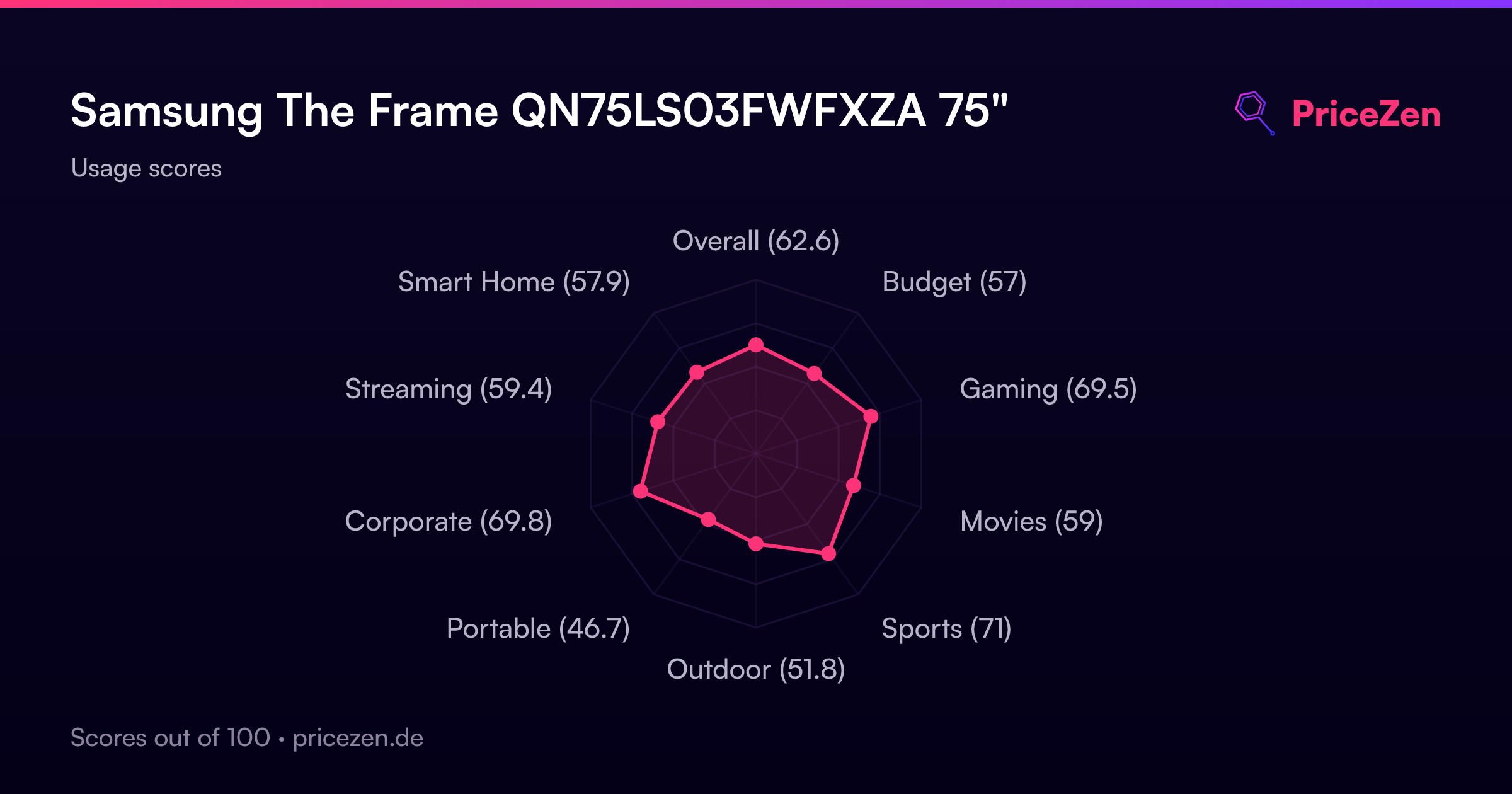
- Overall62.6
- Budget57
- Gaming69.5
- Movies59
- Sports71
- Outdoor51.8
- Portable46.7
- Corporate69.8
- Streaming59.4
- Smart Home57.9