Sony BRAVIA 8 K65XR80 65"
The Cognitive Processor XR powers a 65-inch 4K OLED panel with near-infinite contrast and 120Hz VRR, delivering pure blacks and smooth motion for movies and gaming. Its 2.2.2-channel, 56W speaker system with screen actuators and Dolby Atmos creates immersive audio from the screen's center, while Google TV and AirPlay 2 simplify content access. Best for home theater enthusiasts who want a premium OLED with strong PlayStation 5 integration and a design that blends into a smart home setup.

No current retailer price


Snapshot
The 30-Second Version
The Sony BRAVIA 8 XR80 pairs a 92nd percentile OLED display with 96th percentile built-in audio, which is a combo almost nobody else offers. Picture quality lands at the 69th percentile, so it's not the best OLED panel, but it's still gorgeous. The real story is price: USD 1,002 to USD 3,096 across US listings, and only the low end makes sense.
Pros & Cons
Pros
- Audio ranks in the 96th percentile, best-in-class for built-in TV sound 92nd
- Display quality in the 92nd percentile with near-infinite OLED contrast 91st
- Smart features score 90th percentile with Google TV and AirPlay 2 90th
- Four HDMI 2.1 ports with 120Hz, VRR, and ALLM for gaming 89th
- Dolby Vision and Dolby Atmos support out of the box
Cons
- Affordability sits at a rough 17th percentile
- Picture quality ranking of 69th percentile trails other OLEDs
- Social proof is weak at the 47th percentile, few verified reviews
- 438W power draw is hefty for a 65-inch panel
- One reported unit failure after 18 months with poor warranty support
What owners think
The Word on the Street
How owner sentiment changed over time
ExclusiveBased on when customers actually wrote their reviews - so you can see whether early praise held up.
Fewer happy owners lately: 68% vs 94% in Oct – Dec 2025
Across all 3,085 store ratings: 4.6★. Most owners rate without writing a review. The chart counts the 228 written reviews with stars and their own date.
4 written reviews without stars are left out of the trend.
Show the numbers
| Period | Reviews | Happy | Mixed | Unhappy | Happy share |
|---|---|---|---|---|---|
| Oct – Dec 2025 | 35 | 33 | 1 | 1 | 94% |
| Jan – Mar 2026 | 123 | 112 | 2 | 9 | 91% |
| Apr – Jun 2026 | 51 | 45 | 2 | 4 | 88% |
| Jul – Sep 2026 | 19 | 13 | 2 | 4 | 68% |
- Apr – Jun 202645 of 51 happy
Buyers praise the OLED picture quality, upscaling, and Google TV interface, but one reports a failure after 1.5 years with poor warranty support, and others note brightness struggles in bright rooms.
- Stunning OLED picture with perfect blacks, vibrant colors, and superior upscaling of lower-resolution content.
- Google TV interface is intuitive and preferred over competitors, with built-in apps and voice control.
- One unit stopped working after under 1.5 years; Sony's 1-year warranty left buyer unsupported.
- Brightness is adequate but struggles in bright rooms; some wish for higher peak brightness.
- Jan – Mar 2026112 of 123 happy · 2 without stars
Buyers praised the OLED picture quality, contrast, and built-in speakers, but one reported lip-sync issues and another found the remote cheap.
- Picture quality, contrast, and color are superb, considered the best in-home experience.
- Built-in speakers impress, sufficient for those not connecting external audio.
- Lip-sync issues persist despite adjusting settings; switching HDMI inputs did not resolve.
- Remote control is cheap and Bluetooth pairing with universal remotes is challenging.
- Oct – Dec 202533 of 35 happy · 2 without stars
Buyers in this period praised the TV's picture and sound quality, with one upgrading from an older Sony model and another recommending it. All reviews were positive.
- Picture quality praised in all reviews, with one calling it great and another loving it.
- Sound quality highlighted as excellent in one review.
- Overall satisfaction and recommendation, with one buyer very happy with the upgrade.
- One buyer still learning features, indicating a learning curve but not negative.
Each column joins calendar quarters until it holds at least 10 reviews with stars and their own date. Happy = 4-5★, mixed = 3★, unhappy = 1-2★. Period summaries are in English.
The proof
Performance
The Cognitive Processor XR is doing real work here. The 10-bit panel handles HDR10, HLG, and Dolby Vision, and the HDR performance sits in the 85th percentile. Not the absolute top of the charts, but well above average. Where this set really flexes is audio. The 2.2.2-channel system with actuators behind the screen pushes 56W, and that 96th percentile audio ranking is no fluke. Dialogue comes from where the actor's mouth actually is, not from some downward-firing grille near your TV stand. The newly added tweeters help with surround placement too.
Gaming is solid but not class-leading. You get 120Hz, VRR, ALLM, and HDMI 2.1 across four ports, which lands it in the 78th percentile for gaming. That's strong, but if you're a competitive player chasing every millisecond, there are faster panels out there. For PS5 owners, the integration is genuinely nice. The TV recognizes the console and dials in settings automatically. Picture quality overall sits at the 69th percentile, which sounds mediocre until you remember this is an OLED. The bar is just very high.
Specifications
Full Specifications
Display
| Size | 65" |
| Resolution | 4K |
| Panel Type | OLED |
| Backlight | OLED |
| Aspect Ratio | 16:9 |
| Curved | No |
Picture Quality
| Contrast Ratio | Near Infinite |
| Color Gamut | XR Triluminos PRO |
| Color Depth | 10-bit |
| Motion Tech | XR Motion Clarity |
| Processor | Cognitive Processor XR |
HDR
| HDR Formats | HDR10, HLG, Dolby Vision |
| Dolby Vision | Yes |
| HDR10+ | No |
| HLG | Yes |
Gaming
| Refresh Rate | 120 Hz |
| VRR | ✓ |
| ALLM | Yes |
| Game Mode | Yes |
Smart TV
| Platform | Google TV |
| Voice Assistant | Google Assistant |
| Screen Mirroring | Apple AirPlay 2, Chromecast |
| Works With | Google Home |
Audio
| Speaker Config | 2.1 |
| Wattage | 50 |
| Dolby Atmos | Yes |
| Surround Sound | Dolby Audio, Dolby Atmos |
| eARC | Yes |
Connectivity
| HDMI Ports | 4 |
| HDMI Version | 2.1 |
| USB Ports | 2 |
| Wi-Fi | Wi-Fi 6 |
| Bluetooth | 5.3 |
| Ethernet | Yes |
| Optical Audio | Yes |
| VESA Mount | 300x300 |
Power & Size
| Power | 438 |
| Energy Star | No |
| Annual Energy | 355 |
| Weight | 22.3 kg / 49.2 lbs |
vs Competition
Against the LG OLED evo OLED55C5PUA, the Sony trades blows. The LG typically edges it in raw picture quality and gaming response, but the Sony's audio is in a different league. The Samsung QN990F brings more brightness and a higher gaming ceiling, but you'll pay for it and still want a soundbar. The Hisense U7 Series 65U75QG and TCL QM8K Series 75QM8K undercut the Sony on price by a lot, but they're LED panels. They can't touch the near-infinite contrast here. The Roku Pro Series 55R8C5 is the budget pick with a simpler OS, but it's smaller and the audio is nowhere close. If sound matters and you don't want a separate audio setup, the Sony is the pick. If you already have a soundbar and want max picture performance per dollar, the LG or Samsung might serve you better.
| Spec | Sony BRAVIA 8 K65XR80 65" | LG OLED evo C6 55" | Hisense U7 Series 65U75QG 64.5" | TCL QM8K Series 75QM8K 75" | Samsung The Frame Pro LS03HW 55" | Roku Plus Series 65R6C7 65" |
|---|---|---|---|---|---|---|
| Screen Size | 65 | 55 | 64.5 | 75 | 55 | 65 |
| Resolution | 3840x2160 | 3840x2160 | 3840x2160 | 3840x2160 | 3840x2160 | 3840x2160 |
| Panel Type | OLED | OLED | Mini-LED | Mini-LED | QD-Mini-LED | Mini-LED |
| Refresh Rate | 120 | 120 | 165 | 144 | 144 | 60 |
| Hdr | HDR10, HLG, Dolby Vision | Dolby Vision, HDR10, HLG | Dolby Vision, HDR 10+, HDR 10, Hybrid Log-Gamma (HLG) | Dolby Vision, HDR 10, HDR 10+, Hybrid Log-Gamma (HLG) | HDR10+, HLG | Dolby Vision, HDR 10+, Hybrid Log-Gamma (HLG) |
| Smart Platform | Google TV | webOS | Google TV | Google TV | Tizen | Roku TV |
| Dolby Vision | true | true | true | true | false | true |
| Dolby Atmos | true | true | true | true | true | true |
| Hdmi Version | 2.1 | 2.1 | 2.1 | 2.1 | 2.1 | 2.1 |
| Compare | Compare | Compare | Compare | Compare |
| Product | HDR | Audio | Smart | Gaming | Display | User Sentiment | Connectivity | Social Proof | Affordability | Picture Quality |
|---|---|---|---|---|---|---|---|---|---|---|
| Sony BRAVIA 8 K65XR80 65" | 83.7 | 90.1 | 89 | 76.2 | 91.9 | 10.5 | 91.4 | 85.9 | 17.4 | 66.2 |
| LG OLED evo C6 55" Compare | 96 | 90.1 | 86.6 | 98.9 | 87.2 | 63.5 | 86.3 | 97.9 | 35.9 | 89.2 |
| Hisense U7 Series 65U75QG 64.5" Compare | 88.7 | 94.4 | 93.5 | 94.2 | 76.5 | 94.9 | 96 | 85.9 | 57.4 | 97 |
| TCL QM8K Series 75QM8K 75" Compare | 88.7 | 94.4 | 98.4 | 92 | 89 | 84.3 | 91.4 | 85.9 | 33.4 | 99.3 |
| Samsung The Frame Pro LS03HW 55" Compare | 79.1 | 90.1 | 78.1 | 92 | 81.8 | 0 | 99.7 | 93.3 | 37.1 | 75 |
| Roku Plus Series 65R6C7 65" Compare | 71.2 | 80.4 | 99.5 | 58 | 82.7 | 63.5 | 86.3 | 93.3 | 57 | 75 |
Price
Value & Pricing
Value here depends entirely on where you buy. US listings range from USD 1,002 to USD 3,096, and that USD 2,094 spread is the difference between a steal and a rip-off. At the low end, you're getting a 92nd percentile display and 96th percentile audio for barely more than a mid-range LED. At the high end, you're paying flagship money for a set that doesn't beat every flagship. The CAD listings are tighter, CAD 2,398 to CAD 2,605, but the US market is where the real hunt happens. If you're patient and shop around, the low end of that range is one of the better OLED values we've seen this cycle.
Read more
Overview
The Sony BRAVIA 8 XR80 is a 65-inch 4K OLED that lands in the 92nd percentile for display quality in our database, and honestly, that checks out the second you fire it up. The contrast is near infinite, the colors from the XR Triluminos PRO are rich without looking radioactive, and the 2.2.2-channel speaker setup with 56W of output sits in the 96th percentile for audio. That's a rare combo. Most TVs this thin sound like a laptop speaker. This one doesn't.
But here's the thing. The affordability score is a rough 17th percentile, and prices swing wildly depending on where you shop. We're seeing USD 1,002 to USD 3,096 across US listings. That's a USD 2,094 spread for the same panel. If you pay the high end, you're getting fleeced. If you snag the low end, you're getting one of the best OLED deals we've tracked this year.
Common Questions
Q: Does the Sony BRAVIA 8 support 4K at 120Hz for gaming?
Yes. All four HDMI ports are HDMI 2.1, and the panel supports 120Hz with VRR and ALLM. Gaming performance ranks in the 78th percentile in our database, which is strong but not the fastest we've tested.
Q: Do I need a soundbar with this TV?
Probably not. The 2.2.2-channel system pushes 56W and ranks in the 96th percentile for audio in our database. The screen speakers with actuators behind the panel deliver dialogue from the center of the screen, and Dolby Atmos support is built in.
Q: Is the Sony BRAVIA 8 worth the price compared to other OLEDs?
It depends on the price you find. US listings range from USD 1,002 to USD 3,096. At the low end, it's an excellent value given the 92nd percentile display and 96th percentile audio. At the high end, competitors like the LG OLED evo OLED55C5PUA offer better picture quality for similar money.
Who Should Skip This
If you already own a good soundbar or AVR setup, the BRAVIA 8's biggest advantage is wasted on you. The 69th percentile picture quality ranking means there are better pure panels out there for the same or less money. The LG OLED evo OLED55C5PUA and Samsung QN990F both beat it on raw picture performance, and if you're paying anywhere near the USD 3,096 end of the range, you're overpaying for audio you don't need. Also, if you're sensitive to lip-sync issues or want a premium remote, the complaints from owners about both are worth taking seriously. And at 438W, your power bill will notice this thing.
Verdict
The BRAVIA 8 XR80 is a genuinely great TV with one big asterisk: the price. The 92nd percentile display and 96th percentile audio make it one of the best all-in-one packages we've tested. You don't need a soundbar, and that's rare. But the 69th percentile picture quality ranking means it's not the best OLED panel out there, and the 17th percentile affordability score means you can easily overpay. If you find it near the USD 1,002 end of the range, buy it without hesitation. If you're looking at USD 3,096, walk away and buy the LG or Samsung instead.
Usage Scores
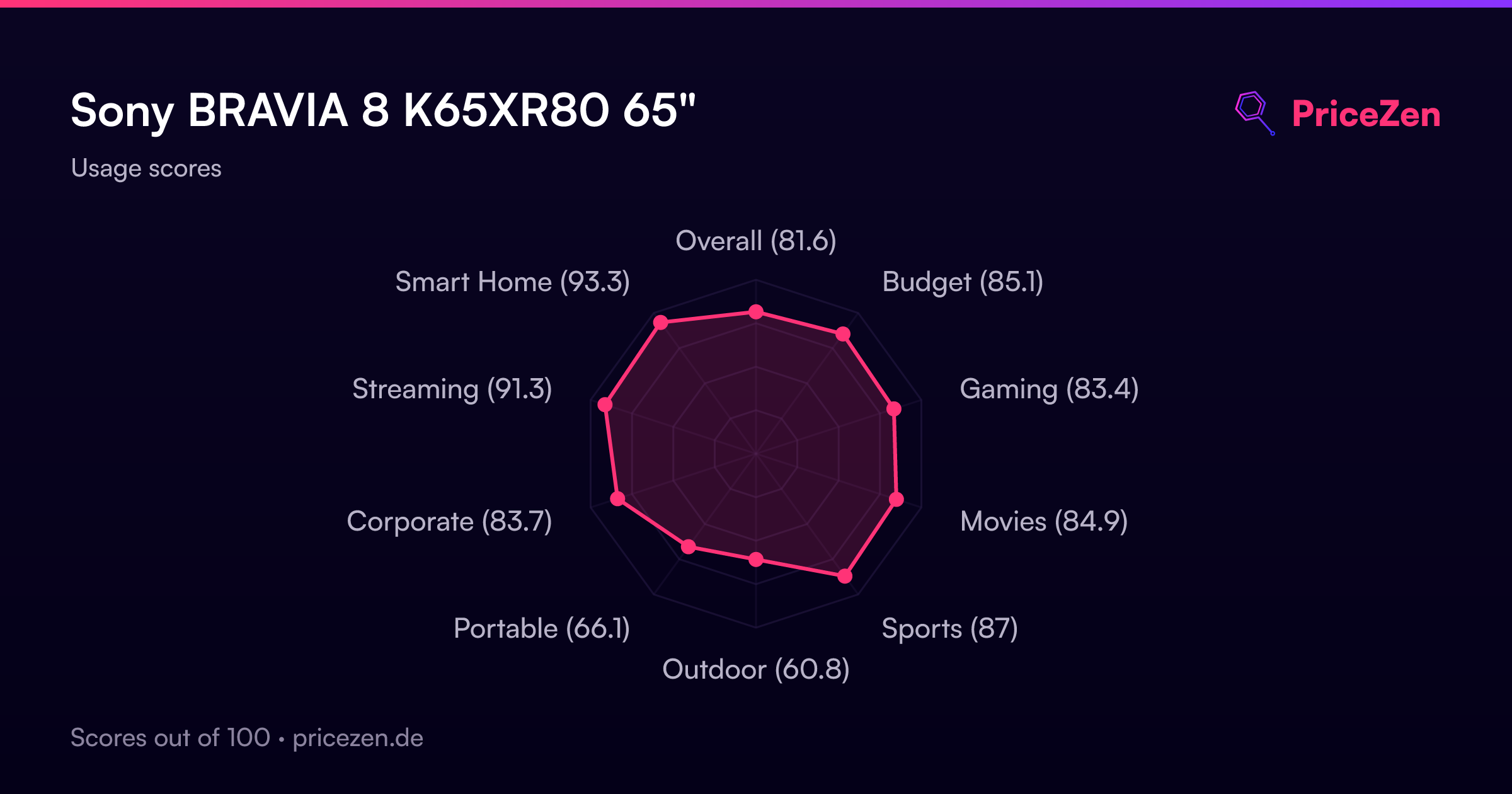
- Overall81.6
- Budget85.1
- Gaming83.4
- Movies84.9
- Sports87
- Outdoor60.8
- Portable66.1
- Corporate83.7
- Streaming91.3
- Smart Home93.3