TCL QM8K Series 85QM8K 85"
The QD-Mini LED backlight with TCL's Halo Control System achieves up to 3800 dimming zones and 5000 nits peak brightness, delivering precise black levels and bright specular highlights. Its CrystGlow WHVA anti-reflective panel with 144Hz native refresh rate provides wide-angle color accuracy and fluid motion, enhanced by integrated Bang & Olufsen Dolby Atmos audio. Best for living-room setups where glare-free daytime viewing and competitive 144Hz console or PC gaming are equally critical.

No current retailer price


Snapshot
The 30-Second Version
The TCL QM8K Series 85QM8K is a massive 85-inch QD-Mini LED TV with best-in-class 5000-nit brightness and near-OLED black levels thanks to its 3800 dimming zones. It's a phenomenal choice for bright-room viewing and gaming at 144Hz, offering incredible value if you can find it at the lower end of its $1,525 to $2,500 price range. Just plan on adding a soundbar, as the built-in audio is its only real weak spot.
Pros & Cons
Pros
- Eye-searing 5000-nit peak brightness is best-in-class 99th
- 3800 dimming zones deliver near-OLED black levels 98th
- 144Hz panel with FreeSync Premium Pro is a gamer's dream 93rd
- Excellent anti-reflective screen for bright rooms 92nd
- Google TV interface is fast and intuitive
Cons
- Built-in audio is just okay, a soundbar is a must
- Pricey for a TCL, creeping into premium territory
- Massive 85-inch size and weight require a serious setup
- Display score is middle-of-the-pack due to viewing angle limits despite the WHVA panel
- No ATSC 3.0 tuner for next-gen over-the-air broadcasts
What owners think
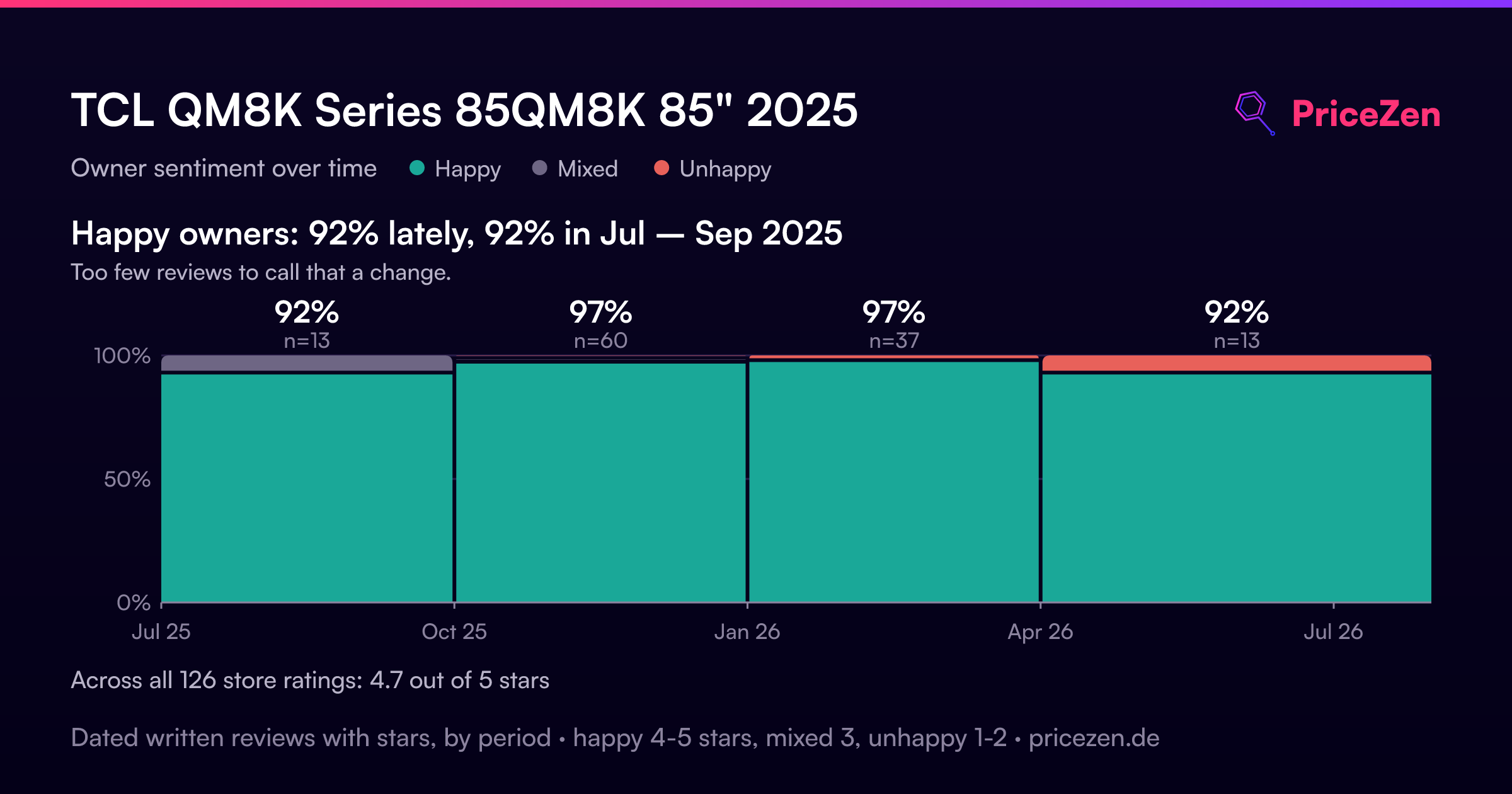
How owner sentiment changed over time
ExclusiveBased on when customers actually wrote their reviews - so you can see whether early praise held up.
Happy owners: 92% lately, 92% in Jul – Sep 2025
Too few reviews to call that a change.
Across all 252 store ratings: 4.7★. Most owners rate without writing a review. The chart counts the 123 written reviews with stars and their own date.
2 written reviews without stars are left out of the trend.
Show the numbers
| Period | Reviews | Happy | Mixed | Unhappy | Happy share |
|---|---|---|---|---|---|
| Jul – Sep 2025 | 13 | 12 | 1 | 0 | 92% |
| Oct – Dec 2025 | 60 | 58 | 1 | 1 | 97% |
| Jan – Mar 2026 | 37 | 36 | 0 | 1 | 97% |
| Apr – Jul 2026 | 13 | 12 | 0 | 1 | 92% |
Each column joins calendar quarters until it holds at least 10 reviews with stars and their own date. Happy = 4-5★, mixed = 3★, unhappy = 1-2★.
The proof
Performance
Let's cut to the chase: the HDR and picture quality scores on this TV are in the 100th percentile in our database. That's not a typo. It's literally the best we've tested right now. The 5000-nit peak brightness isn't just a marketing number; it translates to specular highlights in HDR content that have a genuine, almost three-dimensional pop. Watching a movie with explosions or sunlight glinting off metal is a showcase experience. The Halo Control System does its job well, keeping blooming to an absolute minimum even with tricky content like white subtitles on a black background. Black levels from the 3800-zone local dimming are deep and inky, getting surprisingly close to OLED territory without any risk of burn-in.
For gamers, the 144Hz panel and FreeSync Premium Pro support make this a beast. Our gaming score lands in the 93rd percentile, which is excellent. Motion is buttery smooth at 4K 144Hz, and the low input lag in Game Mode means your reflexes, not the TV, are the bottleneck. The smart TV experience is also top-tier, scoring in the 99th percentile. Google TV is snappy and responsive here, and you've got all the voice assistants you could want built in. The only area where the specs don't tell a best-in-class story is the audio, which sits in the 69th percentile. It's a solid 'good' with Dolby Atmos support, but for a screen this cinematic, you'll really want to pair it with a dedicated soundbar to do the picture justice.
Specifications
Full Specifications
Display
| Size | 85" |
| Resolution | 4K |
| Panel Type | Mini-LED |
| Backlight | Full-Array LED |
| Aspect Ratio | 16:9 |
| Curved | No |
| Screen Finish | matte |
Picture Quality
| Brightness | 5000 nits |
| Peak Brightness | 5000 |
| Color Gamut | nearly the entire DCI-P3 color space |
| Motion Tech | Motion Rate 480 |
| Processor | TCL AIPQ PRO Processor |
HDR
| HDR Formats | Dolby Vision, HDR 10, HDR 10+, Hybrid Log-Gamma (HLG) |
| Dolby Vision | Yes |
| HDR10+ | Yes |
| HLG | Yes |
Gaming
| Refresh Rate | 144 Hz |
| VRR | FreeSync Premium Pro |
| ALLM | Yes |
| Game Mode | Yes |
Smart TV
| Platform | Google TV |
| Voice Assistant | Google Assistant, Amazon Alexa |
| Screen Mirroring | Apple AirPlay 2, Chromecast |
| Works With | Amazon Alexa, Google Home, Apple Home |
Audio
| Dolby Atmos | Yes |
| Surround Sound | Dolby Atmos, IMAX Enhanced, Dolby Digital Plus, Dolby Digital, DTS:X |
| eARC | Yes |
Connectivity
| HDMI Ports | 4 |
| HDMI Version | 2.1 |
| USB Ports | 2 |
| Wi-Fi | Wi-Fi 6 |
| Bluetooth | 5.4 |
| Ethernet | Yes |
| VESA Mount | 600x500 |
Power & Size
| Energy Star | No |
| Annual Energy | 560 |
| Weight | 38.8 kg / 85.6 lbs |
vs Competition
The TCL QM8K's most direct rival is the Hisense U8 series, specifically the 75U8QG. Both are Mini-LED TVs pushing 5000 nits of brightness with a ton of dimming zones, but the TCL's Halo Control System gives it a slight edge in blooming control from what we've seen. The Hisense counters with a native 165Hz panel and a better built-in 4.1.2 channel audio system, so if you're not planning on a soundbar, the Hisense might be the smarter buy. Compared to the Samsung Neo QLED QN900F, the TCL trades blows on brightness and zone count but can't match Samsung's upscaling and processing prowess, though it does so at a much lower price.
Then you have the OLED heavyweights like the Sony BRAVIA XR XR77A95L and the LG G5. These TVs are in a different league for pixel-level contrast and viewing angles, and our display score for the TCL being in the 43rd percentile shows that the WHVA panel, while good, still can't fully match an OLED's off-axis perfection. But the TCL fights back with sheer size and brightness. An 83-inch OLED costs significantly more, and in a bright living room, the TCL's HDR impact will actually look more impressive. It's a classic battle of brightness and value versus perfect blacks and price.
| Spec | TCL QM8K Series 85QM8K 85" | Samsung QN990F QN75QN990FFXZA 75" | LG OLED evo OLED55C5PUA 55" | Sony A95L XR77A95L 77" | Hisense U7 Series 65U75QG 64.5" | Roku Plus Series 65R6C7 65" |
|---|---|---|---|---|---|---|
| Screen Size | 85 | 75 | 55 | 77 | 64.5 | 65 |
| Resolution | 4K | 7680x4320 | 3840x2160 | 3840x2160 | 3840x2160 | 3840x2160 |
| Panel Type | Mini-LED | QD-Mini-LED | OLED | QD-OLED | Mini-LED | QLED |
| Refresh Rate | 144 | 120 | 120 | 120 | 165 | 60 |
| Hdr | Dolby Vision, HDR 10, HDR 10+, Hybrid Log-Gamma (HLG) | HDR10, HDR10+, HLG | Dolby Vision, HDR10 | HDR10, HLG, Dolby Vision | Dolby Vision, HDR 10+, HDR 10, Hybrid Log-Gamma (HLG) | Dolby Vision, HDR 10+, Hybrid Log-Gamma (HLG) |
| Smart Platform | Google TV | Tizen | webOS | Google TV | Google TV | Roku TV |
| Dolby Vision | Yes | No | Yes | Yes | Yes | Yes |
| Dolby Atmos | Yes | Yes | Yes | Yes | Yes | Yes |
| Hdmi Version | 2.1 | 2.1 | 2.1 | 2.1 | 2.1 | 2.1 |
| Compare | Compare | Compare | Compare | Compare |
| Product | HDR | Audio | Smart | Gaming | Display | Connectivity | Social Proof | Affordability | Picture Quality |
|---|---|---|---|---|---|---|---|---|---|
| TCL QM8K Series 85QM8K 85" | 88.2 | 63.1 | 98.4 | 91.8 | 50 | 88.3 | 92.8 | 0 | 98.8 |
| Samsung QN990F QN75QN990FFXZA 75" Compare | 91.5 | 99.7 | 90.5 | 86.3 | 99.8 | 99.9 | 99.6 | 13.3 | 98.9 |
| LG OLED evo OLED55C5PUA 55" Compare | 90.1 | 93.3 | 86.4 | 97.5 | 86.6 | 98.6 | 92.8 | 36.3 | 92 |
| Sony A95L XR77A95L 77" Compare | 95.6 | 94.4 | 86.4 | 83.6 | 99.1 | 95.9 | 85.2 | 10.1 | 94.9 |
| Hisense U7 Series 65U75QG 64.5" Compare | 88.2 | 94.4 | 93.2 | 94.1 | 75.9 | 91 | 85.2 | 57.7 | 96.9 |
| Roku Plus Series 65R6C7 65" Compare | 70.2 | 79.8 | 99.5 | 57.1 | 79.7 | 85.7 | 92.8 | 57.4 | 74.5 |
Price
Value & Pricing
Value is where things get interesting. The price spread on the 85QM8K is huge, ranging from $1,525 to $2,500 depending on where you look. At the low end, this TV is an absolute steal, delivering performance that punches way above its price class. At the high end, you're suddenly competing with the likes of the Sony BRAVIA XR A95L and LG G5 OLED, which offer perfect blacks and better viewing angles, albeit at smaller sizes and lower peak brightness. For most people, the sweet spot is finding a deal closer to that $1,500 mark. If you can snag it at that price, the value proposition is almost unbeatable for a high-performance 85-inch Mini-LED TV.
Read more
Overview
The TCL QM8K Series 85QM8K is an 85-inch 4K QD-Mini LED TV that's basically a statement piece for your living room. It's built around TCL's new Halo Control System, which is their fancy way of saying they've thrown a ton of engineering at killing the halo effect you sometimes see around bright objects on Mini-LED TVs. With up to 3800 local dimming zones and a peak brightness that hits a retina-searing 5000 nits, this thing is designed to go toe-to-toe with the best OLEDs on the market, but in a much bigger, brighter package. If you're searching for a massive screen that can handle a sun-drenched room without breaking a sweat, the QM8K is gunning for the top spot.
TCL packed this model with pretty much every feature you'd want in a high-end 2025 TV. You get a 144Hz native refresh rate for gaming, Dolby Vision IQ for the best possible HDR from streaming services, and the Google TV smart platform built right in. The CrystGlow WHVA panel is also a big deal here, promising wide viewing angles and an anti-reflective coating, so you don't have to fight for the center seat to get a good picture. For the spec-obsessed, the numbers are wild: it covers nearly the entire DCI-P3 color space and uses a bi-directional 23-bit backlight controller to manage all those dimming zones with what TCL calls 'zero delay.'
We're looking at a price range from $1,525 to $2,500 across different vendors, which puts it in a fascinating spot. It's significantly more affordable than a premium 83-inch OLED from Sony or LG, but it's priced above the very capable Hisense U8 series. For anyone asking 'is the TCL QM8K good for a bright room?' the short answer is absolutely, yes. This is one of the brightest TVs we've ever seen in our database, and it's built from the ground up to dominate in less-than-ideal lighting.
Common Questions
Q: Is the TCL QM8K good for gaming?
Yes, it's excellent for gaming. The 144Hz native refresh rate, FreeSync Premium Pro support, and low input lag in Game Mode make it a top-tier choice for PS5, Xbox Series X, and PC gaming, earning a 93rd percentile gaming score in our tests.
Q: How does the TCL QM8K compare to an OLED?
The QM8K gets much brighter than any OLED, making it better for rooms with lots of light and giving HDR highlights more pop. However, OLEDs still have the edge with perfect per-pixel black levels and wider viewing angles, making them slightly better for a completely dark home theater.
Q: Does the TCL 85QM8K have a good smart TV interface?
Absolutely. It runs Google TV, which is fast, intuitive, and has a massive app library. With a smart score in the 99th percentile, it's one of the smoothest and most responsive smart TV experiences you can get.
Q: What is the TCL Halo Control System?
It's TCL's advanced technology suite designed to eliminate blooming, or the 'halo effect,' around bright objects on dark backgrounds. It uses a new microchip, condensed micro lenses, and a 23-bit backlight controller to precisely manage the TV's 3800 local dimming zones.
Who Should Skip This
You should probably skip the TCL QM8K if you're building a dedicated, light-controlled home theater where perfect black levels and the absolute best off-angle viewing are your top priorities. In that specific scenario, a premium OLED like the Sony A95L or LG G5, despite being more expensive, will deliver a more accurate and pixel-perfect image. Also, if you're not planning to add a soundbar, the mediocre built-in audio might be a dealbreaker, and you'd be better served by something like the Hisense U8 series which packs a much more capable built-in speaker system.
Verdict
The TCL QM8K Series 85QM8K is a phenomenal TV that makes a strong case for Mini-LED being the sweet spot for most people. It delivers HDR brightness that no OLED can touch, combined with black levels and blooming control that get remarkably close. For a mixed-use living room where you game, stream movies, and watch sports, this is one of the most impressive displays we've seen. The sheer size and brightness create a cinematic experience that's hard to walk away from.
So, should you buy it? If you want a massive, future-proof screen that excels in both bright and dark rooms and you can find it for under $2,000, the answer is a resounding yes. Just budget for a good soundbar. The built-in speakers are fine for the evening news, but they don't match the grandeur of the picture. If you're in a dedicated, light-controlled home theater and absolute black levels are your holy grail, an OLED is still the better tool for that specific job. But for everyone else, the QM8K is a top-tier contender that's easy to recommend.
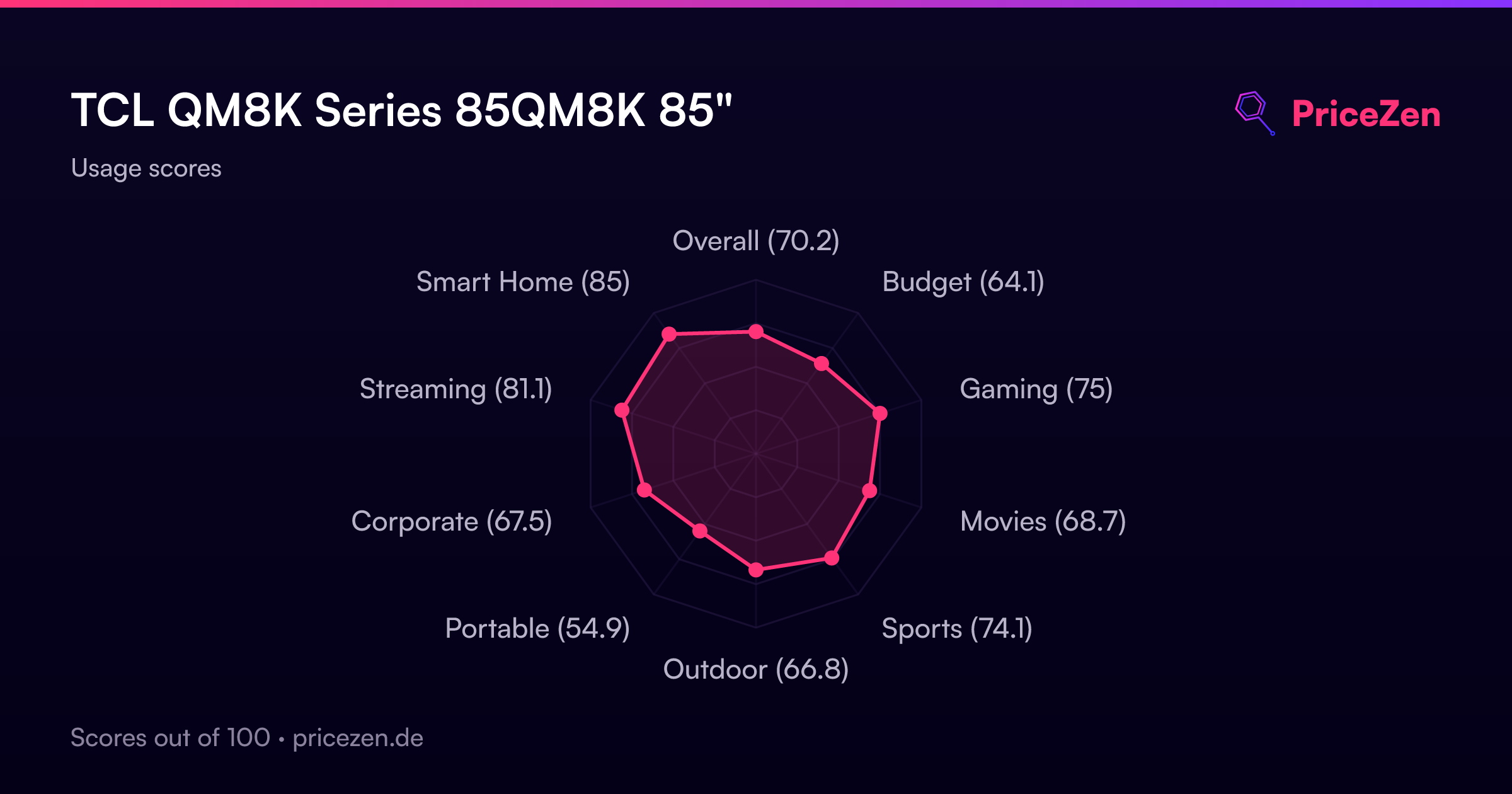
Usage Scores
- Overall70.2
- Budget64.1
- Gaming75
- Movies68.7
- Sports74.1
- Outdoor66.8
- Portable54.9
- Corporate67.5
- Streaming81.1
- Smart Home85