ASUS GeForce RTX 5090 ROG Astral OC 32GB GDDR7 White

98/100 overall score 4.6 average from 152 owner ratings
€6,411.34 above the usual price of €8,764.90.
90-day low €7,219.19Usual €8,764.90High €15,176.24
90-day low €7,219.19Usual €8,764.90High €15,176.24
Price over the last 90 days: low €7,219.19 on Sep 1, high €15,176.24. Usual price €8,764.90. Today €15,176.24.
- GPU
- GeForce RTX 5090
- VRAM
- 32GB GDDR7
- Boost clock
- 2580 MHz
- TDP
- 575 W
- Memory bus
- 512 bit
- Ray tracing
- Yes
- Class
- consumer
Compare prices at 1 store
Cheapest first. New, refurbished and bundled offers are kept apart, so you compare like with like.
| Store | Sold by | Colour and condition | Price | vs lowest | Last checked | Link |
|---|---|---|---|---|---|---|
| New1 offerSingle unit | ||||||
| Amazon | Not known | Not listed | €15,176.24 | Lowest price | Yesterday | Go to store |
 Source: PriceZen, checked Nov 28, 2026
A price counts as current when we checked it in the last 7 days. “Marketplace seller” means a third-party seller on that store, not the store itself.
Price history
The usual store price is €8,764.90, and the lowest price in the last 90 days was €7,219.19.
Checked that dayNot checked that day, still on offer
Source: PriceZen, checked Nov 28, 2026











Snapshot
The 30-Second Version
The ASUS ROG Astral RTX 5090 is a top-tier flagship GPU with 32GB GDDR7, exceptional cooling, and best-in-class raster performance. It's the card to buy if you want the absolute best 4K gaming and AI performance, with per-pin power monitoring as a standout safety feature. But prices range from USD 4,000 to USD 10,000, and the 575W TDP plus 3.8-slot size mean you need serious power and case space. Most gamers would be better served by a 5080 at half the price, but if you want the best and can afford it, this is it.
Pros & Cons
Pros
- Best-in-class raster performance with a PassMark score of 38,845 99th
- 32GB GDDR7 on a 512-bit bus handles 4K textures and AI workloads with ease 99th
- Per-pin power monitoring is a genuinely useful safety feature 99th
- Excellent cooling with four fans and a vapor chamber, runs quiet under load 99th
- Top-tier connectivity with 3x DP 2.1a and 2x HDMI 2.1b
Cons
- Price ranges from USD 4,000 to USD 10,000, which is absurd even for a flagship
- 575W TDP requires a 1000W PSU and will noticeably heat your room
- 3.8-slot design and 358mm length won't fit in many cases
- Coil whine reported by multiple owners, sometimes loud enough to be distracting
- Efficiency is mediocre at the 29th percentile
What owners think
The Word on the Street
- Owners consistently praise the cooling performance, with many noting the card runs surprisingly quiet even under heavy load thanks to the four-fan design and vapor chamber.
- The per-pin power monitoring feature gets a lot of love from buyers who appreciate being able to verify that power is flowing safely through each connector pin.
- Price is a recurring theme, with many owners acknowledging the card is excellent but questioning whether the premium over other 5090 models is justified.
- A subset of buyers report noticeable coil whine, with some describing it as loud enough to be distracting during quiet gaming sessions.
How owner sentiment changed over time
ExclusiveBased on when customers actually wrote their reviews - so you can see whether early praise held up.
Happy owners: 83% lately, 80% in Jan – Sep 2025
Too few reviews to call that a change.
Across all 152 store ratings: 4.6★. Most owners rate without writing a review. The chart counts the 22 written reviews with stars and their own date.
31 reviews from months with approximate dates (the day we first saw a review) are left out of the trend.
8 written reviews without stars are left out of the trend.
Show the numbers
| Period | Reviews | Happy | Mixed | Unhappy | Happy share |
|---|---|---|---|---|---|
| Jan – Sep 2025 | 10 | 8 | 1 | 1 | 80% |
| Oct 2025 – Jul 2026 | 12 | 10 | 1 | 1 | 83% |
- Jan – Mar 202625 of 29 happy · 7 without stars
Buyers praise the RTX 5090 Astral's stellar performance, good temps, and successful B&H purchase experience, but note the high price and question the value of Asus-specific perks.
- Performance is stellar, blasting through everything, enabling maxed-out gaming.
- Good temps for an air-cooled card and useful current monitoring features.
- B&H purchase experience was smooth: shipped within a week, arrived without issues.
- High price (wish under $2500) and Asus Astral perks may not justify the cost; cheaper SKUs exist.
- Jul – Sep 20255 of 6 happy · 2 without stars
Buyers praise the RTX 5090's raw performance and 4K capability, calling it a beast and endgame card. However, they note high price, loud fans, and price drops shortly after purchase.
- Exceptional performance for 4K high-refresh gaming; handles 4K 240Hz easily, a class of its own.
- Expensive; one buyer paid $3500 and saw price drop with free game soon after, causing regret.
- Cooling is effective but fans get loud under load; manageable with headset or distance.
- ASUS reliability praised; one buyer notes long-term trust despite past issues.
- Apr – Jun 20252 of 2 happy · 3 without stars
Buyers praise performance and B&H service, but note high price, quality issues like scratched bezel, and mixed coil whine comments.
- Performance and cooling praised; quiet with custom fan curve, best air-cooled 5090.
- B&H praised for smooth delivery, tracking, and signature requirement.
- Quality control issue: scratched chrome bezel on fan; high price criticized.
- Coil whine mentioned; one says fine, another suggests Gigabyte to avoid it.
Each column joins calendar quarters until it holds at least 10 reviews with stars and their own date. Happy = 4-5★, mixed = 3★, unhappy = 1-2★. Period summaries are in English.
The proof
Performance
Let's talk numbers. The PassMark G3D score of 38,845 puts this card in the 98th percentile for raster performance. That means it's not just fast, it's one of the fastest GPUs we've ever tested. In practical terms, you're looking at 4K gaming at high refresh rates without breaking a sweat. The 32GB of GDDR7 on a 512-bit bus means you won't run into VRAM limitations even with texture packs that would choke lesser cards. And the 3593 AI TOPS figure tells you this thing is an absolute beast for local AI workloads, whether that's running LLMs, doing image generation, or training smaller models.
Ray tracing performance sits at the 84th percentile, which is strong but interestingly not as dominant as the raster numbers. That's likely because the RTX 5090's raw compute advantage matters more in traditional rendering than in ray tracing, where architectural efficiency plays a bigger role. Still, with DLSS 4 in the mix, real-world ray tracing performance at 4K is excellent. The thermal performance is also solid at the 84th percentile, which is impressive given the 575W TDP. ASUS's four-fan design and vapor chamber clearly do their job. The one weak spot in the numbers is efficiency, which lands at the 29th percentile. This card pulls a lot of power for what it delivers, and you'll need a 1000W PSU minimum to keep it fed.
Specifications
Full Specifications
Chipset
| GPU Chipset | GeForce RTX 5090 |
| Brand | NVIDIA |
| Architecture | Blackwell |
| Class | consumer |
Memory
| VRAM | 32 GB |
| Memory Type | GDDR7 |
| Memory Bus | 512 |
Compute
| CUDA Cores | 21760 |
| Tensor Cores | 3593 |
| Base Clock | 2610 |
| Boost Clock | 2580 |
Performance
| PassMark G3D | 38958 |
| GPU Compute | 26734 |
Power & Cooling
| TDP | 575 |
| Recommended PSU | 1000 |
| Power Connectors | 1 x 16-Pin |
| Cooler | Triple Fan |
| Fans | 4 |
Connectivity
| Interface | PCI Express 5.0 |
| DisplayPort | 3 |
| HDMI | 2 |
| Max Displays | 4 |
| Max Resolution | 7680 x 4320 |
Physical
| Length | 358 |
| Slot Width | 3.8 |
| Form Factor | Full Height |
| Weight | 4.6 kg / 10.0 lbs |
Features
| Ray Tracing | Yes |
| Upscaling | DLSS 4 |
| AV1 Encode | Yes |
| VR Ready | Yes |
| DirectX | 12 |
| RGB | Yes |
vs Competition
The RTX 5090 Astral doesn't have many direct competitors at its performance level, but there are some interesting alternatives worth considering. The Gigabyte AERO RTX 5080 OC comes in at a much lower price point and still delivers strong 4K performance, though you're giving up 16GB of VRAM and a significant chunk of raw compute. If you're primarily gaming and don't need the AI horsepower, the 5080 is the smarter buy for most people. The ZOTAC APOCALYPSE RTX 5080 is another solid option in that same tier, with aggressive factory overclocks that narrow the gap in gaming scenarios.
For those who want to stay in the 5090 family but spend less, the ASUS TUF RTX 5090 offers similar core performance without the Astral's premium cooling setup and per-pin monitoring. You lose the four-fan design and the white aesthetic, but you keep the 32GB of VRAM and the same GPU. The MSI Ventus RTX 5070 Ti is worth mentioning as a budget alternative, though it's really in a different class entirely. If you're running 1440p or don't need maximum ray tracing settings, the 5070 Ti delivers excellent value at a fraction of the cost. The trade-off is simple: you're paying a huge premium for the last 15-20% of performance.
| Spec | ASUS GeForce RTX 5090 ROG Astral OC | MSI GeForce RTX 5090 Gaming Trio | Gigabyte GeForce RTX 5090 WINDFORCE OC | ZOTAC GeForce RTX 5090 SOLID OC White Edition | PNY NVIDIA RTX PRO 6000 Blackwell Max-Q Workstation Edition | NVIDIA RTX PRO 6000 Blackwell Max-Q Workstation Edition |
|---|---|---|---|---|---|---|
| Chipset | GeForce RTX 5090 | GeForce RTX 5090 | GeForce RTX 5090 | GeForce RTX 5090 | NVIDIA RTX PRO 6000 Blackwell Max-Q Workstation Edition | NVIDIA RTX PRO 6000 Blackwell Max-Q Workstation Edition |
| Vram | 32GB GDDR7 | 32GB GDDR7 | 32GB GDDR7 | 32GB GDDR7 | 96GB GDDR7 | 96GB GDDR7 |
| Boost Clock Mhz | 2580 | 2480 | 2467 | 2422 | 2280 | 2280 |
| Tdp W | 575 | 575 | 575 | 575 | 300 | 300 |
| Memory Bus Bits | 512 | 512 | 512 | 512 | 512 | 512 |
| Ray Tracing | Yes | Yes | Yes | Yes | Yes | Yes |
| GPU Class | consumer | consumer | consumer | consumer | workstation | workstation |
| Compare | Compare | Compare | Compare | Compare |
| Product | AI | Rt | Vram | Raster | Compute | Feature | Thermal | User Sentiment | Efficiency | Connectivity | Social Proof | Affordability |
|---|---|---|---|---|---|---|---|---|---|---|---|---|
| ASUS GeForce RTX 5090 ROG Astral OC | 98.6 | 84.1 | 97.8 | 98.8 | 99 | 95.7 | 84 | 57.5 | 23 | 99.3 | 84.1 | 2.4 |
| MSI GeForce RTX 5090 Gaming Trio Compare | 97.6 | 90.8 | 97.8 | 98.8 | 98.4 | 95.7 | 91.8 | 57.5 | 23 | 94.2 | 93.7 | 3 |
| Gigabyte GeForce RTX 5090 WINDFORCE OC Compare | 98.5 | 84.1 | 97.8 | 98.8 | 98.3 | 95.7 | 91.8 | 71.1 | 23 | 94.2 | 69.5 | 3 |
| ZOTAC GeForce RTX 5090 SOLID OC White Edition Compare | 97.4 | 90.8 | 97.8 | 98.8 | 98 | 95.7 | 91.8 | 96.1 | 23 | 94.2 | 40 | 2.1 |
| PNY NVIDIA RTX PRO 6000 Blackwell Max-Q Workstation Edition Compare | 99.8 | 99.6 | 99.8 | 87.2 | 99.4 | 99.8 | 24.8 | 96.1 | 69 | 87.3 | 47.1 | 0.4 |
| NVIDIA RTX PRO 6000 Blackwell Max-Q Workstation Edition Compare | 99.9 | 99.6 | 99.8 | 87.2 | 99.9 | 99.8 | 24.8 | 0 | 69 | 87.3 | 41.2 | 0.6 |
Price
Value & Pricing
Here's where things get uncomfortable. The price spread on this card is genuinely wild. In the US, you're looking at anywhere from USD 4,000 to USD 10,000 across seven listings. That's a USD 6,000 difference for the same GPU. The best deal we're seeing is on Amazon, where the price sits at the lower end of that range. In Canada, the spread is CAD 5,560 to CAD 9,080, with Memory Express offering the most reasonable pricing. European buyers are getting hit the hardest, with EUR 8,448 to EUR 10,702 across German, French, and Italian retailers.
Is it worth it? If you're coming from an RTX 4090 or even a 3090 Ti, the honest answer is probably not. The performance jump is real but not transformative for most gaming scenarios. Where this card earns its keep is in AI and content creation workloads where the 32GB of VRAM and 3593 AI TOPS genuinely change what you can do locally. For pure gaming, you're paying a massive premium for marginal gains over cheaper options. The value proposition only makes sense if you're either doing serious GPU compute work or you simply want the best and money isn't a factor.
Read more
Overview
The ASUS ROG Astral RTX 5090 is the kind of card you buy when you've already decided you want the absolute fastest thing on the shelf and you're willing to pay whatever it takes to get there. This is a 32GB GDDR7 monster built on NVIDIA's Blackwell architecture, with 21,760 CUDA cores and a boost clock of 2580 MHz out of the box. ASUS didn't just slap a cooler on a reference board here. They went with a four-fan design, a vapor chamber, and a 3.8-slot heatsink that makes this thing look less like a graphics card and more like a small appliance you mount inside your case.
Who's this for? Enthusiasts running 4K displays who want ray tracing cranked to the max, people doing serious AI and LLM work at home, and anyone who looks at a 575W TDP and thinks "yeah, that sounds about right." Our database puts this card at the top of the charts for connectivity, raster performance, and AI workloads. It's genuinely best-in-class in several categories. But that comes with a catch, and the catch is that this thing costs somewhere between USD 4,000 and USD 10,000 depending on where you shop.
What makes the Astral interesting compared to other RTX 5090s is the attention to detail. ASUS added per-pin power monitoring so you can actually see how much current is flowing through each of the 12 pins on that 16-pin connector. Given the melting connector drama from previous generations, that's a genuinely useful feature, not just marketing fluff. The white color scheme is also a nice touch if you're building a themed rig, though it's purely cosmetic. Underneath the paint, this is still a 358mm long, 3.8-slot behemoth that will not fit in most mid-tower cases without some planning.
Common Questions
Q: Will this card fit in my case?
At 358mm long and 3.8 slots thick, this is one of the largest consumer GPUs on the market. You'll need a full-tower case or a very spacious mid-tower with at least 360mm of GPU clearance. Also check that you have room for the included GPU support bracket, since the card's weight makes sag a real concern.
Q: What power supply do I need?
ASUS recommends a 1000W PSU minimum, and that's not a suggestion you should ignore. The card has a 575W TDP, and transient power spikes can push well beyond that. Make sure your PSU has a native 16-pin connector or use the included adapter, and consider a high-quality unit from a reputable brand to handle the load safely.
Q: Is the per-pin power monitoring actually useful?
Yes, especially given the history of melting 16-pin connectors on high-end cards. The Astral lets you monitor current draw on each of the 12 pins in real time through ASUS software. If one pin starts pulling significantly more current than the others, you'll know there's a potential connection issue before it becomes a catastrophic failure.
Q: Is this worth upgrading to from an RTX 4090?
For most people, no. The performance improvement in gaming is real but incremental, and the 4090 is still an extremely capable card. The main reasons to upgrade would be the 32GB of VRAM for AI workloads, DLSS 4 support, or if you're running into VRAM limitations in specific applications. If you're happy with your 4090's gaming performance, save your money.
Who Should Skip This
If you're gaming at 1440p or 1080p, this card is massive overkill. You'd be paying thousands of dollars for performance you'll never actually use, and the 575W power draw means higher electricity bills and a warmer room for no practical benefit. A 5070 Ti or 5080 will max out your monitor's refresh rate at those resolutions for a fraction of the cost. Similarly, if you're coming from an RTX 4090 and only care about gaming, the upgrade isn't compelling enough to justify the expense.
Case size is another dealbreaker. If you're running a compact or mid-tower build without at least 360mm of GPU clearance, this card simply won't fit. The 3.8-slot thickness also means you'll lose access to adjacent PCIe slots, which matters if you need room for a capture card, sound card, or additional NVMe expansion. And if you're sensitive to noise, be aware that some units exhibit noticeable coil whine. Consider the ASUS TUF 5090 for similar performance with a more conventional cooling setup, or look at 5080 options if you want to stay in a reasonable budget range.
Verdict
For 4K gaming enthusiasts who want the absolute best and have the budget to match, the ASUS ROG Astral RTX 5090 is the card to beat. The cooling is exceptional, the performance is top-tier, and the per-pin power monitoring provides genuine peace of mind. If you're building a no-compromise system and your case can physically accommodate a 3.8-slot, 358mm card, this is as good as it gets right now. The white color scheme is a bonus if you're going for a specific aesthetic.
For everyone else, think carefully before dropping this kind of money. If you're coming from a 4090, the upgrade is incremental for gaming. If you're building a new system from scratch, a 5080 will get you 85% of the performance for roughly half the price. The Astral makes the most sense for people doing serious AI work, content creation, or anyone who simply refuses to compromise on specs. Just make sure your power supply is up to the task and your case has room for this beast.
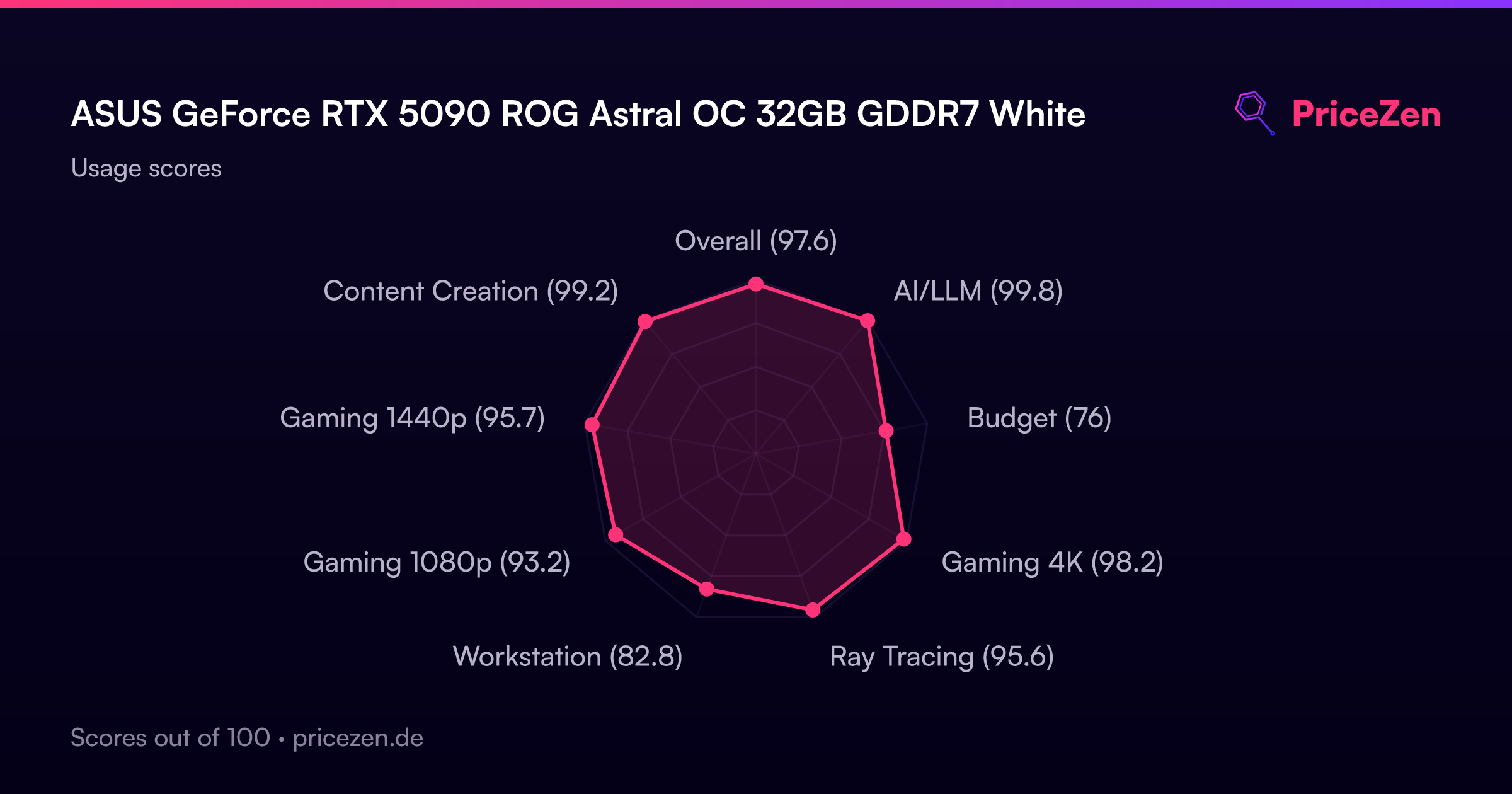
Usage Scores
- Overall97.6
- AI/LLM99.8
- Budget76
- Gaming 4K98.2
- Ray Tracing95.6
- Workstation82.8
- Gaming 1080p93.2
- Gaming 1440p95.7
- Content Creation99.2